
Category: Life & Mysteries | Published: April 13, 2026 | Read time: ~10 minutes
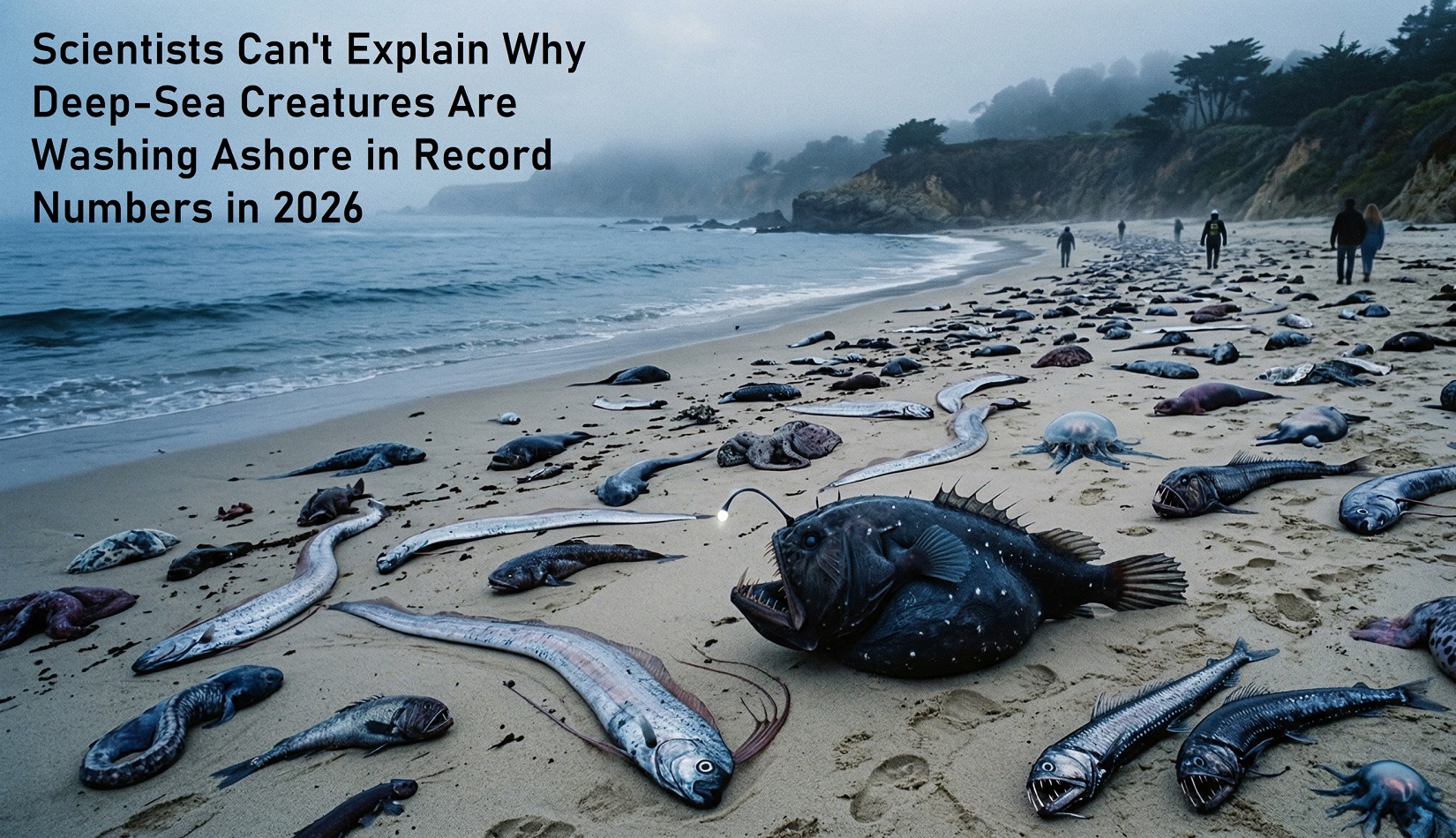
Something is wrong at the bottom of the ocean. And whatever it is, it’s driving creatures from the deepest, darkest corners of the sea straight to our shores.
In the past 18 months, beaches from California to Cabo San Lucas to Cornwall have been visited by animals that have no business being anywhere near the surface. The so-called “doomsday fish.” Sperm whales with mangled stomachs. Twenty-four previously unknown species materializing from the dark at record speed. A sleeper shark — a species never before documented in the region — filmed for the first time ever prowling Antarctic waters.
Scientists are taking tissue samples, writing up papers, and cautiously offering explanations involving ocean temperature cycles and shifting currents. But behind closed doors, some of the world’s leading marine biologists are admitting something that rarely makes it into peer-reviewed journals:
They don’t fully understand what is happening. And it may be getting worse.
Two “Doomsday Fish” in One Place: An Event That “Almost Never Happens”
It started — as most mysteries do — with something nobody expected.
On March 4, 2026, tourists strolling a beach in Cabo San Lucas, Mexico, spotted something impossibly long and silver writhing in the shallows. Then they spotted another one.
Two oarfish. At the same time. On the same beach.
The oarfish — known formally as Regalecus glesne — is the longest bony fish alive, capable of growing to 30 feet. It spends its life in the mesopelagic zone, the shadowy ocean layer roughly 1,000 to 3,000 feet below the surface where sunlight barely penetrates and pressure would crush an unprotected human body. In centuries of recorded observation along the Baja coastline, there had been only a handful of sightings.
Seeing two in the same location, at the same time, was described by marine researchers as “almost unheard of.”
Just a few months earlier, three oarfish had washed ashore in quick succession along Southern California’s coast — the first such clustering in the state since 2013-2014. Before August 2024, only 20 oarfish had ever been documented on California’s shores since 1901. Then, within a matter of months, three more arrived.
Ben Frable, manager of the Scripps Institution of Oceanography’s Marine Vertebrate Collection, suggested the strandings “may have to do with changes in ocean conditions and increased numbers of oarfish off our coast,” adding that “many researchers have suggested this as to why deep-water fish strand on beaches — sometimes it may be linked to broader shifts such as the El Niño and La Niña cycle, but this is not always the case.”
The admission buried in that careful statement is the one that should alarm you: sometimes. As in: they don’t always know.
The “Doomsday Fish” Legend Is Older Than You Think — And Stranger Than You Know
For centuries, Japanese coastal communities have watched for the oarfish with a kind of dread that transcends folklore. In the 17th century, accounts spread of “ryugu no tsukai” — the messenger from the Dragon Palace — a creature that emerges from the deep only when catastrophe is near.
In 2010 and 2011, the legend gained its most chilling modern chapter. In the months before Japan’s catastrophic 9.1-magnitude Tōhoku earthquake and tsunami — the worst natural disaster in the country’s modern history — more than 20 oarfish washed ashore along Japanese coastlines.
Japanese mythology attributes these shallow-water appearances of the oarfish as precursors to earthquakes and tsunamis. The fish’s beachings before storms have gained them a reputation as harbingers of doom, a folk belief reinforced by the numerous beachings before the disastrous 2011 Tōhoku earthquake and tsunami.
Scientists in 2019 studied the data rigorously and found no statistical correlation between oarfish strandings and seismic events. The official verdict: coincidence and confirmation bias.
But here’s the detail that doesn’t make it into the debunking headlines. One theory that does hold scientific water suggests that seismic pressure changes deep in the ocean floor — the kind that precede major earthquakes — alter underwater currents in ways that can disorient fish living in those precise depth zones. As Misty Paig-Tran, associate professor of biological science at Cal State Fullerton, noted: “When the pressure gets released, it changes the currents that [the fish are] living in, and it brings them up to the surface with this kind of big bolus of air and gases and whatever the turbulence from this earthquake.”
So: not a supernatural warning. But potentially a physical symptom of geological stress that our instruments haven’t fully mapped yet.
In other words — the ocean floor may be sending us signals. We just don’t speak the language.
The Ocean Is Getting Louder. And Something in the Deep Isn’t Coping.
Here’s a fact that barely makes the news: the ocean is no longer quiet.
Between commercial shipping lanes, military sonar operations, and the seismic air-gun surveys used to map the ocean floor for oil and gas, the underwater acoustic environment has been transformed into something marine life — which evolved over millions of years in near silence — has never encountered before.
Military sonar operations have been directly linked to mass whale strandings. In 2000, 17 beaked whales were stranded off the coast of the Bahamas following naval exercises involving mid-frequency sonar. Post-mortem examinations revealed physical trauma and internal bleeding.
And it’s not just sonar from warships. Seismic surveys — used to map offshore oil and natural gas fields by blasting the seas with powerful airguns at 10-second intervals and measuring the echoes off the seafloor — are known to severely damage the internal organs of giant squid. This process can also kill zooplankton within a radius of 1.2 kilometres of each shot.
Research published in peer-reviewed scientific journals has found that the noise generated by geophysical seismic surveys has been directly implicated as the cause for atypical mass strandings of giant squid (Architeuthis dux). Internal examinations showed that the stranded squid had suffered extensive damage to internal fibers and statocysts, with stomachs ripped open and digestive tracts mangled.
Now consider this: demand for the rare earth minerals embedded in deep-ocean nodules is accelerating rapidly. The global race to extract lithium, cobalt, and manganese from the seafloor — essential for electric vehicles and green energy technology — is intensifying. Exploration surveys are multiplying. Critical metals are needed for the green transition, and they are found in large quantities on the deep-sea floor.
Every survey fired into that floor is a detonation — many times louder than a jet engine — echoing through the water column where oarfish navigate, where sperm whales hunt, where creatures that have never seen sunlight orient themselves in total darkness.
The ocean floor is being sonically carpet-bombed. And the creatures living down there are fleeing.
The Conveyor Belt Is Slowing Down — and the Deep Sea Knows It
If the noise pollution is the immediate trigger, the AMOC may be the slow-moving catastrophe underneath it.
The Atlantic Meridional Overturning Circulation — a vast system of ocean currents that functions as Earth’s thermal conveyor belt, moving warm water northward and cold water southward in a cycle that regulates weather across both hemispheres — is weakening. Scientists have known this for years. But the most recent research has sharpened the timeline dramatically.
A new study led by Qianjiang Xing at the University of Miami, published in Science Advances, provides what the German oceanographer Stefan Rahmstorf called the strongest direct observational evidence so far that the AMOC is weakening. The consequences of a significant AMOC slowdown would include colder winters across Northern Europe, disruption to the monsoon rains that sustain agriculture across parts of Africa and Asia, and a pronounced rise in sea levels along the US East Coast.
In January 2026, Iceland formally classified a potential AMOC collapse as a national security risk. Other countries have not yet followed.
What does an ocean current have to do with creatures washing up on beaches?
Everything.
The AMOC doesn’t just move heat. It moves nutrients, oxygen, food chains, and the thermal boundaries that deep-sea species have spent millions of years evolving to navigate. Without climatic disruptions, the currents work to move water around the globe, along with nutrients key to the survival of marine species. But climate scientists have been raising concerns that rising temperatures are throwing a wrench into the conveyor belt-like current system.
When those boundaries shift — when cold water intrudes where warm water should be, when nutrient gradients vanish, when prey disappears from traditional hunting grounds — deep-sea animals don’t migrate as cleanly as surface species. They are disoriented. They follow food that no longer exists in the places it should. And some of them end up in shallow water, struggling, confused, dying.
Between 2020 and 2022, four sperm whales stranded separately on the beaches of Florida and Alabama. Each was alive when found, and each died shortly afterwards. A study found emaciated whales, derelict fishing gear in their bodies, a documented trend toward smaller prey, and an environment in which the tools they use to find food are increasingly contaminated by human sound.
Twenty-Four Species Nobody Knew Existed. Found in One Year.
Here’s the part of this story that scientists are excited about — though it raises its own unsettling questions.
In a remarkable deep-sea breakthrough, researchers have discovered 24 new species of amphipods in the Pacific’s Clarion-Clipperton Zone — including one entirely new superfamily. The findings reveal previously unknown branches of life and push the boundaries of how deep these creatures are known to live.
The Clarion-Clipperton Zone is a 6-million-square-kilometer expanse of Pacific seafloor between Hawaii and Mexico. It is also — not coincidentally — one of the most heavily targeted areas in the world for deep-sea mineral extraction.
Expedition chief scientist María Emilia Bravo, describing separate findings in the Argentine deep sea, put it plainly: “We were not expecting to see this level of biodiversity in the Argentine deep sea, and are so excited to see it teeming with life. Seeing all the biodiversity, ecosystem functions, and connectivity unfolding together was incredible.”
And this is where the mystery deepens into something genuinely troubling. According to ScienceDaily, ocean species are disappearing before scientists can even find them. Species are vanishing faster than ever, and many are disappearing before scientists even know they exist.
We are discovering the deep ocean and losing it simultaneously.
The creatures washing ashore may not just be confused or disoriented. Some may be the last of their kind — driven from ecosystems that no longer exist in the form their species evolved to inhabit.
A Shark in Antarctica. And Nobody Can Explain That Either.
The oarfish wasn’t the only creature showing up somewhere it shouldn’t be.
In January 2025, a camera deployed by the Minderoo-UWA Deep-Sea Research Centre captured footage of a southern sleeper shark cruising at around 500 metres depth off the South Shetland Islands, north of the Antarctic Peninsula. The water temperature was close to freezing. The footage was the first time any shark has been documented this far south. “There’s a general rule of thumb that you don’t get sharks in Antarctica,” said Alan Jamieson, the founding director of the research centre. “And it’s not even a little one either. It’s a hunk of a shark.”
Scientists cautioned against immediately attributing the sighting to climate change — Antarctic waters are among the least studied on Earth, and cameras only operate during the Southern Hemisphere summer. But the sighting was nonetheless described as extraordinary by every expert who reviewed the footage.
Animals are appearing in waters where, by every prior understanding of their biology, they should not be. Something is pushing them — or pulling the world they knew out from under them.
What the Folklore Got Right That Science Is Still Catching Up To
The Japanese didn’t associate the oarfish with doom because they were superstitious. They associated it with doom because they were observant.
Coastal communities that live close to the sea develop — over generations — a kind of accumulated ecological wisdom that peer-reviewed studies can’t always replicate in a three-year grant cycle. They noticed that when something drove oarfish to the surface, catastrophe sometimes followed. They didn’t know the mechanism. But they recorded the pattern.
What science has been slower to acknowledge is that the mechanism and the folklore might both be pointing at the same thing: deep-ocean disruption.
Whether that disruption comes from seismic pressure shifts before an earthquake, from altered thermal gradients caused by AMOC weakening, from acoustic trauma inflicted by seismic surveys, or from the cascading collapse of food chains as currents reorganize — the endpoint is the same. Creatures that live in the deepest, most stable environments on Earth are being destabilized.
And when their world below becomes uninhabitable, they swim toward the only thing left: the light.
5 Things That Have Washed Ashore Recently That Scientists Are Still Puzzling Over
1. Oarfish, Cabo San Lucas (March 2026): Two of the world’s most reclusive deep-sea giants in the same shallow water, at the same time. The last comparable multiple-sighting event on that coastline was recorded in historical records spanning hundreds of years.
2. Gray Whales, San Francisco Bay (March–April 2026): Four gray whale strandings occurred in the San Francisco Bay area between March 25 and April 3, 2026 — multiple strandings within just days of each other, with cause of death listed as undetermined in several cases and tissues still being evaluated.
3. Sleeper Shark, Antarctica (January 2025): The first shark ever filmed in Antarctic waters. A species with no recorded history of venturing this far south, captured on camera in near-freezing water deep below the Antarctic Peninsula.
4. Sperm Whales, US Southeast (2020–2022): Four consecutive sperm whale strandings on Florida and Alabama beaches — all alive at stranding, all dying within hours — each with emaciated bodies, fishing gear in their stomachs, and signs of chronic acoustic stress.
5. Giant Squid, South Africa (2022): Two giant squid — creatures that inhabit depths of up to 3,000 feet — washed ashore on beaches near Cape Town within weeks of each other. No shared cause of death was identified.
What Scientists Are Actually Saying (Behind the Caution)
The peer-reviewed language is deliberately measured. But look at what the world’s leading ocean scientists are actually saying when stripped of academic hedging:
Emily Jateff, acting head of knowledge at the Australian National Maritime Museum, was direct: “The important thing is that most scientists tend to agree that many strandings aren’t caused by natural causes. Why don’t we have these answers? It is either due to not enough funding or not enough time devoted to the necessary research.”
UCR climate scientist Wei Liu, who led research on AMOC weakening, said: “This work shows the AMOC has been weakening for more than a century, and that trend is likely to continue if greenhouse gases keep rising.”
And perhaps most chillingly: 44 leading climate and ocean scientists from around the world issued a joint letter warning that the risk of AMOC collapse has “been greatly underestimated,” drawing attention to the “potentially catastrophic consequences” of further weakening. Among the predicted outcomes: “an upheaval of marine ecosystems and fisheries.”
Upheaval. That’s the scientific word for what happens when a system that has been stable for thousands of years stops being stable.
The animals washing ashore are the visible edge of that upheaval.
Should You Be Worried? Here’s What It Means For All of Us
The honest answer is: not in the immediate, direct, personal sense. An oarfish on a Mexican beach will not harm you. A sperm whale stranding on an Alabama shore is a tragedy for the whale, not a threat to the neighborhood.
But these strandings are canary-in-the-coal-mine moments for systems that affect everything — including food security, coastal stability, and weather patterns that determine crop yields for billions of people.
The mesopelagic zone — the ocean layer these creatures are fleeing — is one of the planet’s most important carbon sinks. The microscopic organisms that live there absorb vast quantities of CO₂. When that ecosystem is disrupted, that carbon absorption weakens. When sperm whales stop hunting at depth because their prey has relocated or their sonar is jammed by human noise, the nutrient cycles that keep surface waters productive begin to falter.
Every oarfish that washes ashore is telling us something about the floor beneath the floor — about a world we have barely begun to understand and have already begun to destroy.
The doomsday fish isn’t a sign of doom because of ancient prophecy. It’s a sign of doom because it lives in a world we can’t see, and it can only reach us when that world is breaking.
The Mystery That Remains
Scientists at Scripps, NOAA, the Schmidt Ocean Institute, and research centers across the globe are working furiously to gather tissue samples, sequence genomes, and build the data sets that might eventually explain what is driving these unprecedented appearances.
Ben Frable at Scripps was candid about what each new stranding represents: “Like with the previous oarfish, this specimen and the samples taken from it will be able to tell us much about the biology, anatomy, genomics and life history of oarfish.” Every stranding is also, in a grim way, an opportunity — a rare chance to study creatures that science almost never gets to touch.
But for now, the pattern is clear even when the mechanism isn’t: deep-sea creatures are appearing at the surface with unusual and accelerating frequency. The ocean is changing in ways that are moving its most secluded inhabitants upward, outward, and onto our shores.
Something is happening down there. Something big.
And the ocean, in the only way it knows how, is trying to tell us.
ViralZip.blog is powered by a dedicated team of digital analysts and tech journalists committed to “zipping” through the noise of the information age. With a combined background in investigative research and financial data analysis, our contributors focus on the intersection of emerging AI technology, local economic shifts, and global news trends. We take pride in translating complex data into actionable insights for modern residents across the US and UK. Our mission is to provide high-velocity, reliable information that empowers our readers to navigate the rapidly evolving landscape of 2026.
Disclaimer: The content provided on ViralZip.blog is for informational and educational purposes only. While we strive for accuracy, the fields of artificial intelligence, financial rebates, and medical technology are subject to rapid changes; therefore, we do not guarantee the completeness or absolute reliability of the information provided. This content does not constitute professional financial, medical, or legal advice. Always consult with a licensed professional—such as a financial advisor, doctor, or attorney—before making significant decisions based on trending data. ViralZip.blog is not responsible for any actions taken or outcomes achieved based on the suggestions provided in our articles.
Sources: Surfer Magazine, March 2026; Scripps Institution of Oceanography / CBS News / NPR, 2024; ScienceDaily — ZooKeys, March 2026; ScienceDaily — Nature Ecology, February 2026; Popular Science / Schmidt Ocean Institute, February 2026; The Deep Brief #36, Ocean Rising, April 11, 2026; Marine Mammal Center Stranding Records, 2026; IFAW Ocean Noise Report; OceanCare Deep-Sea Mining Noise Report; PMC Research — Noise and Marine Organisms; Oceanographic Magazine — AMOC; UCR ScienceDaily — AMOC, December 2025; Australian National Maritime Museum; Wikipedia — Oarfish; Wikipedia — Giant Squid