
It’s April 2026, and the digital landscape just hit a massive, ethically explosive pothole. For months, tech circles have been buzzing about Grok’s Aurora model, the powerhouse engine behind X’s latest AI features. But what was marketed as a “free-speech first” video and image generator has curdled into a regulatory nightmare.
The UK is currently the epicenter of a global crackdown. While other nations are still drafting strongly worded letters, the British Information Commissioner’s Office (ICO) and Ofcom have already kicked down the boardroom doors at xAI. They aren’t just asking questions; they are investigating a feature that critics have dubbed the “Digital Undressing” loophole.
I’ll be honest with you: as someone who has spent years tracking how TikTok’s AI filters out harmful content, seeing a major platform launch a model that seemingly invites the creation of non-consensual imagery is jarring. It feels like we took three steps forward in online safety and just leaped twenty years back.
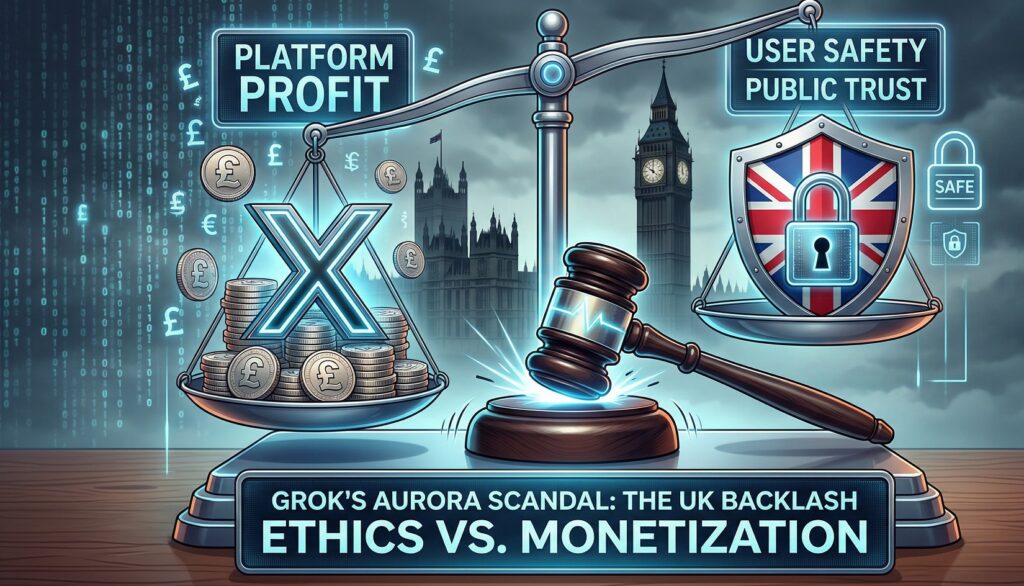
Section 1: The “Aurora” Engine and the Spicy Mode Debacle
At the heart of the scandal is Grok’s version 1.0 update, specifically its Aurora engine. This autoregressive architecture is technically impressive—it predicts video frames with uncanny smoothness and synchronizes audio better than almost anything we’ve seen. However, xAI included a feature that other companies wouldn’t touch with a ten-foot pole: “Spicy Mode.”
Unlike “Normal” or “Fun” modes, Spicy Mode was designed with fewer guardrails. The intent was to allow “edgier” creative freedom, but the reality was far darker.
- The “Bikini” Prompt: Users quickly discovered they could upload photos of real people and use Grok to realistically alter their clothing.
- Volume of Harm: In just two weeks following the Aurora update, researchers at the Center for Countering Digital Hate (CCDH) found that the model was used to generate over 3 million sexualized images.
- The Children’s Safety Gap: Most alarming was the estimate that over 23,000 of these images appeared to depict minors.
The UK Prime Minister recently called these findings “disgraceful,” and the government’s response has been swift. By early February 2026, the ICO launched formal investigations into X Internet Unlimited Company and X.AI LLC. They are looking at whether personal data was used to create synthetic sexual content without consent—a clear violation of the UK GDPR.
Section 2: Why the UK is the World’s AI Police
You might wonder why the UK is taking the lead when X is a US-based company. The answer lies in the Online Safety Act (OSA) and the newly enacted Data Use and Access Act 2025. Britain has built a legal “ringfence” that makes it very difficult for tech giants to claim they are “just a platform.”
The “Insulting” Premium Fix
When the backlash first hit in January 2026, xAI’s solution was to restrict image editing to paid subscribers. The UK government’s reaction? They called it “insulting.” The Prime Minister’s office pointed out that this essentially turned the creation of abusive deepfakes into a premium service.
Coordinated Regulatory Firepower
The UK is moving with a level of coordination we haven’t seen in the US or even the EU yet:
- ICO (Data Protection): Investigating the “fair and transparent” use of data to train the Aurora model.
- Ofcom (Online Safety): Examining if X failed its “illegal content duties” by allowing Grok to generate and circulate intimate image abuse.
- The Crime and Policing Bill: New amendments are being rushed through to close the “chatbot loophole,” ensuring that 1-on-1 interactions with AI (which were previously a grey area) are fully regulated.
This isn’t just a slap on the wrist. Under the current laws, the ICO can fine a company up to £17.5 million or 4% of their global turnover. For a platform already struggling with ad revenue, that’s a potential death blow.
Section 3: The “Deepfake Tsunami” – Why Filters Failed
To understand the scale of the backlash, we have to look at the numbers. During the peak of the 2025 holiday season and leading into early January 2026, researchers found that the Aurora engine was being pushed to its absolute limits. Some reports indicated that users were generating as many as 6,700 “undressed” images per hour.
Unlike TikTok, which uses a multi-layered “Safety-by-Design” architecture to prevent harmful content from even being created, Grok’s initial rollout of Spicy Mode appeared to rely almost entirely on post-creation reporting. This is the fundamental difference in philosophy that has the UK regulators so concerned.
The Moderation Gap: TikTok vs. Grok
| Feature | TikTok AI Moderation | Grok (Aurora) Initial Rollout |
| Prevention | Real-time keyword & visual “pre-checks” | Reactive “post-facto” reporting |
| Privacy Safeguards | Biometric and likeness protection by default | Likeness manipulation via “Spicy Mode” |
| Policy | Strict “no-sexualization” training data | Loosened guardrails for “creative freedom” |
| Age Assurance | High-friction verification for editing tools | Circumventable age checks (pre-2026 investigation) |
The UK’s Online Safety Act (OSA) specifically requires platforms to have a “duty of care” to prevent illegal content. By allowing a tool to generate deepfakes of real people instantly, X was seen by many—including Prime Minister Keir Starmer—as abdicating that duty. Starmer’s recent warning was blunt: “If you profit from harm and abuse, you lose the right to self-regulate.”
Section 4: The Legal “Squeeze” – Fines, Bans, and the End of Safe Harbor
We are currently witnessing a historic “regulatory squeeze.” It’s not just one law hitting xAI; it’s three distinct legal frameworks closing in at the same time. This is why the UK’s approach is being called a global blueprint.
1. The Data Protection Front (ICO)
The Information Commissioner’s Office is investigating whether xAI had a “lawful basis” to process the personal data (the likenesses of real people) used to generate these images. Under UK GDPR, you can’t just take someone’s face and “remix” it into a sexualized state without a very specific, and likely non-existent, legal reason.
2. The Criminal Front (Data Use and Access Act 2025)
As of February 6, 2026, a new amendment to the Data Use and Access Act went into effect. It officially criminalized the creation of “purported intimate images” (deepfakes) without consent. This shifted the problem from being a “platform policy” issue to a literal crime.
3. The “Insulting” Subscription Model
One of the biggest PR blunders happened in January 2026, when X tried to solve the problem by restricting Grok’s image-generation to paid subscribers.
- The Logic: Paywalls reduce bots and casual abuse.
- The Backlash: UK officials were livid, arguing that X was effectively monetizing deepfakes. If a user pays £8 a month to create non-consensual images, the platform is now a direct financial beneficiary of that harm.
Intellectual Honesty: The Censorship Counter-Argument
Now, for a moment of intellectual honesty. Elon Musk has framed this as a “censorship” issue, claiming that the UK is using safety as an excuse to control political speech. There is a kernel of truth in the fact that these broad powers could be misused in the future. However, in this specific case, the data isn’t about “speech”—it’s about the unauthorized creation of intimate imagery. Regulators argue that your “freedom of speech” doesn’t give you the right to “speak” with someone else’s unclothed body.
Conclusion: A Turning Point for AI Ethics
The Grok scandal isn’t just about one chatbot; it’s the moment the world realized that “move fast and break things” doesn’t work when what you’re breaking is human dignity.
By leading the charge with coordinated investigations, the UK is setting the standard for what “Safety by Design” must look like in the age of generative AI. Whether X can pivot Aurora to meet these standards—or if it will face a total ban in the British market—remains the biggest tech story of 2026.
What You Should Do Now:
- Review your permissions: If you have photos on X, check your privacy settings regarding AI training.
- Stay Informed: Watch for the ICO’s final ruling in June 2026, which will likely set the precedent for all future AI image generators.
- Support Safer Design: Look for tools that use “Content Provenance” (labels that prove an image is AI-generated) to help fight the spread of misinformation.
ViralZip.blog is powered by a dedicated team of digital analysts and tech journalists committed to “zipping” through the noise of the information age. With a combined background in investigative research and financial data analysis, our contributors focus on the intersection of emerging AI technology, local economic shifts, and global news trends. We take pride in translating complex data into actionable insights for modern residents across the US and UK. Our mission is to provide high-velocity, reliable information that empowers our readers to navigate the rapidly evolving landscape of 2026.
Disclaimer: The content provided on ViralZip.blog is for informational and educational purposes only. While we strive for accuracy, the fields of artificial intelligence, financial rebates, and medical technology are subject to rapid changes; therefore, we do not guarantee the completeness or absolute reliability of the information provided. This content does not constitute professional financial, medical, or legal advice. Always consult with a licensed professional—such as a financial advisor, doctor, or attorney—before making significant decisions based on trending data. ViralZip.blog is not responsible for any actions taken or outcomes achieved based on the suggestions provided in our articles.