
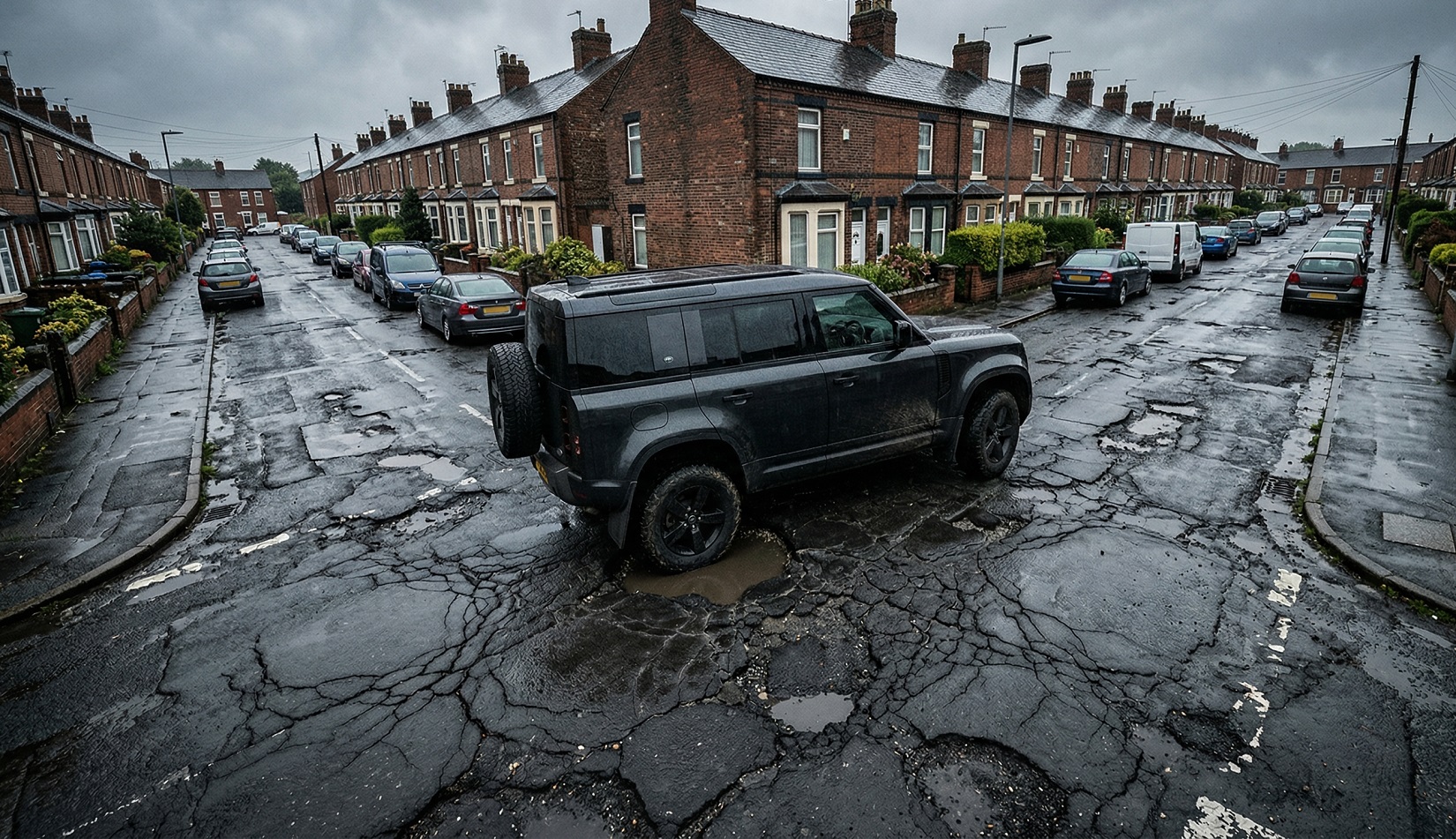
SUVs causing potholes refers to the documented engineering phenomenon where heavier vehicles — particularly sports utility vehicles — impose disproportionately greater axle loads on road surfaces, accelerating asphalt cracking and pothole formation. Research confirms that road damage does not scale linearly with weight: a vehicle twice as heavy causes up to 16 times more surface damage.
You bought the SUV partly because of the potholes. Sit with that for a moment.
The sales pitch practically writes itself: higher ride height, bigger wheels, tougher suspension. When UK roads look like the surface of the moon, an SUV feels like the sensible, protective choice. Millions of British drivers have made exactly that calculation. SUVs now account for 33% of all new car registrations in 2024 — up from just 12% a decade earlier.
Here’s what nobody tells you. The vehicle you bought to survive the potholes is one of the primary reasons those potholes exist in the first place.
This isn’t opinion. It’s physics. And the research confirming it has serious implications not just for how we think about road damage, but for how Britain funds, taxes, and rebuilds its crumbling infrastructure.
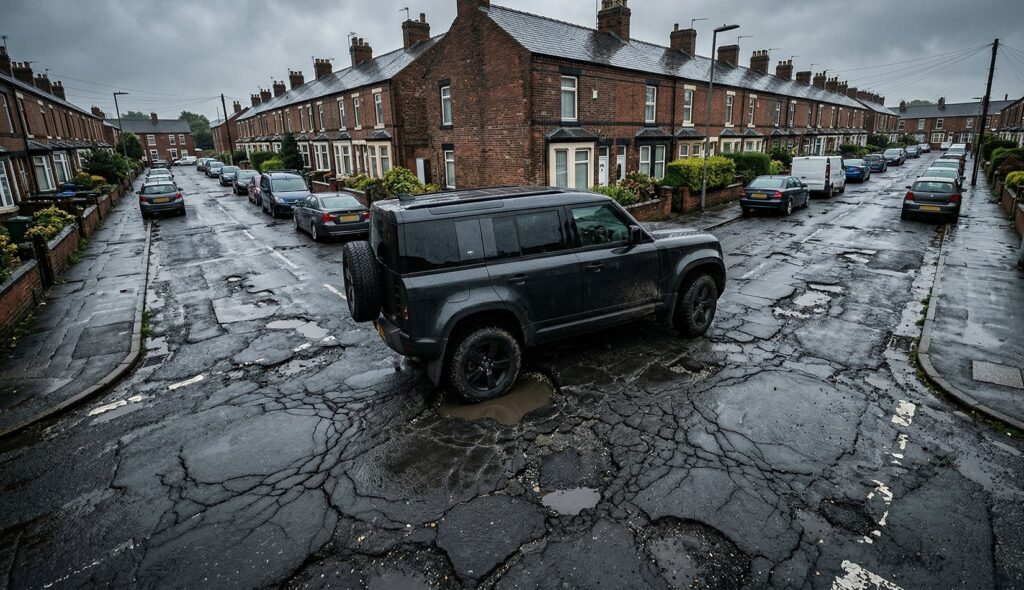
Are SUVs Really Causing Potholes? What the Science Actually Shows
The short answer: yes, demonstrably, and the mechanism is well-understood.
Analysis by the University of Leeds shows that heavier vehicles impose substantially more wear and tear on road surfaces, increasing the risk of small cracks which develop into potholes. Such stress on roads causes greater movement of asphalt, which creates small surface fractures — and if these are not repaired promptly, they expand and eventually become the potholes that puncture tyres and bend suspension arms across Britain every day.
The underlying principle is known in civil engineering as the fourth power law — a relationship that has been understood since the 1960s. A two-tonne SUV does 16 times more damage to road surfaces than a one-tonne car. Cleancitiescampaign Not twice as much. Not four times. Sixteen times. The damage doesn’t scale with weight — it scales with the fourth power of the axle load ratio. This is not a contested finding. It’s a foundational principle of pavement engineering.
Britain’s roads were not designed for the vehicle fleet currently using them. Most of the UK’s residential road network was built and surfaced at a time when the average car weighed considerably less than today’s typical family SUV, which routinely tops 1,800–2,000kg. When millions of these vehicles repeat the same journeys over the same surfaces day after day, the cumulative stress is not additive. It is exponential.
How Bad Is the UK’s Pothole Crisis Right Now?
Before we get into the why, it helps to understand the full scale of what we’re dealing with. Because the numbers are genuinely alarming.
The Asphalt Industry Alliance’s 2024 ALARM survey revealed a road repair backlog exceeding £16.3 billion in England and Wales — a record high. To fix every pothole and bring roads up to a good standard is now estimated to take ten years.
Ten years. That’s not a maintenance problem. That’s a structural failure.
UK drivers are 1.7 times more likely to break down as a result of a pothole today than they were in 2006. A 2025 survey found that 5% of drivers spent more than £1,000 on pothole-related vehicle repairs, and the average repair bill ran to £320. RAC Tyres, suspension, wheel alignment, steering components — the financial toll lands squarely on ordinary motorists.
And the public knows the situation is deteriorating. A 2026 Great British Pothole Poll found that 58% of drivers said general road quality is worse than 12 months ago, and 70% said that when potholes were repaired, the fixes were failing within days or weeks.
Billions in government funding. Record repair backlogs. A public that has largely lost faith in the system working. Something structural is wrong — and the growing weight of the cars on these roads is a major part of what the infrastructure conversation keeps sidestepping.
H3: Why UK Roads Are Particularly Vulnerable to Heavier Vehicles
Over 95% of UK roads are currently surfaced with asphalt — a mixture of crushed rock, sand, gravel and binder materials. Construction News Asphalt is flexible, which is precisely why it has been the dominant road surface for decades: it can absorb and distribute load. But flexibility has a limit. Every time a heavy axle passes over the same point, the asphalt deflects. Over thousands of repetitions, those micro-deflections initiate cracks. Water enters the cracks. In winter, it freezes and expands. The crack becomes a cavity. The cavity becomes a pothole.
This is not a flaw in the material. It’s the natural behaviour of asphalt under loads it wasn’t sized to handle repeatedly. Britain’s residential streets, in particular, were built for a vehicle fleet that no longer exists.
The Irony No One Wants to Say Out Loud: SUV Drivers Are the Biggest Victims and the Biggest Contributors
I’ve spoken to enough drivers in the last few years to know how this conversation tends to go. Most SUV owners are genuinely surprised — and a little defensive — when confronted with the physics here. They didn’t buy a heavy car to damage roads. They bought one because the roads were already bad.
That’s not wrong. It’s just incomplete.
The trap is that the problem compounds itself. As roads deteriorate, more drivers switch to SUVs for the ride height and suspension clearance. As the SUV fleet grows, the additional axle loads accelerate road deterioration further. The cycle tightens. The backlog grows. The repair bills — both for councils and for individual drivers — climb higher.
The RAC estimates there are around six potholes per mile on council-controlled roads in England and Wales, and that UK drivers have to battle against at least one million potholes on the country’s roads. That number will not decrease if the composition of the vehicle fleet continues shifting toward heavier, wider cars.
The difficult intellectual honesty moment here is this: there is no single villain. Chronic underfunding of local authority road maintenance is real, and it predates the SUV boom. Extreme weather cycles — wetter winters, hotter summers — accelerate road decay regardless of what vehicles are using the surface. But vehicle weight is an accelerant. It is a variable we are actively choosing to increase, year after year, while simultaneously complaining that the roads can’t cope.
What Does the “Fourth Power Law” Mean in Practice for Everyday Roads?
Think of it this way. Imagine a residential street in Leeds or Bristol — two lanes, modest traffic, a surface that was last properly resurfaced twelve years ago. Now picture the change in the vehicle mix using that road over the past decade.
In 2014, most cars on that road weighed between 1,100 and 1,400kg. Today, with SUVs at a third of new registrations, a significant proportion of vehicles weigh 1,700–2,100kg. That weight increase — say, from 1,200kg to 1,900kg — doesn’t double the road damage. Using the fourth power relationship, it increases the damage contribution per vehicle pass by roughly six to eight times.
Multiply that by the number of passes per day. Multiply that by the proportion of the fleet that has shifted in this direction. The cumulative additional stress on that road surface, purely from the change in vehicle weight composition, is substantial — and entirely separate from weather, utility company street works, or local authority funding decisions.
Around 4.6 million cars have been sold in the UK since 2021 that are larger than a typical urban car parking space, with numbers growing annually according to researchers at Clean Cities. These are not abstract statistics. These are vehicles turning onto the same residential streets, the same B-roads, the same town centre routes, day after day.
Is There a Policy Solution? What Experts and Campaigners Are Calling For
The policy conversation is moving — slowly — in the direction the engineering has been pointing for years.
A YouGov survey found that car owners themselves want additional charges on SUVs to be spent on fixing potholes — 54% backed this as the most popular use of such revenue, ahead of safer roads (40%) and better public transport (36%). That’s a remarkable finding. Even within the SUV-owning population, there’s a recognition that the current system isn’t fair or sustainable.
The proposals on the table include weight-based vehicle excise duty, parking charges scaled to vehicle size (already operating in some French cities), and revised road tax structures that better reflect the infrastructure cost each vehicle imposes. None of these are radical ideas. They simply apply the principle that cost should follow impact.
What I find genuinely interesting — and what is largely absent from the political debate — is that weight-based charging would create a direct financial incentive for manufacturers, not just consumers. If buyers face meaningful additional costs for heavier vehicles, the commercial pressure on carmakers to produce lighter options intensifies. The market does some of the work.
Should You Feel Guilty for Owning an SUV? The Honest Answer
No. But you should be informed.
Driving a heavy vehicle is not a moral failing. Roads are public infrastructure, and the responsibility for maintaining them sits primarily with government bodies and the funding decisions made over decades of underfunding. Individual consumer choices are made in a market context. Nobody buying a family SUV in 2022 was handed a pamphlet explaining the fourth power law.
But the context has changed. The research is public. The scale of the infrastructure crisis is documented. And the policy decisions coming down the line — weight-based charges, revised VED, parking pricing — will affect SUV owners directly.
Being informed about how vehicle weight translates into road damage isn’t about guilt. It’s about understanding why certain policy changes are coming, what the engineering rationale behind them is, and how to factor that into your next vehicle decision.
The irony at the heart of this whole story is a perfectly elegant one. The vehicle Britain’s drivers chose to cope with deteriorating roads is one of the reasons those roads keep deteriorating. That loop has a name now. It has research behind it. And it has policy implications that will be hard to avoid for much longer.
What Comes Next: The Weight Conversation Britain Can’t Avoid
The UK government announced a record £7.3 billion local roads funding boost at the end of 2025, following an earlier £1.6 billion announcement. That is real money. But it lands into a system where the repair backlog exceeds £16 billion and where the vehicle fleet applying daily stress to road surfaces is heavier than it has ever been.
Funding alone, without addressing the weight trajectory of the vehicle fleet, is treadmill policy. You run hard to stay in the same place.
The engineering is clear. The data is available. The public, even among SUV owners, appears more open to a conversation about fair contribution than politicians currently give them credit for. The question now is whether infrastructure policy catches up with the physics before the repair bill climbs to a number that no budget announcement can absorb.
The “fourth power law” in road engineering states that road damage increases with the fourth power of the axle load ratio between vehicles. A vehicle twice as heavy as another causes up to 16 times more road surface damage — meaning the shift toward heavier SUVs has a non-linear, compounding effect on UK pothole formation and infrastructure deterioration.
Q: Are SUVs really causing more potholes on UK roads?
A: Yes, according to established road engineering principles. The fourth power law shows that a vehicle twice as heavy causes up to 16 times more road surface damage. With SUVs now making up 33% of new UK car registrations — up from 12% a decade ago — the cumulative additional stress on British road surfaces is significant and well-documented.
Q: What did University of Leeds research find about vehicle weight and road damage?
A: University of Leeds analysis found that heavier vehicles impose substantially greater stress on asphalt surfaces, causing micro-deflections that initiate cracks. These cracks allow water ingress, which expands during freezing conditions and develops into potholes. The research also found that the average electric car puts 2.24 times more stress on roads than its petrol equivalent, primarily due to battery weight.
Q: What is the current cost of the UK pothole repair backlog?
A: According to the Asphalt Industry Alliance’s 2024 ALARM survey, the road repair backlog in England and Wales exceeds £16.3 billion — a record high. Fully addressing the problem is estimated to take ten years at current funding levels.
ViralZip.blog is powered by a dedicated team of digital analysts and tech journalists committed to “zipping” through the noise of the information age. With a combined background in investigative research and financial data analysis, our contributors focus on the intersection of emerging AI technology, local economic shifts, and global news trends. We take pride in translating complex data into actionable insights for modern residents across the US and UK. Our mission is to provide high-velocity, reliable information that empowers our readers to navigate the rapidly evolving landscape of 2026.
Disclaimer: The content provided on ViralZip.blog is for informational and educational purposes only. While we strive for accuracy, the fields of artificial intelligence, financial rebates, and medical technology are subject to rapid changes; therefore, we do not guarantee the completeness or absolute reliability of the information provided. This content does not constitute professional financial, medical, or legal advice. Always consult with a licensed professional—such as a financial advisor, doctor, or attorney—before making significant decisions based on trending data. ViralZip.blog is not responsible for any actions taken or outcomes achieved based on the suggestions provided in our articles.