
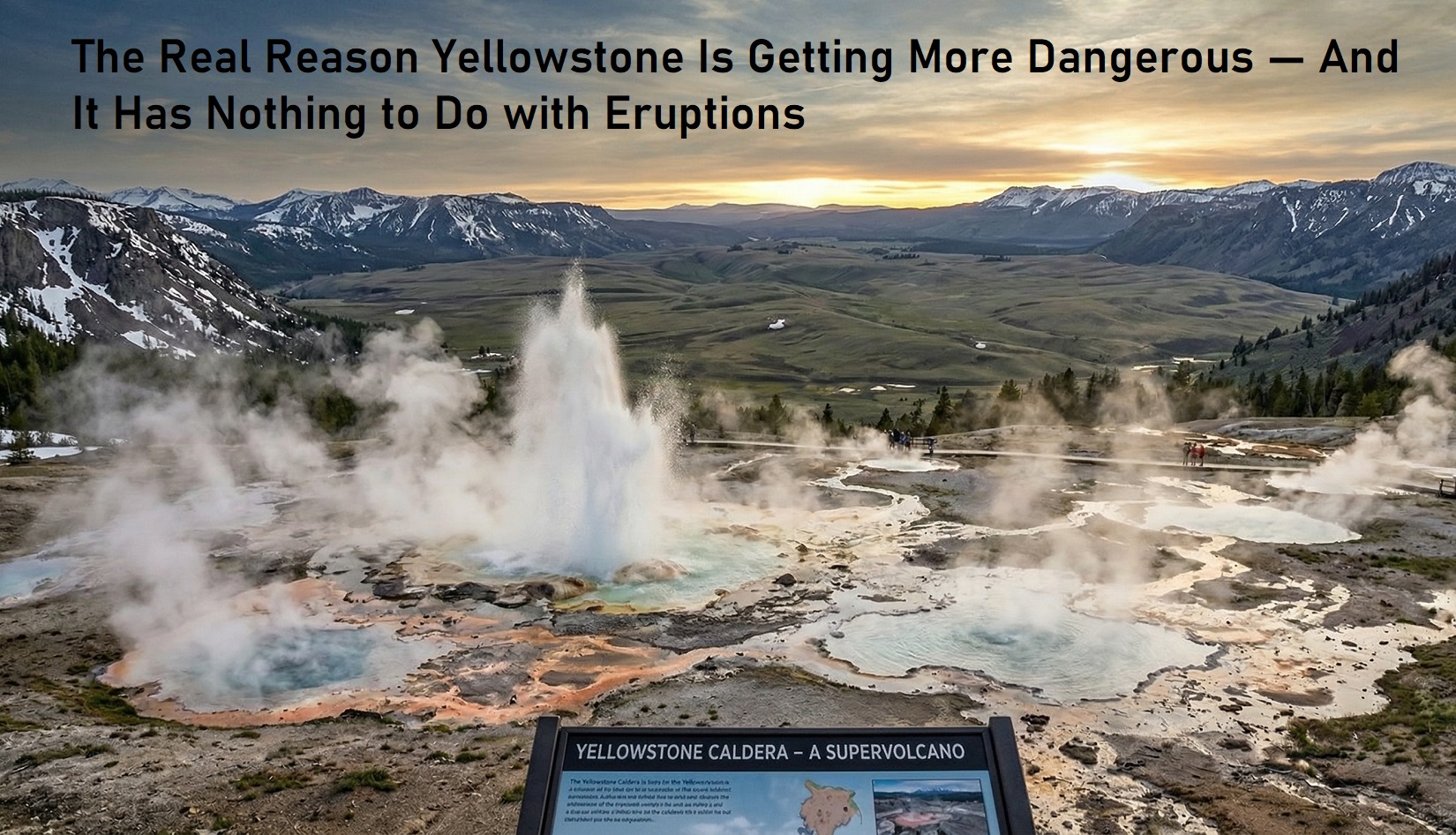
Everyone’s heard the doomsday version of the Yellowstone story. Supervolcano. Mass extinction. The kind of eruption that buries half a continent in ash. Movies have been made about it. YouTube channels live off it.
Here’s the thing, though. Scientists aren’t losing sleep over that scenario. Not right now, anyway.
What is keeping the USGS Yellowstone Volcano Observatory busy in 2025 and 2026? Something far more immediate — and far less reported. The ground itself is moving. Geysers that were dead for years are suddenly erupting again. A pool near Old Faithful blew up without a single second of warning. And a mysterious 20-mile-wide bulge on the park’s northern rim is being tracked around the clock by satellites and GPS sensors sensitive enough to detect shifts smaller than a human fingernail.
None of this means Yellowstone is about to erupt. But it does mean the park is more active — and in some ways more dangerous — than it has been in decades. And most visitors have absolutely no idea.
What’s Actually Happening Under Yellowstone Right Now
Let’s start with what scientists confirmed in the summer of 2025.
An area on the north rim of Yellowstone caldera, just south of Norris Geyser Basin, started to uplift slightly in July 2025. Scientists call it the Norris Uplift Anomaly — or the NUA. It’s not a new thing. The same area bulged upward between 1996 and 2004. But the fact that it’s back, doing the same thing again, is what has researchers paying close attention.
Here’s what “uplift” actually means in plain English. The ground is rising. Slowly, quietly, and in a specific location. We’re not talking about mountains forming overnight. The bulge stretches around 20 miles on the northern rim of the caldera and has risen about an inch since last July. One inch doesn’t sound like much. But the source of that push is roughly 10 miles below the surface.
“It is a sign of some pretty dramatic changes happening deep underground,” said Mike Poland, the scientist in charge at the Yellowstone Volcano Observatory. “The source of this is 10 miles deep, so there’s a lot of rock between there and the surface, but it still has the energy to push the surface up — even if it’s only about an inch, that is still impressive.”
So what’s pushing it up? Possibly magma shifting deep underground. Possibly hydrothermal fluids — basically superheated water — accumulating under pressure. Or a combination of both. Scientists at YVO are keeping a close eye on it, but at this point there are no clear answers about what will come of this current deformation episode.
What Does Ground Deformation Actually Mean for You?
Ground deformation at Yellowstone is not a countdown to catastrophe. Let’s be clear about that. It is very unlikely to lead to any sort of volcanic eruption — there would need to be a lot of changes before that would become possible.
But deformation does matter for two reasons:
- It can trigger earthquake swarms. In November 2025, there was an uptick in seismicity near the NUA, including a swarm that occurred directly on top of the center of uplift. Swarms in Yellowstone can range from tiny undetectable tremors to earthquakes large enough to feel.
- It can destabilize hydrothermal systems. This is the part that actually matters for the millions of visitors who walk those boardwalks every summer. When the ground shifts, the pressure inside underground water chambers changes. And that’s when things can go wrong very fast.
Which brings us to what happened on July 23, 2024 — a morning that most Americans completely missed in the news cycle, but that changed how scientists think about visitor safety at the park forever.
The Explosion Nobody Saw Coming (And Why It Could Happen Again)
Picture a Tuesday morning in Yellowstone. Cars in parking lots. Bison dozing in meadows. Tourists strolling wooden boardwalks near Biscuit Basin, cameras out, maybe two miles northeast of Old Faithful. Normal summer day.
Then, just before 10 a.m., the ground underneath Black Diamond Pool essentially detonated.
Jets of muddy, rock-laden water and steam shot from the turbid depths of the pool, building into bursts as high as 400–600 feet that showered the surrounding area and boardwalk with rocks and mud. Water from the pool surged toward the nearby Firehole River, carrying boulders and debris, and a steam plume was visible from kilometres away.
The boardwalk was destroyed. Grapefruit-sized rocks flew through the air. Miraculously, no injuries were reported, but the incident has been described as one of the most powerful hydrothermal explosions in the park’s recorded history.
There were zero precursors. No warning. Seismicity, ground deformation, and gas and thermal emissions all remained at normal background levels beforehand, and there were no detectable precursors to this event.
That’s the part that should make you pause. Every early warning system they had — and Yellowstone has a lot of them — showed nothing unusual in the hours before the explosion.
How Does a Hydrothermal Explosion Actually Work?
Think of a pressure cooker. A sealed one, heated from below.
Yellowstone sits on one of the world’s most powerful volcanic systems. Magma reservoirs four to six miles below the surface heat groundwater to extreme temperatures. Normally, that water finds a way out — as a geyser, a hot spring, a steam vent.
But sometimes, a layer of silica — basically natural rock cement — seals the escape route. Years of silica buildup beneath the surface created a solid seal. Over time, pressure mounted. And when it finally exceeded the rock’s strength, the explosion tore through with violent force.
It’s not volcanic. There’s no lava. But the energy release is enormous and completely unpredictable.
And here’s the thing: the initial analyses indicate that small explosions at Black Diamond Pool have continued since July 2024 through to the present, posing an ongoing hazard. Some of these explosions have been large enough to carry seismic instruments several meters downhill and partially bury others in fine sediment.
Smaller outbursts occurred on November 5, 2024, during a scientific gas sampling expedition, and again on January 3, 2025, witnessed by a winter tour group. Biscuit Basin — one of the most visited sections of the park — remained closed for the entire summer of 2025 as a result.
Why This Is the Risk Nobody Talks About
Here’s what I find genuinely interesting about the public conversation around Yellowstone: almost all of it is about the supervolcano scenario. Will it erupt? When will it erupt? What happens if it erupts?
That framing misses the actual, present-day risk entirely.
The odds of a catastrophic volcanic eruption at Yellowstone in any given century are extraordinarily small. Scientists are clear on that. But hydrothermal explosions? They typically occur in the park one to a few times per year — often in backcountry areas where they go undetected. When they happen near visitor areas, the danger is immediate and real.
The July 2024 explosion happened at one of the most visited spots in the park. At 10 a.m. on a summer Tuesday. The fact that no one was standing on that specific boardwalk at that specific moment was, by most accounts, fortunate timing rather than adequate safety margin.
How Scientists Are Tracking All of This — And Why It’s Actually Remarkable
Here’s something most people don’t realise. The reason we know about the ground shifting at Yellowstone — the reason this story exists at all — is because the monitoring technology watching this park has become extraordinarily precise over the last two decades.
Let’s break down what’s actually happening out there.
GPS Stations That Feel the Ground Breathe
Yellowstone has dozens of permanent GPS stations scattered across the park. Not the kind in your phone. These are highly specialised instruments bolted into rock, communicating with satellites 24 hours a day, seven days a week.
These stations communicate with orbiting satellites to calculate their exact position. By comparing position data over time, scientists can determine whether the ground is rising, sinking or shifting sideways. GPS instruments at Yellowstone can detect vertical changes as small as hundredths of an inch.
Let that sink in. Hundredths of an inch. That’s smaller than the thickness of a fingernail. And they can detect it happening in real time, across a volcanic system the size of a small state.
The GPS network isn’t working alone, either. Scientists also deploy temporary portable stations every spring, placing them in locations the permanent network can’t easily reach. According to the YVO, the semi-permanent GPS stations are placed in the field every spring or early summer and then collected in the fall. These GPS tools can track ground deformation to the millimetre.
InSAR — The Satellite Camera That Sees What Eyes Can’t
The second major tool is called InSAR, which stands for Interferometric Synthetic Aperture Radar. It sounds intimidating. It’s actually a brilliant concept once you understand it.
Radar satellites — including the European Space Agency’s Sentinel-1 — pass over Yellowstone regularly. The Sentinel-1 mission collects images from the region every week or two. Each time the satellite passes, it bounces radar waves off the ground surface and measures the return signal. When it comes back weeks later and does the same thing, scientists compare the two images. Any shift in the ground — even centimetres — shows up as a change in that signal.
The result? A detailed colour map showing exactly where the ground moved, by how much, across the entire caldera at once.
“We’re talking about the ground rising and falling by an inch. And we have multiple techniques that can detect and characterize the deformation,” USGS scientist Michael Poland said. “It speaks to how expanded monitoring and advances in technology have improved our understanding of how volcanoes work — Yellowstone in particular.”
This is genuinely impressive science. The combination of GPS and InSAR gives researchers both the continuous real-time detail (GPS) and the big-picture spatial view (InSAR). Together, they’ve turned Yellowstone into one of the best-monitored geological systems on Earth.
What the Latest Data Shows (As of April 2026)
Here’s the current situation, pulled directly from the most recent USGS update:
The April 2026 Yellowstone Volcano Observatory monthly update confirms that Yellowstone Caldera activity remains at background levels, with 61 located earthquakes in March, the largest being a M1.9. Deformation measurements indicate a pause in the uplift that had been occurring along the north caldera rim since July 2025.
In other words: the ground bulge that started in July 2025 appears to have stopped rising as of mid-January 2026. Scientists are watching to see what it does next. Does it subside gradually — as it did after the 1996–2004 episode? Does it pause and then start again? Nobody knows yet.
But something else caught attention in the same update. Echinus Geyser, in Norris Geyser Basin, reawakened from a several-year slumber in February 2026, with about 40 eruptions that month. Echinus is one of Yellowstone’s most famous geysers. It went quiet for years. Now it’s back — erupting dozens of times in a single month.
Coincidence? Or another signal that the subsurface plumbing system is shifting?
Scientists are careful not to over-interpret individual events. But they’re watching. Closely.
Common Mistakes to Avoid (And Misconceptions to Drop)
Whether you’re a curious reader or someone actually planning a trip to Yellowstone, these are the mistakes I see people make constantly — online, in comment sections, and honestly, in mainstream news coverage.
❌ Mistake 1: Treating Ground Deformation as an Eruption Warning
Ground deformation at Yellowstone is constant. The park goes through cycles of uplift and subsidence that have been happening for decades — centuries, probably. There is evidence of ground movement at many volcanic systems for hundreds to thousands of years without an eruption. Deformation on volcanoes is a complicated process.
Uplift does not equal eruption imminent. The two are connected in some scenarios, but ground shifting at Yellowstone is normal behaviour for an active geothermal system.
❌ Mistake 2: Panicking About the “Overdue Eruption” Myth
This one refuses to die. The idea that Yellowstone erupts every 600,000 years and is therefore “overdue” is statistically meaningless. It is not valid to calculate a recurrence period solely on two values — the two intervals between supereruptions. Volcanoes don’t work on timelines.
“They erupt when there is enough eruptible magma beneath the surface, and pressure to cause that magma to ascend. Neither condition is in place at Yellowstone right now,” USGS scientist Michael Poland told Live Science.
The “overdue” framing is clickbait. Full stop.
❌ Mistake 3: Believing Viral Social Media Rumours
2025 was a year of internet rumours at Yellowstone, mostly related to animals fleeing the park — and none of them were true. In July 2025, a fake AI-generated video of animals supposedly evacuating the park went massively viral. It wasn’t real. It was never real. But millions of people shared it as though it were.
The USGS publishes monthly updates. They are free, public, and written in plain English. Check there before you believe anything you see on TikTok or X.
❌ Mistake 4: Underestimating Hydrothermal Danger as a Visitor
This is the flip side — and the more practically important mistake. The hydrothermal explosion risk at Yellowstone is real, documented, and has already closed one of the park’s most popular areas for over a year.
Staying on boardwalks isn’t just a rule about protecting the landscape. It’s a safety measure. The thermal ground around those features can be thin. A few steps off a boardwalk in the wrong area, and you’re standing on a pressure lid that could give way.
⚠️ COMMON VISITOR SAFETY RULES MOST PEOPLE IGNORE:
- Stay on designated boardwalks in ALL thermal areas — no exceptions
- Never wade in, touch, or taste thermal pools
- Keep children within arm’s reach near any hydrothermal feature
- Check the USGS and NPS websites before your visit for current closures
- If you hear rumbling or see water suddenly surge, move away immediately
FAQs: What People Are Actually Asking About Yellowstone Right Now
Q1: Is Yellowstone going to erupt soon?
No. The current volcano alert level is NORMAL — the lowest possible. Researchers from Rice University, the University of New Mexico, and the University of Utah determined in 2025 that the magma is spread out across different reservoirs, making eruption unlikely. Yellowstone National Park The last volcanic eruption at Yellowstone was 70,000 years ago. Scientists see no signs of that changing anytime soon.
Q2: What was the Norris Uplift Anomaly and should I be worried?
The Norris Uplift Anomaly (NUA) is a 20-mile-wide area on Yellowstone’s north caldera rim that began rising in July 2025. It happened before — between 1996 and 2004 — and eventually stopped without any volcanic event. As of April 2026, the uplift that started in July 2025 has paused. USGS Volcanoes Scientists are monitoring it but are not alarmed. It’s fascinating geology, not a crisis.
Q3: Is it safe to visit Yellowstone in 2026?
Yes — with awareness. The park remains open and receives millions of visitors a year. The key risks are not volcanic. They’re hydrothermal. Stay on boardwalks, follow all posted closures, and check the NPS website for any restricted areas before you arrive. Biscuit Basin was closed through 2025 and may still have restrictions — verify current access before planning your route.
Q4: What caused the Black Diamond Pool explosion in 2024?
The July 23, 2024, hydrothermal explosion at Biscuit Basin resulted from water suddenly transitioning to steam in the shallow hydrothermal system beneath Black Diamond Pool. It was not caused by volcanic activity. Silica deposits had sealed underground water until pressure exceeded what the rock could contain. The resulting explosion sent debris hundreds of feet into the air and destroyed a boardwalk — with no warning of any kind.
Q5: How do scientists know when something dangerous is happening at Yellowstone?
Through a network of GPS stations, InSAR satellite imaging, seismic sensors, gas monitors, and thermal cameras. The collaboration between Yellowstone National Park and the USGS forms one of the most advanced geothermal monitoring networks in the world, integrating seismic sensors, GPS stations, satellite interferometry, and thermal imaging. If something genuinely alarming were developing, the alert level would change — from NORMAL upward. Right now, it hasn’t.
The Bottom Line: Respect the Ground You’re Walking On
Here’s what I want you to take away from all of this.
Yellowstone is not about to kill us all. The supervolcano doomsday scenario is, by every credible scientific measure, not a near-term threat. The scientists monitoring this park around the clock are not panicking. The alert level is green. You can visit. You should visit — it’s one of the most extraordinary places on Earth.
But the real story of Yellowstone in 2025 and 2026 isn’t the eruption myth. It’s something more subtle and, honestly, more interesting. The ground is moving in ways scientists are still working to understand. A geyser that went silent for years just woke back up. A pool near the park’s most famous attraction exploded without a single second of warning and had to be closed for over a year.
This is a living, breathing geological system. It doesn’t follow a script. The danger it poses to visitors isn’t cinematic — it’s local, quiet, and capable of striking without warning in the exact spot where someone was standing five minutes earlier.
The scientists watching it have better tools than ever. They’re sharing the data publicly, every single month. The least we can do is pay attention to what they’re actually saying — instead of the AI-generated panic videos going viral on social media.
ViralZip.blog is powered by a dedicated team of digital analysts and tech journalists committed to “zipping” through the noise of the information age. With a combined background in investigative research and financial data analysis, our contributors focus on the intersection of emerging AI technology, local economic shifts, and global news trends. We take pride in translating complex data into actionable insights for modern residents across the US and UK. Our mission is to provide high-velocity, reliable information that empowers our readers to navigate the rapidly evolving landscape of 2026.
Disclaimer: The content provided on ViralZip.blog is for informational and educational purposes only. While we strive for accuracy, the fields of artificial intelligence, financial rebates, and medical technology are subject to rapid changes; therefore, we do not guarantee the completeness or absolute reliability of the information provided. This content does not constitute professional financial, medical, or legal advice. Always consult with a licensed professional—such as a financial advisor, doctor, or attorney—before making significant decisions based on trending data. ViralZip.blog is not responsible for any actions taken or outcomes achieved based on the suggestions provided in our articles.