
The Secret Reason 11% of Brits Refuse to Buy New: Inside the 2026 UK Secondhand Fashion Trends
The cost of living is suffocating household budgets across the country. A casual trip to the high street to update your wardrobe—once a standard weekend activity—now feels like a luxury few can safely afford.
Wages are failing to match inflation, and even historically “cheap” fast fashion brands are hiking their prices. You want to look presentable, stay modern, and dress your family appropriately. But doing so at a traditional retailer means draining your already depleted disposable income or sacrificing your utility bill payments. It is a brutal financial ultimatum.
We are witnessing a retail rebellion. The UK secondhand fashion trends completely reshaping the 2026 market are not born out of a sudden desire to save the planet. They are born out of necessity. We are going to explore exactly why a record-breaking 11% of British shoppers now outright refuse to buy new clothes, utilizing platforms like Vinted not for eco-points, but as an essential smart spending strategy.
What is driving the UK secondhand fashion trends in 2026? Driven by severe inflationary pressure, the leading UK secondhand fashion trends in 2026 revolve around consumers abandoning traditional retail for peer-to-peer clothing platforms like Vinted. Currently, 11% of British shoppers begin their purchasing journey on the resale market, prioritizing accessible prices and financial survival over fast fashion.
The Secret Driver Behind UK Secondhand Fashion Trends in 2026
When we analyze the latest consumer data, one statistic stops us dead in our tracks: 11% of shoppers in the United Kingdom now begin their search for clothing exclusively on secondhand platforms. This marks the highest global share of secondhand-first shoppers in the world.
Mainstream lifestyle media consistently frames this explosion of secondhand shopping as a triumph of environmentalism. They paint a picture of a noble, eco-friendly push against fast fashion, driven by Gen Z climate anxiety and a widespread commitment to Environmental, Social, and Governance (ESG) principles.
We disagree. Our research indicates that this narrative is fundamentally flawed.
While keeping textiles out of landfills is a wonderful byproduct, it is not the catalyst. The true driver of the 2026 resale boom is pure economic triage. The British public is not flocking to Vinted to save the ice caps; they are doing it to save their bank accounts. When you dig into the Consumer Price Index (CPI) and look at how aggressively the cost of essential goods has risen over the last three years, discretionary spending on apparel is the first thing to be slashed.
What is causing the mass exodus from traditional high street retail?
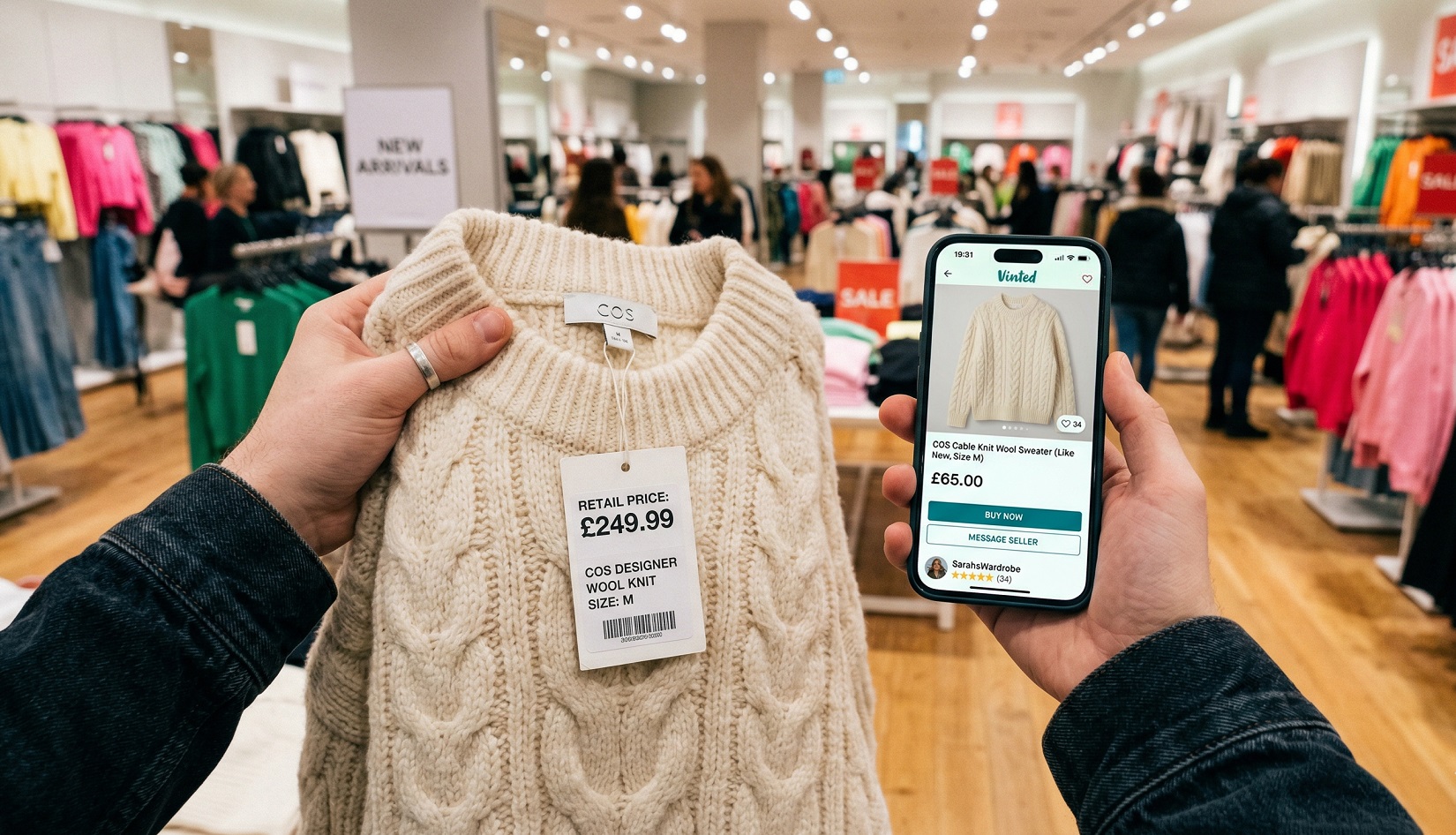
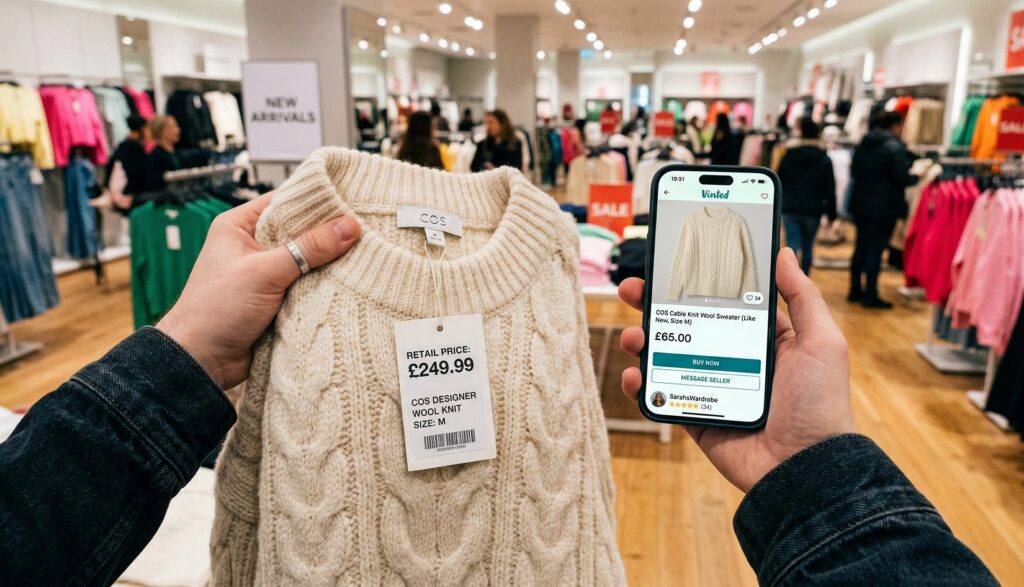
The high street is becoming a showroom rather than a point of sale. Consumers walk into brick-and-mortar stores to check sizing, feel the fabric, and identify what they like. Then, they immediately pull out their smartphones. They open a resale app and search for that exact item, often finding it lightly worn—or even brand new with tags—for half the price.
This behavior is a direct reaction to shrinking profit margins in traditional retail. Supply chain disruptions, elevated energy costs for storefronts, and rising manufacturing expenses have forced legacy brands to pass the costs onto the consumer. The consumer, quite simply, has reached their breaking point. They are actively rejecting the retail mark-up.
Financial Survival vs. Eco-Friendly Choices
To understand the modern British consumer, we have to look at the psychology of smart spending. In previous decades, buying secondhand carried a stigma. It was associated with dusty charity shops and outdated styles.
That stigma has vanished.
Today, successfully securing a high-quality garment on the resale market is viewed as a badge of honor. It is a flex of financial intelligence. We speak with consumers every day who proudly share how little they paid for a premium item.
Why smart spending and accessible prices matter more than sustainability
When gas and electricity bills double, the definition of an “accessible price” shifts dramatically. A £40 sweater from a mid-tier brand is no longer an impulse purchase; it requires financial calculation.
The circular economy provides an escape hatch. Families facing the inflationary pinch use the resale market to bypass retail expectations altogether. If a household budget only allows for £50 a month on clothing, that £50 goes significantly further on a peer-to-peer app than it does in a shopping mall. We are seeing parents exclusively outfitting their children in pre-loved clothing, recognizing that kids outgrow garments long before the fabric deteriorates.
Sustainability is the marketing spin. Affordability is the conversion trigger. If the resale market were suddenly more expensive than the high street, the “eco-friendly” motivation would evaporate overnight.
Vinted, Depop, and the Rise of Clothing Platforms
The engine powering this behavioral shift is technology. The infrastructure of the secondhand economy has evolved from clunky auction sites into hyper-optimized, frictionless mobile applications.
Vinted has emerged as the undisputed king of the UK market. Depop continues to hold a strong grip on the Gen Z demographic, but Vinted’s aggressive user acquisition and intuitive interface have made it ubiquitous across all age groups.
How peer-to-peer resale markets became the new shopping mall
Why are these specific clothing platforms dominating? The answer lies in their elimination of friction.
Historically, selling old clothes meant spending a Saturday morning at a car boot sale or navigating complex seller fees on eBay. Vinted removed the seller fees entirely. They shifted the cost of postage and buyer protection onto the purchaser. For the seller, the process is zero-risk and zero-cost. You snap a photo, upload it in sixty seconds, and wait.
This creates a massive influx of inventory. Because there is no financial penalty for listing an item, millions of users treat these platforms as a digital extension of their physical wardrobes. You are no longer constrained by the seasonal inventory of a traditional retailer. The resale market offers infinite aisles, categorized by exact measurements, brand preferences, and color palettes. It is a highly personalized, algorithm-driven shopping mall resting in your pocket.
If you want to understand how to leverage this for your own household, we suggest exploring strategies for household budgeting and smart spending to see how liquidating assets directly impacts your monthly cash flow.
The Primark Paradox: Can Fast Fashion Survive the Resale Market?
This brings us to a fascinating economic standoff. If the primary motivation for secondhand shopping is securing an accessible price, what happens to the ultimate accessible-price retailer? What happens to Primark?
Primark has long been the undisputed champion of the budget-conscious British shopper. Their entire business model relies on massive volume and razor-thin margins. But the 2026 resale boom has created what we call the “Primark Paradox.”
Shifting retail expectations in an era of inflation
Here is the paradox: Vinted is now frequently undercutting Primark.
When a shopper can buy a mid-tier brand (like Zara, H&M, or even premium labels like COS) on the resale market for the exact same price as a brand-new, entry-level item from Primark, the value proposition shatters. We are witnessing consumers engage in brand arbitrage. They are choosing higher-quality, secondhand garments over lower-quality, brand-new garments simply because the price tags are now identical.
Primark is attempting to hold the line, but they are squeezed by the same macro-economic forces as everyone else. If they raise their prices by even a fraction to cover supply chain costs, they push their core demographic directly into the arms of the resale apps. To understand the immense pressure these brands are under, one must look closely at the hidden costs behind fast fashion supply chains. The era of disposable fashion is ending, not because consumers grew a conscience, but because they demanded better financial return on their spending.
4 Ways the Resale Market is Changing Consumer Behavior
The dominance of the resale market has triggered permanent changes in how the British public interacts with fashion. We have identified four distinct behavioral shifts defining the 2026 landscape.
1. Wardrobe Liquidation for Cash Flow We no longer hoard clothes we do not wear. A dormant coat sitting in a closet is now viewed as trapped capital. Consumers actively audit their wardrobes at the end of each season, aggressively listing items to generate immediate cash flow. This liquidity is then used to pay essential bills or fund the purchase of replacement items. The closet is treated as a revolving bank account. If you want to optimize this process, you must learn how to maximize your profits on the resale market by mastering lighting, descriptions, and algorithmic timing.
2. The Death of the Impulse Buy The dopamine hit of walking past a window display and buying a shirt on a whim is dead. The modern consumer is remarkably disciplined. When they see an item they want, they engage a mandatory waiting period. They scan the barcode or search the item name on secondhand platforms to see if a cheaper alternative exists in the secondary market. The impulse has been replaced by the hunt.
3. Purchasing with “Resale Value” in Mind Much like buying a car, British shoppers now factor in depreciation before purchasing clothing. We see a sharp decline in the purchase of ultra-cheap, unbranded garments because they possess zero resale value. Instead, consumers are slightly stretching their budgets to buy recognized brands, knowing they can recoup 40% to 60% of the initial cost by selling it on Vinted six months later. They are renting the clothes from themselves.
4. The Micro-Entrepreneurization of the Household Finally, selling clothes has transitioned from a chore into a legitimate side hustle. Families are treating their peer-to-peer platform accounts like miniature businesses. They track trends, engage in price negotiation, and build seller reputations. In an economy where traditional career advancement is stalling, controlling your own micro-revenue stream offers a psychological sense of financial control.
The 11% of Brits refusing to buy new clothes are the vanguard of a permanent economic shift. The UK secondhand fashion trends of 2026 are a masterclass in consumer resilience. By leveraging technology to bypass traditional retail margins, the public is successfully fighting back against the inflationary squeeze, one pre-loved garment at a time.
Frequently Asked Questions (FAQs)
Why is everyone in the UK suddenly using Vinted?
While environmental concerns play a minor role, the primary driver is the cost of living crisis. With inflation squeezing household budgets, Brits are using Vinted to bypass retail mark-ups and find accessible prices to ensure their financial survival.
Is buying secondhand actually cheaper than shopping at Primark?
Increasingly, yes. This is what industry experts call the “Primark Paradox.” Shoppers are realizing they can buy higher-quality, mid-tier, or premium brands gently used on resale apps for the exact same price as entry-level, brand-new fast fashion.
Can you really make money selling clothes on Vinted?
Yes. Because Vinted removed seller fees, users keep 100% of their profits. Many UK households are now treating wardrobe liquidation as a legitimate micro-revenue stream to help pay for essential utility bills or fund new purchases.
What percentage of the UK buys secondhand clothes?
As of 2026, a record-breaking 11% of British shoppers begin their clothing search exclusively on secondhand platforms before ever checking traditional high street retailers, marking the highest global share of resale-first shoppers.
What are the most popular secondhand clothing apps in the UK?
Vinted is currently the undisputed leader due to its zero-seller-fee model and highly intuitive interface. Depop remains incredibly popular (particularly among the Gen Z demographic), while legacy platforms like eBay still hold a significant portion of the market.
ViralZip.blog is powered by a dedicated team of digital analysts and tech journalists committed to “zipping” through the noise of the information age. With a combined background in investigative research and financial data analysis, our contributors focus on the intersection of emerging AI technology, local economic shifts, and global news trends. We take pride in translating complex data into actionable insights for modern residents across the US and UK. Our mission is to provide high-velocity, reliable information that empowers our readers to navigate the rapidly evolving landscape of 2026.
Disclaimer: The content provided on ViralZip.blog is for informational and educational purposes only. While we strive for accuracy, the fields of artificial intelligence, financial rebates, and medical technology are subject to rapid changes; therefore, we do not guarantee the completeness or absolute reliability of the information provided. This content does not constitute professional financial, medical, or legal advice. Always consult with a licensed professional—such as a financial advisor, doctor, or attorney—before making significant decisions based on trending data. ViralZip.blog is not responsible for any actions taken or outcomes achieved based on the suggestions provided in our articles.