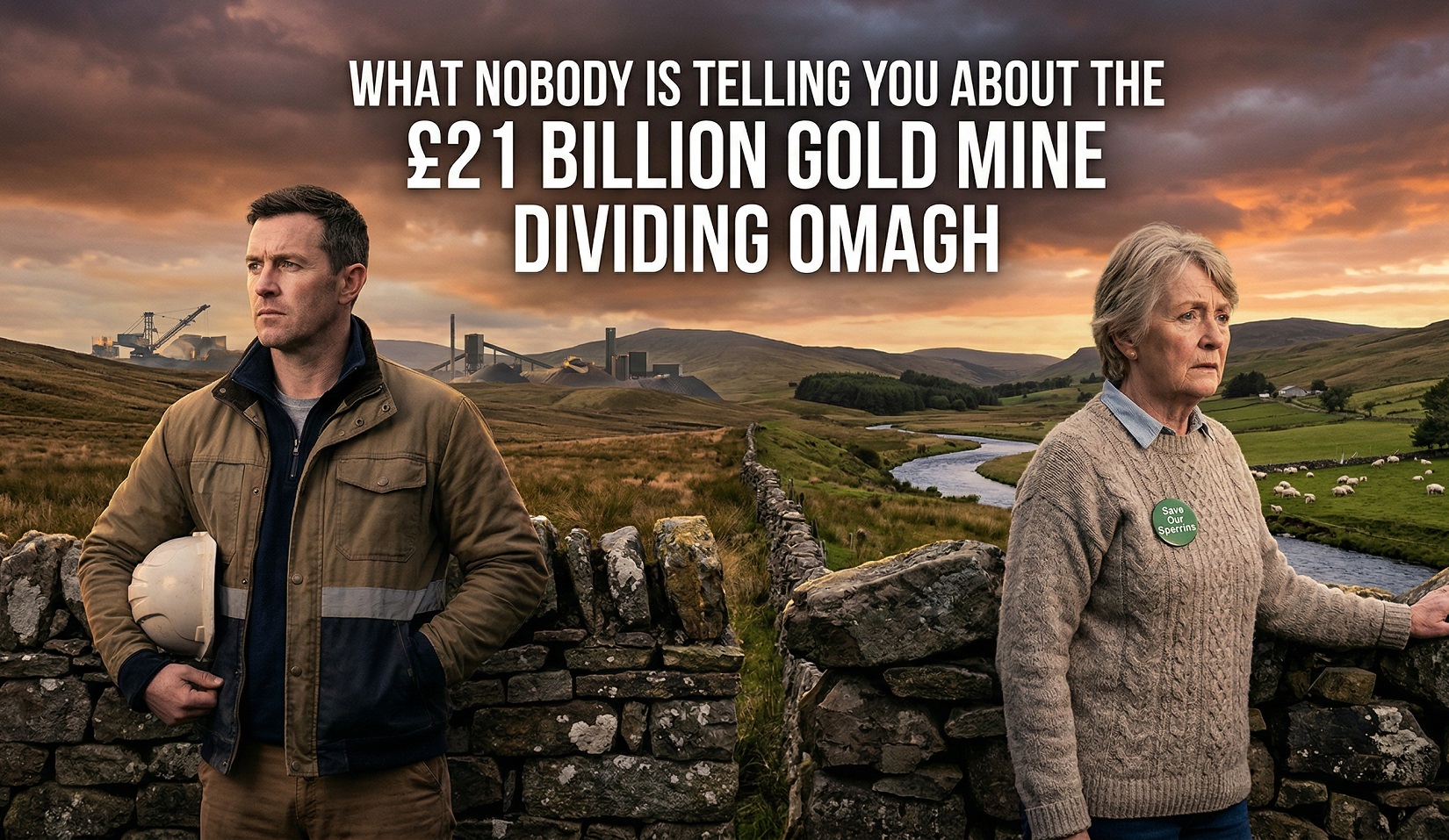
What Nobody Is Telling You About The £21 Billion Omagh Gold Mine Dividing a Community
Imagine discovering a lottery ticket worth billions buried beneath your family’s ancestral home. Now imagine that cashing in that ticket requires tearing down the house, displacing your neighbors, and potentially poisoning the well you all drink from. That is the excruciating reality currently paralyzing County Tyrone. The Omagh gold mine represents one of the most lucrative untapped mineral deposits in Europe, but the pursuit of this £21 billion prize is leaving a trail of social destruction in its wake. We traveled into the heart of the Sperrin Mountains to look past the corporate spreadsheets and investigate the profound human cost of a community at war with itself.
What is the Omagh gold mine controversy? The Omagh gold mine is a highly contested, multi-billion-pound mining proposal in County Tyrone, Northern Ireland. While corporations project massive economic growth and job creation, local residents are fiercely divided over severe environmental impact concerns, specifically regarding water contamination and the industrialization of the Sperrin Mountains.
The Shadow Over the Sperrins: Understanding the Omagh Gold Mine
To comprehend the sheer scale of the fracture in Northern Ireland, you first have to grasp the geography and the staggering financials. The Sperrin Mountains are categorized as an Area of Outstanding Natural Beauty (AONB). It is a landscape defined by rolling heather, deep glens, and a quiet, ancient stoicism. It is also sitting on top of an absolute fortune.
Geological surveys indicate that the subterranean rock formations hold an estimated £21 billion to £25 billion worth of high-grade gold. It is a world-class deposit. For mining conglomerates, this is the ultimate prize.
But the locals do not live on a balance sheet. They live on the land. When mining firms set up camp and began drafting their Environmental Impact Assessments, they ignited a powder keg. The narrative quickly split into two irreconcilable camps: those who see the mine as a desperate economic lifeline for a historically underfunded region, and those who view it as an apocalyptic threat to their way of life.
A Billion-Pound Project vs. The Local Community
We sat down with residents on both sides of the divide. The tension is palpable. It hangs in the air at local pubs, post offices, and Sunday services.
Proponents of the mining proposal point to the undeniable economic decay of rural Northern Ireland. Youth emigration is devastating the local demographic. Young people are fleeing to Belfast, London, or further abroad because County Tyrone simply lacks high-paying, industrial-scale career opportunities. To the supporters, the mine is not an environmental hazard; it is a vital injection of Foreign Direct Investment (FDI).
We reviewed the corporate pledges. Mining operations promise hundreds of direct, high-paying jobs, from heavy machinery operators to geologists and administrative staff. They promise millions injected into the local supply chain. For a family struggling to keep the lights on, the moral high ground of environmental conservation is a luxury they cannot afford. They want the jobs.
However, the opposition is equally fierce and significantly louder. Protest camps have been erected. Groups like Save Our Sperrins have mobilized a highly effective grassroots campaign, arguing that the short-term economic boom is a Trojan horse. They believe the billion-pound project will ultimately strip the wealth from the region, funnel it to foreign shareholders, and leave the local community to manage a toxic, industrialized wasteland long after the gold is gone.
The Environmental Impact of Extracting Northern Ireland’s Gold
You cannot talk about the Omagh gold mine without talking about the environmental terror gripping the opposition. Extracting microscopic flecks of gold from tons of solid rock is an inherently violent, chemically intensive process.
Cyanide, Water Tables, and the Fear of Contamination
The most visceral fear centers on processing methods. Modern gold extraction frequently utilizes cyanide leaching to separate the precious metal from the ore. Even though companies insist on state-of-the-art containment facilities, the word “cyanide” alone is enough to mobilize an entire county.
We looked at the local geography. The Sperrins are a massive catchment area. The water network here feeds directly into rivers that sustain local agriculture, wild salmon populations, and ultimately, human drinking supplies. The Northern Ireland Environment Agency (NIEA) monitors these waterways, but locals remain entirely unconvinced by corporate reassurances.
They point to global historical precedents where tailing dams have failed, leaking heavy metals and toxic sludge into local ecosystems. In County Tyrone, the margin for error is zero. A single catastrophic breach or slow, undetected seepage into the water table would permanently destroy the agricultural backbone of the region. The community asks a valid question: How do you price the risk of permanently poisoning a county’s water supply against a temporary influx of mining jobs?
The Human Cost: How a Mining Proposal Fractured County Tyrone
This is the element of the story that the financial press ignores. The £21 billion valuation is a headline. The reality is two brothers who no longer speak to one another because one signed a land-access lease with the mining company, and the other is standing on a picket line outside the proposed site.
Neighbors Turned Adversaries
In rural Northern Ireland, community is everything. It is a region with a deeply complex, historically fraught relationship with authority and land ownership. The community survived decades of political conflict by relying on each other. Now, the Omagh gold mine is achieving what decades of sectarian strife could not: it is turning neighbor against neighbor.
We heard stories of intimidation. Families who publicly support the mine have reported being ostracized. Conversely, anti-mine activists have faced aggressive legal pushback and accusations of sabotaging the economic future of their own children.
It is a psychological pressure cooker. The mental health toll on the residents of Omagh and the surrounding villages is profound. People are trapped in a state of permanent anxiety. They are waiting for planning commissions to render decisions that will fundamentally alter the trajectory of their lives. The £21 billion deposit has cursed them with the burden of potential.
The Corporate Engine: Dalradian, Galantas, and Foreign Investment
While the community fights on the ground, the corporate machinations continue above their heads. The mining landscape in Northern Ireland is complex, involving multiple players and shifting ownership structures over the years, involving entities like Dalradian Gold (focused on the Curraghinalt deposit) and Galantas Gold (focused on the Cavanacaw mine).
Recently, we have seen aggressive financial restructuring. Joint ventures and massive debt-to-equity conversions are taking place in boardrooms thousands of miles away from the Sperrin Mountains. For instance, investment firms like Ocean Partners are pouring millions into exploration and restart plans, converting loans into heavy equity stakes.
This foreign financial maneuvering fuels the local resentment. The community watches as international holding companies and wealthy investors trade shares of the land beneath their feet. It creates a deep sense of disenfranchisement. The decisions governing the ecological safety of County Tyrone are being heavily influenced by individuals who will never have to drink from its water table.
Where Does the Omagh Gold Mine Go From Here?
The stalemate cannot last indefinitely. The planning applications, the environmental reviews, and the public inquiries are slowly grinding toward a definitive conclusion.
If the full-scale mining operations are approved, the economic landscape of County Tyrone will transform overnight. Heavy industry will alter the skyline of the Sperrins. But if the proposals are ultimately rejected, the companies will pack up their drills, taking the promised jobs and the multi-billion-pound investment with them, leaving the region to figure out its own economic salvation.
Regardless of the outcome, the damage to the social fabric of the community is already done. Trust has been broken. Lines have been drawn in the heather. The £21 billion Omagh gold mine has proven that sometimes, the most destructive thing you can discover in your backyard is a fortune you cannot agree on how to handle.
What is the Omagh gold mine project?
It is a highly controversial, large-scale mining proposal located in County Tyrone, Northern Ireland, centered around the Sperrin Mountains—a designated Area of Outstanding Natural Beauty (AONB).
How much is the gold actually worth?
Geological surveys estimate that the subterranean rock formations in the region contain high-grade gold deposits valued between £21 billion and £25 billion, making it one of the richest untapped mineral deposits in Europe.
Why is the local community protesting the mine?
The community is deeply fractured. Opponents argue the mine will destroy the local landscape and pose severe health risks. Conversely, supporters point out that the rural area suffers from heavy youth emigration and desperately needs the hundreds of high-paying jobs and foreign investment the mining companies are promising.
What are the specific environmental risks?
The primary fear is water contamination. Locals are deeply concerned that the chemical-intensive extraction processes (such as cyanide leaching) and the storage of mining waste could leak into the water table, permanently poisoning the rivers that supply local drinking water and sustain agriculture.
Which companies are involved in the mining?
The region features overlapping projects from major corporate players. Dalradian Gold is the primary company attempting to develop the massive £21bn Curraghinalt deposit in the Sperrins, while Galantas Gold Corporation operates the nearby Cavanacaw/Omagh mine.
Has the gold mine been officially approved?
Not fully. While some exploratory and underground development has occurred, full-scale operations (particularly Dalradian’s massive project) are currently locked in a massive Public Local Inquiry. The Northern Ireland Planning Appeals Commission is actively reviewing thousands of environmental impact assessments, public objections, and legal arguments before deciding its ultimate fate.
ViralZip.blog is powered by a dedicated team of digital analysts and tech journalists committed to “zipping” through the noise of the information age. With a combined background in investigative research and financial data analysis, our contributors focus on the intersection of emerging AI technology, local economic shifts, and global news trends. We take pride in translating complex data into actionable insights for modern residents across the US and UK. Our mission is to provide high-velocity, reliable information that empowers our readers to navigate the rapidly evolving landscape of 2026.
Disclaimer: The content provided on ViralZip.blog is for informational and educational purposes only. While we strive for accuracy, the fields of artificial intelligence, financial rebates, and medical technology are subject to rapid changes; therefore, we do not guarantee the completeness or absolute reliability of the information provided. This content does not constitute professional financial, medical, or legal advice. Always consult with a licensed professional—such as a financial advisor, doctor, or attorney—before making significant decisions based on trending data. ViralZip.blog is not responsible for any actions taken or outcomes achieved based on the suggestions provided in our articles.