
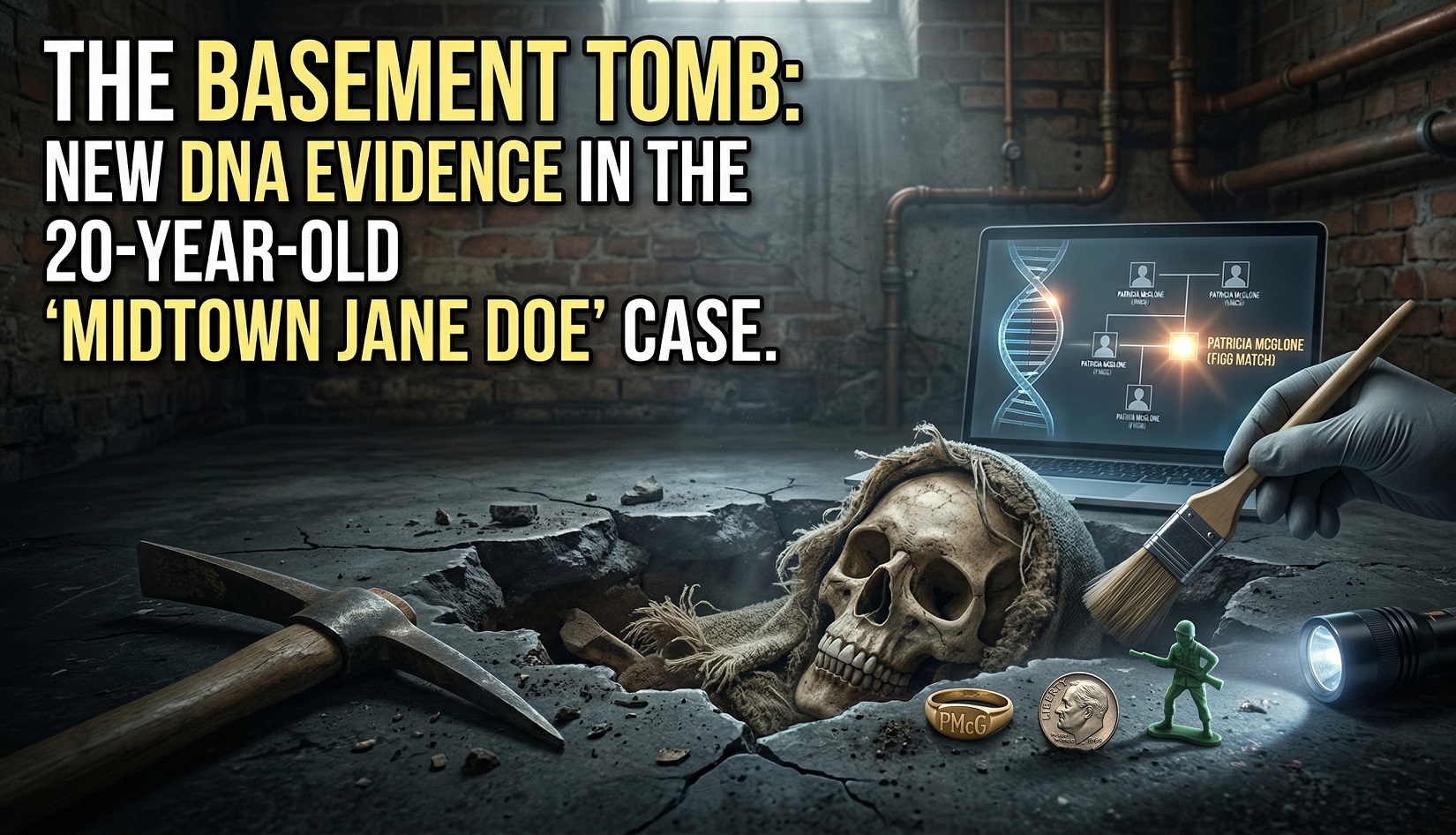
In February 2003, construction workers demolishing a dilapidated building in Hell’s Kitchen swung a sledgehammer into a concrete floor, expecting nothing but dust and rubble. Instead, a human skull rolled out from beneath the slab. Encased in a cement “tomb” in the basement of what was once a legendary 1960s rock club, the remains were hogtied with electrical cords and wrapped in a piece of old carpet. For over two decades, the victim was known only as “Midtown Jane Doe”—a ghost from New York City’s grittiest era.
Fast forward to April 2026, and the silence surrounding this concrete-encased mystery has finally been broken. Thanks to a stunning breakthrough in forensic investigative genetic genealogy, the NYPD Cold Case Squad has officially given “Jane Doe” her name back: Patricia Kathleen McGlone.
In this deep dive, we explore how a 55-year-old cold case was cracked open using DNA from a 9/11 victim’s mother and what this means for the search for her killer. Whether you’re a true crime junkie or a tech enthusiast, the story of Patricia McGlone is a masterclass in how modern science is rewinding the clock on justice.
1. The Concrete Discovery: A Time Capsule of Horror
The building at 301 West 46th Street wasn’t just any basement; in the late 1960s, it housed Steve Paul’s The Scene, a nightclub where icons like Jimi Hendrix and Jim Morrison once performed. When the building was being cleared for a new hotel in 2003, workers found Patricia’s remains in a fetal position, preserved by the very concrete intended to hide her forever.
The Clues Left Behind
Investigators originally had very little to go on. Inside the “tomb,” they found:
- A 1969 Dime: This provided the earliest possible date for her death.
- A Pinky Ring: A small gold ring with the initials “PMcG” engraved on it.
- A Plastic Toy Soldier: A strange, haunting item found mixed with the carpet fibers.
Despite these physical clues, the case went cold for 20 years. Traditional DNA databases (CODIS) didn’t have a match because Patricia had never been arrested, and she was never officially reported missing by her family in 1969. She simply vanished from the face of the Earth at just 16 years old.
2. The 9/11 Connection: How Genealogists Cracked the Code
The breakthrough that identified Patricia McGlone in 2024—and led to the final evidentiary filings this April 2026—came from an incredibly unlikely source: the tragic events of September 11, 2001.
The Twist in the DNA
NYPD investigators, led by Detective Ryan Glas, utilized Forensic Investigative Genetic Genealogy (FIGG) to build a massive family tree. They discovered a distant maternal cousin, but there was a problem—the cousin had already passed away. However, the cousin’s son revealed a crucial detail: his mother had submitted a DNA swab decades earlier.
- Why was the DNA on file? She had submitted it to help identify her own daughter, who had tragically died in the 9/11 terror attacks.
- The Match: When investigators compared the “9/11 reference sample” to the remains found in the Hell’s Kitchen basement, the markers lined up perfectly.
From Jane Doe to Patricia McGlone
Patricia was a “runaway and a truant” from Sunset Park, Brooklyn. She had attended Catholic school and was a baptized member of the church before her life took a dark turn. By identifying her, police were able to finally look into her life in 1969—leading them to a primary suspect who had been hiding in plain sight for half a century.
3. The Primary Suspect: A Shadow in the Basement
Identifying Patricia allowed detectives to reconstruct her final months in 1969. They discovered that the 16-year-old had entered into a marriage with a man more than twice her age—a musician named Donald Grant.
Why He is the Focus
As of April 2026, the NYPD has released new findings regarding Grant’s connection to the crime scene:
- The Residence Match: Marriage records show that Donald Grant lived at 301 West 46th Street in 1969—the exact building where Patricia’s remains were found encased in the basement floor.
- The Vanishing Act: City records show Grant lived in the building in 1969 but vanished from all registries by 1970, just as Patricia disappeared.
- The Access Point: Grant was a regular at Steve Paul’s The Scene, the club in the basement. He had intimate knowledge of the building’s layout, including the trap doors and secluded sections of the basement that were under construction.
The “Fetal Position” and the Toy Soldier
The most chilling part of the discovery was that Patricia was buried in a calculated way. The presence of the green plastic toy soldier led investigators to believe she may have given birth or been pregnant at the time of her death. Cold case detectives are currently searching for records of a child born to McGlone and Grant in 1968 or 1969, believing that child—now in their late 50s—could be the final key to the motive.
4. Common Mistakes in Tracking Cold Case History
When following a story this old, it’s easy to get lost in the “urban legends” of 1960s New York. Avoid these common misconceptions:
- Confusing “The Scene” with the Murder: While the building housed a famous rock club, there is no evidence the club’s management or the famous musicians who played there were involved. The murder likely happened in the residential apartments or utility areas above the club.
- Assuming CODIS is the Only Database: Many people think DNA matches happen instantly like on CSI. Mistake: Patricia was never in the national criminal database. Without Investigative Genetic Genealogy (IGG) and the voluntary 9/11 family sample, she would still be “Jane Doe” today.
- The “Cement Myth”: People often think cement “destroys” DNA. In reality, being encased in concrete actually preserved Patricia’s skeletal remains by protecting them from moisture and soil bacteria, allowing for the high-quality genetic profile 20 years later.
5. Pro Tip: How to Support Investigative Genealogy
Pro Tip: If you have an unsolved mystery in your own family tree, consider uploading your DNA profile to GEDmatch or FamilyTreeDNA and opting into “Law Enforcement Discovery.” Unlike private sites (Ancestry/23andMe) which require specific warrants, these databases allow genealogists to compare unidentified remains against distant relatives. Your one kit could be the “9/11 sample” that solves the next cold case.
6. Frequently Asked Questions (FAQs)
Was Patricia Kathleen McGlone ever reported missing?
No. Because she was a known runaway and truant with a transient lifestyle, her family never filed an official police report. This is why she remained unidentified for so long.
Is Donald Grant still alive in 2026?
Police have not officially confirmed his status. However, if alive today, he would be in his late 80s or early 90s. Tracking him down has been the primary challenge for the NYPD Cold Case Squad.
What happened to the green toy soldier?
It remains in the NYPD evidence locker. It is considered a “signature” item that suggests the killer had a specific, perhaps remorseful or symbolic, reason for placing it with her.
Conclusion: Justice Delayed, But Not Denied
The story of Patricia McGlone is a testament to the fact that no basement is deep enough to hide the truth forever. In 2026, we are witnessing the final chapter of a 55-year-old mystery, where 1960s grit met 21st-century science. By identifying Patricia, the NYPD didn’t just solve a puzzle; they restored dignity to a 16-year-old girl who had been forgotten in a concrete tomb.
As the search for her killer reaches its peak this April, it serves as a warning to those who think they have gotten away with the unthinkable: the dead can still speak, and science is finally listening.
ViralZip.blog is powered by a dedicated team of digital analysts and tech journalists committed to “zipping” through the noise of the information age. With a combined background in investigative research and financial data analysis, our contributors focus on the intersection of emerging AI technology, local economic shifts, and global news trends. We take pride in translating complex data into actionable insights for modern residents across the US and UK. Our mission is to provide high-velocity, reliable information that empowers our readers to navigate the rapidly evolving landscape of 2026.
Disclaimer: The content provided on ViralZip.blog is for informational and educational purposes only. While we strive for accuracy, the fields of artificial intelligence, financial rebates, and medical technology are subject to rapid changes; therefore, we do not guarantee the completeness or absolute reliability of the information provided. This content does not constitute professional financial, medical, or legal advice. Always consult with a licensed professional—such as a financial advisor, doctor, or attorney—before making significant decisions based on trending data. ViralZip.blog is not responsible for any actions taken or outcomes achieved based on the suggestions provided in our articles.