Imagine the world going dark in an instant. No Netflix, no international banking, and a sudden, freezing halt to the gas heating your home. While we often think of “the cloud” as something floating in the sky, the reality of our modern life actually lies in thousands of miles of fragile fiber-optic cables snaking across the cold, dark floor of the Atlantic Ocean.
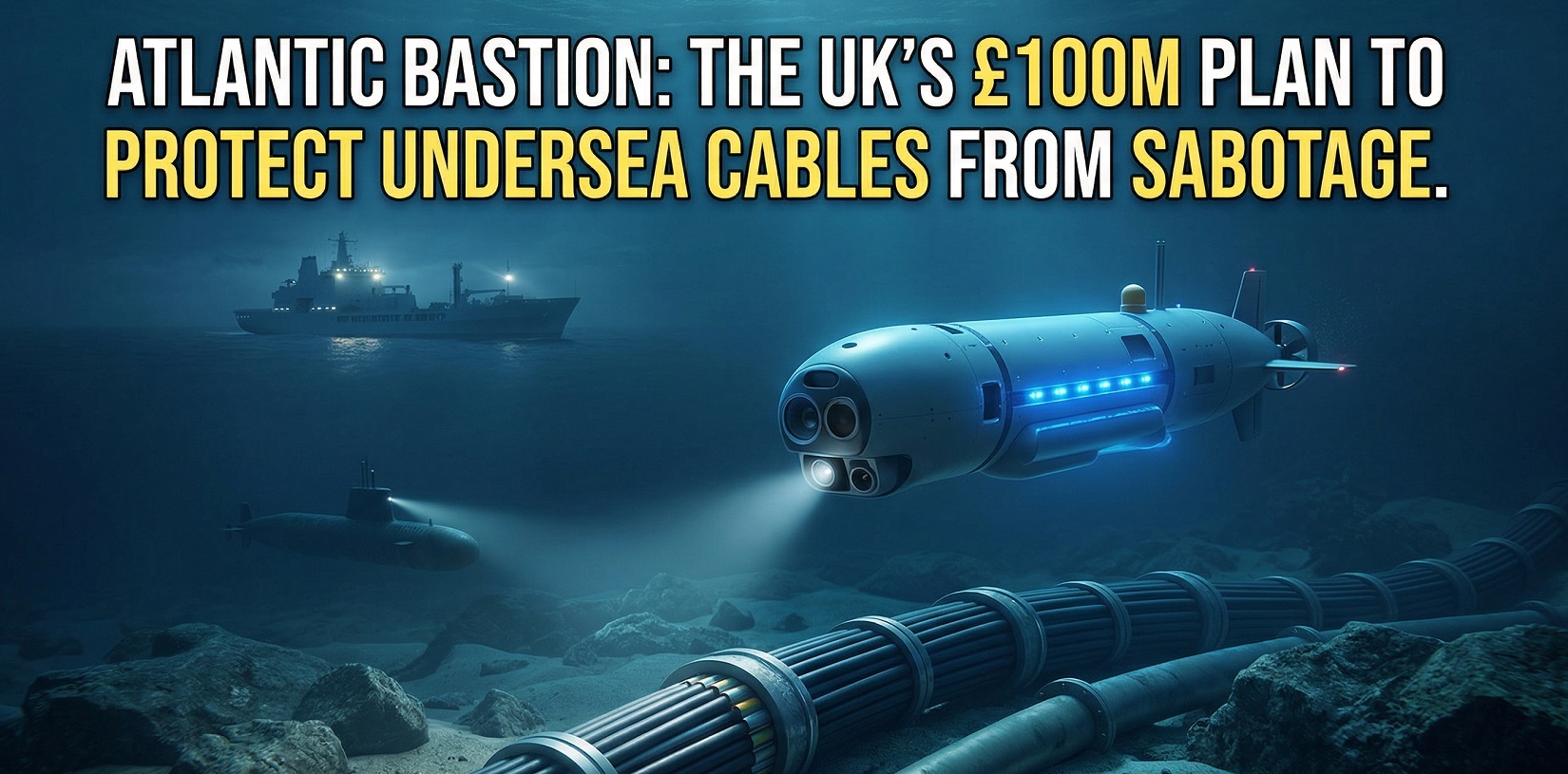
This month, the UK Ministry of Defence (MoD) pulled back the curtain on a massive operation that feels like a scene from a Tom Clancy novel. After tracking Russian “spy” submarines for over 30 days near critical infrastructure, Defense Secretary John Healey announced Atlantic Bastion: a £100 million surge to build a “hybrid naval force” specifically designed to guard these undersea lifelines.
In this deep dive, we’re exploring why the seabed has become the newest front line in global security. Whether you’re a tech enthusiast or just a taxpayer wondering where that £100M is going, here is everything you need to know about the wall being built beneath the waves.
1. Why the MoD is Deploying a “Hybrid Naval Force”
The term “Hybrid Naval Force” sounds like a futuristic fleet, and in many ways, it is. Historically, defending our waters meant sending out massive frigates and destroyers. But you can’t fight a silent, invisible threat on the seabed with just a big ship and a deck gun.
The Shift to Autonomous Sentinels
The £100 million investment isn’t just buying more of the “same.” It’s a pivot toward a blend of human expertise and machine persistence:
- Autonomous Submersibles: Think of these as underwater drones. They can stay submerged for weeks, patrolling cable routes and detecting the “clink” of a submarine trying to attach a tap or a cutter.
- P-8 Poseidon Upgrades: A significant chunk of the funding is going toward the RAF’s P-8 “Submarine Hunters.” These aircraft drop specialized sonar buoys that create an acoustic net, making it impossible for “ghost” subs to hide.
- RFA Proteus: This is the flagship of the operation—a “mothership” for underwater robots. It’s a commercial vessel converted into a high-tech hub that can launch and recover uncrewed systems even in the brutal storms of the High North.
The Real-Life Threat: The GUGI Factor
The Ministry of Defence specifically named GUGI—Russia’s Main Directorate for Deep-Sea Research. These aren’t standard military units; they are specialized scientists and saboteurs who operate “spy ships” like the Yantar. Their goal isn’t to start a war, but to conduct “Hybrid Warfare”—damaging a cable and claiming it was just a “fishing anchor accident” to disrupt the UK economy without firing a single shot.
2. The High Stakes: 99% of Your Life is Underwater
It is a common misconception that our internet comes from satellites. While Starlink is great for remote areas, 99% of all international data traffic travels through undersea cables.
What’s Actually at Risk?
- The Economy: Trillions of pounds in global trade move through these cables every single day. If the transatlantic links are severed, the London Stock Exchange and your local ATM both stop working.
- Heating and Energy: It’s not just data. Undersea pipelines provide roughly half of the gas used to heat UK homes. Sabotage here doesn’t just cut the internet; it leaves millions in the cold.
- The “Shadow” Threat: The MoD revealed that Russian Akula-class attack submarines were recently shadowing these pipelines for over a month. The goal? To map the exact “weak points” where a single charge could cause maximum damage.
By launching Atlantic Bastion, the UK is moving from a posture of “monitoring” to one of “active deterrence.” As the Defense Secretary put it to President Putin this week: “We see you.”
3. The “Arctic Sentry” Mission: Why Now?
The timing of Atlantic Bastion isn’t accidental. In the first quarter of 2026, UK Defence Intelligence reported a 30% spike in Russian naval activity in the “GIUK Gap”—the strategic naval passage between Greenland, Iceland, and the UK.
The “Yantar” Incident
Just last month, the MoD tracked the Russian spy ship Yantar hovering directly over the TAT-14 cable—a massive fiber-optic artery that connects the UK to New Jersey. The Yantar is unique because it isn’t a combat ship; it’s a “research” vessel equipped with deep-sea submersibles that can:
- Tap into data lines to siphon sensitive government communications.
- Map “stress points” where a single explosive charge could cause a months-long outage.
- Test response times of the Royal Navy’s current fleet.
Deterrence by Exposure
The £100M plan shifts the UK’s strategy to “Deterrence by Exposure.” By deploying the new hybrid force, the UK is telling the world—and specifically Moscow—that the deep sea is no longer a place to hide. If a Russian Akula-class submarine even brushes against a gas pipe, the MoD’s AI-powered acoustic net will alert Downing Street before the sub can even turn around.
4. Practical Tips for Digital Resilience
While the Navy handles the deep-sea defense, there are things you should do at home to prepare for a “Worst-Case Scenario” where undersea infrastructure is compromised.
- Invest in Starlink (as a Backup): Because Starlink uses a satellite constellation, it is one of the few ways to stay online if the undersea fiber-optic cables are severed.
- Download “Offline” Maps: Ensure you have your local region’s maps downloaded on your phone. In a cable blackout, GPS hardware still works, but the “data” to load the map tiles will not.
- Physical Backups: If you rely on “The Cloud” (Google Drive, iCloud) for business, keep a local encrypted SSD backup. Undersea cable sabotage could make cloud access intermittent or impossible for weeks.
- Analog Emergency Kit: Keep a battery-powered FM/AM radio. If the internet fails, traditional radio waves will be the government’s primary way to communicate with the public.
5. Pro Tip: The “Diversify Your Data” Rule
Pro Tip: Don’t rely on a single point of failure. In 2026, “Geographic Diversity” is key. If your business server is in London, ensure your backup is in a different region, like the US or Singapore. This ensures that even if a major Atlantic cable is cut, your data can still be “routed around” the damage using alternative undersea paths.
6. Common Mistakes to Avoid
- Assuming Satellites Can Handle Everything: Many people think that if the cables go, satellites will save us. Mistake: Satellites currently handle less than 1% of global traffic. They are a “safety net,” not a replacement for high-speed fiber.
- Ignoring “Cable Landing Stations”: People often worry about the middle of the ocean, but the most vulnerable points are where cables come ashore (like in Cornwall). Mistake: Not knowing where your local infrastructure enters the country.
- Panic Buying Tech: In a crisis, people rush to buy satellite phones. Mistake: Waiting until a blackout happens. These devices require active subscriptions and clear sky views; set them up before you need them.
7. Frequently Asked Questions (FAQs)
Can a single submarine really shut down the whole UK internet?
Not entirely. The UK has over 60 undersea cables. However, cutting just the 3 or 4 largest “backbone” cables would cause massive slowdowns and collapse the banking systems that rely on millisecond-fast connections.
Is £100 million enough to protect the whole Atlantic?
It’s a start. This funding is specifically for the “Atlantic Bastion” hybrid force (drones and AI). It’s designed to act as an early-warning tripwire, not a physical wall across the entire ocean.
Has any cable actually been cut recently?
In 2024 and 2025, several cables in the Baltic Sea and near Taiwan were “accidentally” cut by anchors. The MoD believes these were “dry runs” for larger-scale sabotage.
Securing the Invisible Front Line
The £100M Atlantic Bastion plan is more than just a military budget line; it’s a recognition that our modern way of life is physically tethered to the ocean floor. By using AI, drones, and elite naval units, the UK is ensuring that the internet remains “invisible” to us and “exposed” to those who wish to harm it.
The ocean may be deep, but the UK’s new hybrid force is proving that there is nowhere left for saboteurs to hide.
ViralZip.blog is powered by a dedicated team of digital analysts and tech journalists committed to “zipping” through the noise of the information age. With a combined background in investigative research and financial data analysis, our contributors focus on the intersection of emerging AI technology, local economic shifts, and global news trends. We take pride in translating complex data into actionable insights for modern residents across the US and UK. Our mission is to provide high-velocity, reliable information that empowers our readers to navigate the rapidly evolving landscape of 2026.
Disclaimer: The content provided on ViralZip.blog is for informational and educational purposes only. While we strive for accuracy, the fields of artificial intelligence, financial rebates, and medical technology are subject to rapid changes; therefore, we do not guarantee the completeness or absolute reliability of the information provided. This content does not constitute professional financial, medical, or legal advice. Always consult with a licensed professional—such as a financial advisor, doctor, or attorney—before making significant decisions based on trending data. ViralZip.blog is not responsible for any actions taken or outcomes achieved based on the suggestions provided in our articles.