
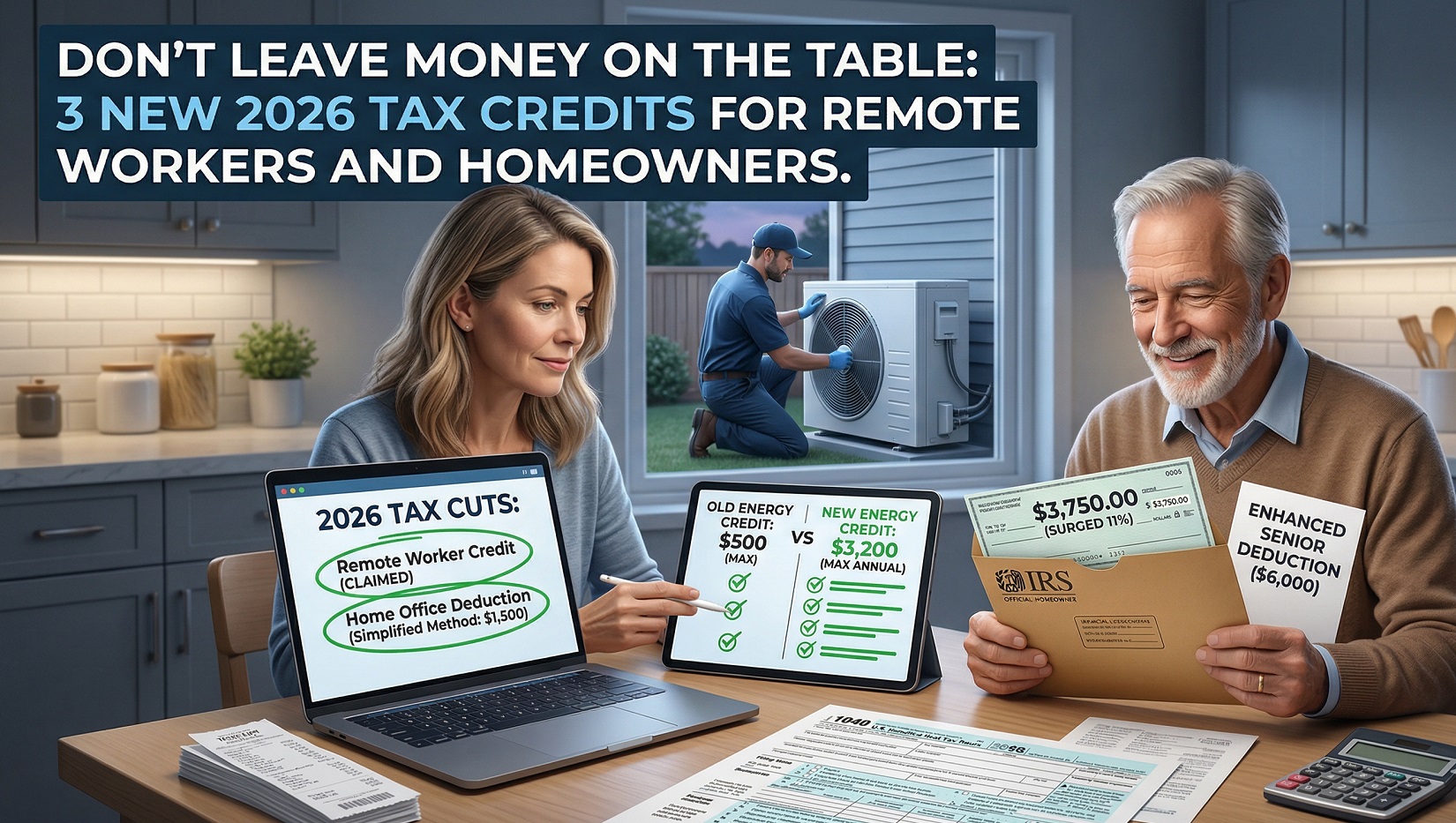
If you feel like your paycheck has been shrinking lately, there is finally some light at the end of the tunnel. This April, millions of Americans are discovering that the 2026 tax season isn’t just another year of paperwork—it’s the debut of the Working Families Tax Cuts, a massive legislative overhaul designed to put thousands of dollars back into your pocket.
Early IRS data shows that nearly half of all returns filed so far have claimed at least one of these new “Trump Era” credits, with the average refund surging toward $3,750. Whether you’ve spent the year working from your kitchen table or upgrading your home’s efficiency, the window to claim your share is closing fast.
In this guide, we’re breaking down the three “heavy hitters” of 2026: the revolutionary overtime exemption, the expanded senior bonus, and the homeowners’ green energy windfall. Here is how to make sure you get every cent you’re owed before the April 15 deadline.
1. The “Blue-Collar Bonus”: No Tax on Overtime
For the first time in modern history, the IRS is rewarding the “grind.” Under the 2026 rules, millions of hourly employees are eligible for the No Tax on Overtime provision. If you worked more than 40 hours in a week last year, a significant chunk of that extra pay might be completely tax-free.
How Much Can You Save?
This isn’t just a small deduction; it’s a full exemption on the “premium” portion of your pay.
- The Math: If you earned “time-and-a-half,” the IRS now allows you to exclude that extra “half” from your taxable income, up to a limit of **$12,500** ($25,000 for married couples).
- The Impact: For a typical worker in a 22% tax bracket, maximizing this credit could mean an extra $2,750 added directly to your refund check.
Who Qualifies?
While originally aimed at manufacturing and trades, the rule applies to any hourly, non-exempt worker. This includes many remote customer service reps and administrative assistants who are paid hourly rather than on a fixed salary. Check your W-2 for “Box 14”—many employers are now specifically labeling these earnings as “QUAL OT” to make filing easier for you.
2. The $3,200 Homeowner Windfall: Energy Efficient Upgrades
If you invested in your home’s infrastructure last year, the government is ready to pay you back. The 2026 Energy Efficient Home Improvement Credit has been supercharged, offering up to $3,200 annually—and unlike older credits, this one doesn’t have a lifetime limit.
Breaking Down the Credits
You can stack multiple upgrades in a single year to reach the maximum payout:
- Heat Pump Technology: Claim 30% of the cost, up to $2,000, for installing an air-source heat pump or a heat pump water heater.
- Home Envelope Upgrades: Claim up to **$1,200** for “smaller” fixes like high-efficiency windows ($600 cap), exterior doors ($500 cap), and professional insulation.
- Home Energy Audits: You can even claim 30% of the cost (up to $150) for a professional audit to find out where your home is leaking money.
Real-Life Example: The “Comfort” Credit
Imagine a homeowner who spent $6,000 on a new energy-efficient heat pump and $1,500 on new attic insulation. Under the 2026 rules, they would receive the full $2,000 credit for the heat pump and a $450 credit for the insulation (30% of $1,500). That’s **$2,450 off their tax bill**, effectively turning a major home repair into a government-subsidized upgrade.
3. The Remote Worker’s “Hidden” Deductions
While the federal government still largely restricts the Home Office Deduction to the self-employed (freelancers, side-hustlers, and contractors), 2026 has introduced a major shift for W-2 employees at the state level.
The State-Level Surge
States like Indiana, Kansas, and Michigan have launched aggressive “Remote Recruitment” credits. If you moved to a participating community in 2025 to work remotely, you may be eligible for:
- Relocation Credits: Some states are offering up to $5,000 in direct tax credits (not just deductions) to offset the cost of moving your “home office” to their jurisdiction.
- The “Dedicated Workspace” Rule: For those who are self-employed, the 2026 Simplified Method remains at $5 per square foot (up to 300 sq. ft.). However, the OBBBA now allows you to “stack” this with new broadband subsidies—letting you deduct a larger portion of your high-speed internet costs if you can prove it’s a “critical business utility.”
Real-Life Tip: The 100% Rule
To claim any home office deduction in 2026, the space must be used exclusively for work.
Example: A desk in your guest room only counts if that room is never used for guests. If you have a dedicated shed or converted garage (“The She-Shed Office”), you can often use the Regular Method to deduct 100% of the repairs made specifically to that structure.
4. The Senior “Golden” Deduction: $6,000 Extra
If you are 65 or older, 2026 is officially your year. One of the most talked-about features of the new law is the Enhanced Senior Deduction, which is designed to help retirees keep more of their fixed income.
How the Senior Boost Works
This new deduction is in addition to the existing higher standard deduction for seniors. If you were 65 by December 31, 2025, you can claim:
- A $6,000 additional deduction for single filers.
- A $12,000 additional deduction if you are married filing jointly and both spouses are 65+.
The Income “Sweet Spot”
To keep the benefit focused on those who need it most, this deduction phases out for higher earners.
- Single Seniors: Full deduction is available for those with a Modified Adjusted Gross Income (MAGI) up to $75,000.
- Married Seniors: Full deduction up to $150,000 MAGI.
For a senior couple in the 22% bracket, this change alone can result in a tax cut of up to $2,640, significantly bloating their final 2026 refund.
5. Pro Tip: The “W-2 to 1099” Hybrid Strategy
Pro Tip: If you are a remote W-2 employee and feel like you’re missing out on the best home office deductions, consider starting a small “side hustle” (Consulting, Etsy, etc.) from that same office. By reporting even a small amount of 1099 income on a Schedule C, you unlock the ability to deduct your home office, equipment, and a portion of your utilities against that income—legally bypassing the W-2 restrictions.
6. Common Mistakes to Avoid in 2026
- Forgetting the “Qualified OT” Box: If you worked extra shifts, don’t just enter your total wages. Ensure you (or your software) specifically identify the Box 14 “QUAL OT” amount to trigger the overtime tax exemption.
- The “Commuter” Confusion: Just because you work from home doesn’t mean your trip to the main office is deductible. Mistake: Claiming mileage for “occasional” office visits. These are still considered personal commutes by the IRS.
- Ignoring State Conformity: States like California and North Carolina are “Fixed-Date” states, meaning they haven’t adopted all the OBBBA changes yet. Mistake: Assuming your state refund will increase as much as your federal one.
7. Frequently Asked Questions (FAQs)
Can I claim the Home Energy Credit if I rent my home?
Generally, no. Most energy credits are reserved for the person who pays for the upgrade (the homeowner). However, “Enabling” upgrades like smart thermostats or portable heat pumps might qualify if you have a long-term lease.
Do I need receipts for the $3,200 Energy Credit?
Absolutely. You don’t send them to the IRS, but you must keep them for 7 years. You’ll specifically need the Manufacturer’s Certification Statement for each item.
What happens if I turn 65 on January 1st, 2026?
You’re in luck! The IRS considers you to be 65 on the day before your birthday. So, if your birthday is Jan 1, 2026, you count as 65 for the entire 2025 tax year.
Conclusion: Don’t Leave Your Refund on the Table
The 2026 tax season is a rare “double win” for American households. Between the $3,200 Homeowner Credit and the $6,000 Senior Deduction, the “Working Families Tax Cuts” are finally delivering on the promise of a lighter tax burden.
Whether you’re filing for the first time or the fiftieth, take the extra hour this week to dig into your W-2 for that overtime bonus and check your state’s remote worker rules. That extra $3,000 isn’t just a number—it’s your money, and it’s time to bring it home.
ViralZip.blog is powered by a dedicated team of digital analysts and tech journalists committed to “zipping” through the noise of the information age. With a combined background in investigative research and financial data analysis, our contributors focus on the intersection of emerging AI technology, local economic shifts, and global news trends. We take pride in translating complex data into actionable insights for modern residents across the US and UK. Our mission is to provide high-velocity, reliable information that empowers our readers to navigate the rapidly evolving landscape of 2026.
Disclaimer: The content provided on ViralZip.blog is for informational and educational purposes only. While we strive for accuracy, the fields of artificial intelligence, financial rebates, and medical technology are subject to rapid changes; therefore, we do not guarantee the completeness or absolute reliability of the information provided. This content does not constitute professional financial, medical, or legal advice. Always consult with a licensed professional—such as a financial advisor, doctor, or attorney—before making significant decisions based on trending data. ViralZip.blog is not responsible for any actions taken or outcomes achieved based on the suggestions provided in our articles.