Category: Finance & Rebates | Published: April 13, 2026 | Read time: ~12 minutes
You didn’t get a letter. There was no announcement on the evening news. Nobody knocked on your door and said, “By the way, we’ve added a few hundred dollars to your annual cost of living.”
It just happened. At the checkout. On your receipt. In the price that looked almost the same as last month — but wasn’t.
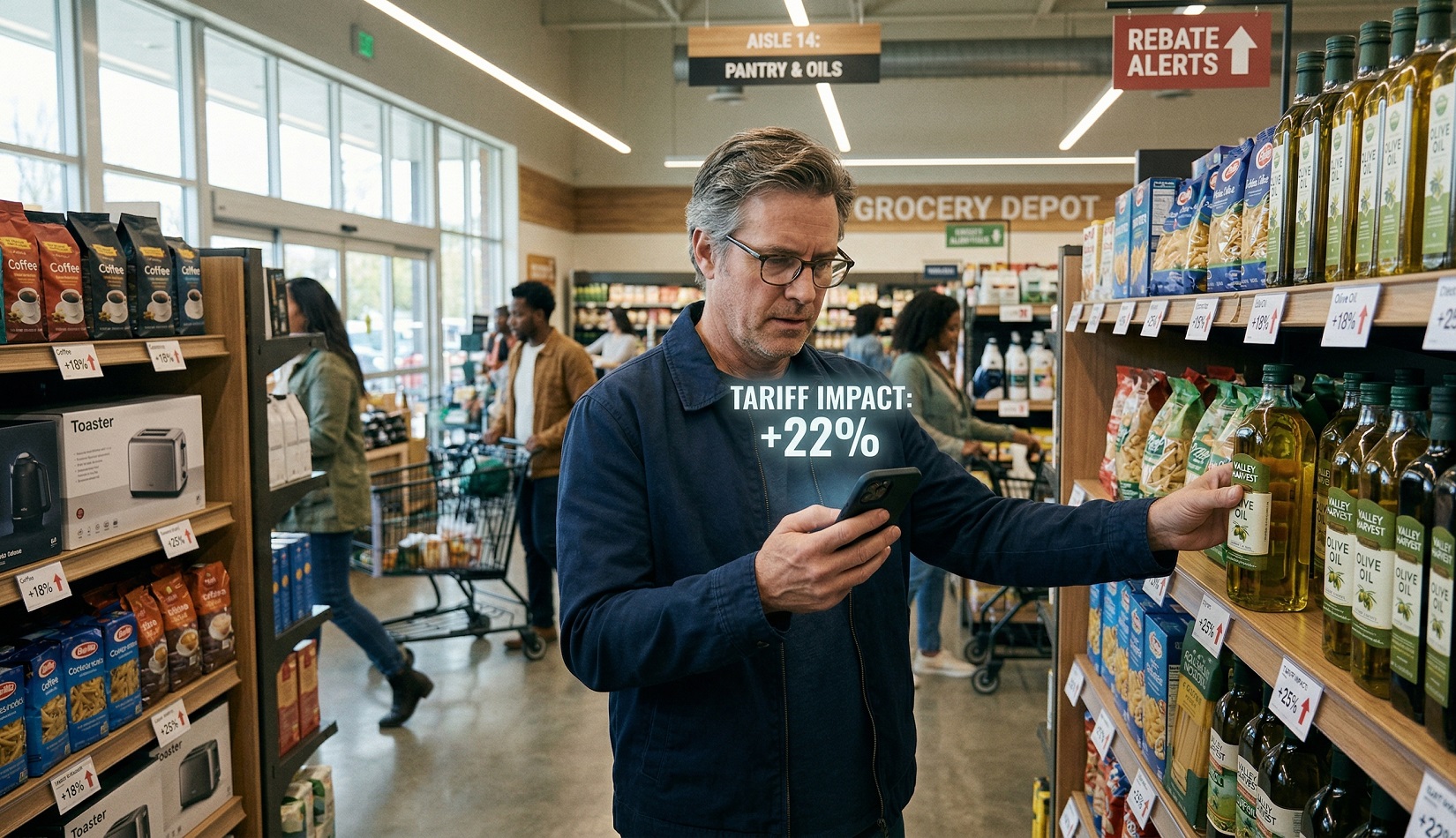
Since early 2025, a rolling wave of US import tariffs has been reshaping the price of almost everything that crosses a border into America. Some of the increases were loud and obvious. Others were gradual, quiet, and deliberately hard to notice — passed on incrementally as retailers burned through pre-tariff inventories, then adjusted prices one product at a time.
By April 2026, the picture has become substantially clearer. Harvard economists tracking real-time retail barcode data found that tariffs had raised retail prices of imported goods by approximately 7 percentage points relative to the pre-tariff trend before the Supreme Court’s February 2026 ruling on IEEPA — with specific categories hit dramatically harder. And that was before new Section 232 tariffs on pharmaceuticals were announced on April 2, 2026.
The Trump tariffs are, according to the Tax Foundation, the largest US tax increase as a percent of GDP since 1993, amounting to an average tax increase per US household of $1,500 in 2026.
This is the shopping list of what got hit — how hard, what it’s actually costing you, and critically: what rebates, programmes, and alternatives exist right now that can claw some of that money back.
The Tariff Timeline: Why April 2026 Is the Moment to Pay Attention
The consumer price story of 2025–2026 has three distinct phases, and understanding them tells you why prices are still climbing now even though some tariffs have been struck down.
Phase one — early 2025 — saw retailers absorb the initial shock. Pre-tariff inventories were full, uncertainty was high, and brands were reluctant to raise prices aggressively for fear of backlash. Prices began increasing a few months after tariffs were implemented; tariff-induced price increases appeared as a pattern of gradual and slow adjustments to retail prices on store shelves, rather than a one-time spike.
Phase two — mid to late 2025 — was the slow burn. Pre-tariff stocks depleted. Goldman Sachs estimated that the consumer share of tariff costs would climb from 55% in mid-2025 toward 70% in 2026 as inventories depleted and contracts renegotiated. Americans who felt broadly fine through last summer are now, in April 2026, facing the full weight of costs retailers could no longer absorb.
Phase three — now — adds a new complexity. The Supreme Court struck down the IEEPA tariffs in February 2026, removing roughly three-quarters of the tariffs Trump imposed in 2025. But the White House immediately replaced them with new Section 122 tariffs of 10% on most imports, and added new Section 232 tariffs on pharmaceuticals — with rates of up to 100% — on April 2, 2026.
The Yale Budget Lab currently places the US average effective tariff rate at 11.0%, the highest since 1943 (excluding 2025). The average US household faces a real income loss of approximately $1,681 this year as a direct result.
The Hidden Price List: What’s Actually Cost More and By How Much
These aren’t estimates or warnings. These are the real numbers from Harvard Business School’s Pricing Lab, Tax Foundation analysis, Yale Budget Lab research, and Bureau of Labor Statistics data — tracking actual retail prices paid by real households in 2025 and into 2026.
Clothing and Apparel: The Biggest Hidden Hit
If there’s one category where tariffs have been most brutally felt — and most quietly passed on — it’s clothing.
Harvard’s real-time retail data shows clothing prices up 17.5 percentage points relative to pre-tariff trends by February 2026. The Yale Budget Lab found apparel prices rising 17% under all 2025 tariff actions combined. Tax Foundation analysis identified apparel at 8.99 percentage points above pre-tariff baseline.
What does this mean in practice? A pair of trainers that cost £60 / $75 in early 2024 now costs the equivalent of £70 / $88, and that’s on top of ordinary price inflation. Brands that manufacture in Vietnam (where the US imposed tariffs of up to 46%), China, and Bangladesh are all affected.
Major brands confirmed the impact directly. UBS estimates a 10–12% increase in prices of goods from Vietnam, where Nike produces half its footwear. Columbia Sportswear executives said in an earnings call that the retailer plans to raise prices for spring and fall merchandise by a “high single-digit percent.” H&M’s CEO said US tariffs would ultimately “come at the cost of the consumer.” Levi Strauss confirmed it “implemented additional pricing actions to further mitigate tariffs.”
Clothing accessories — hats, scarves, gloves, belts — saw particularly sharp increases, alongside jewelry and watches.
What to do about it: Shop secondhand via ThredUp, Poshmark, or Facebook Marketplace in the US; Vinted, Depop, or eBay in the UK. These platforms are entirely unaffected by import tariffs and offer brand-name and designer items at 20–80% below retail. For children especially — who outgrow clothing faster than it wears out — secondhand is nearly always the smarter choice regardless of tariffs.
Furniture and Home Goods: The Category Nobody Warned You About
Furniture ranks among the most severely tariff-affected categories, partly because so much of it is manufactured in China, Vietnam, and Southeast Asia — precisely the regions targeted by the steepest US import levies.
Harvard’s data shows furniture prices up 7.4 percentage points above pre-tariff baseline. The Federal Reserve Bank of St. Louis identified furniture and home furnishings as showing “clear increases in prices with a magnitude commensurate with their tariff exposure.” Household textiles — bedding, towels, curtains — are up 8 percentage points above baseline.
Trump specifically announced additional targeted tariffs on furniture in 2025: kitchen cabinets and bathroom vanities faced proposed tariff rates of 50%, while upholstered furniture faced 30%. These were paused at 10% at the end of 2025, but the underlying category remains exposed. The UK negotiated preferential 10% rates on timber and furniture, offering modest relief.
What to do about it: For large furniture, check Facebook Marketplace and local resale first. For home essentials like bedding and towels, buy British-made or European-manufactured alternatives where possible — the UK-EU supply chain is far less tariff-exposed than US-Asia routes.
Electronics and Appliances: The 18% Warning Nobody Talked About
This is the category where the numbers are most alarming — and where the available rebates are most generous.
The Yale Budget Lab estimates that consumer electronics prices will increase 18% in the short run from tariffs, with a long-run stabilisation around 5%. China accounts for 79% of US laptop and tablet imports and 78% of smartphone imports, according to the Consumer Technology Association. With China facing tariff rates that have ranged from 54% to over 100% at various points in 2025, the impact on electronics pricing is structural.
Consumer Reports’ chief economist found the largest appliance price increases in washers and dryers, dishwashers, and microwaves. Laptop prices rose 5 to 10% as of earlier data, with further increases expected as pre-tariff inventory depletes. SharkNinja, which manufactures in China and Southeast Asia, confirmed it would continue raising prices. Morningstar projects durable goods prices — electronics, toys, tools and small appliances — to rise 4.5% in 2026 alone, on top of increases already implemented.
What to do about it — US readers: This is where government rebates are most powerful. The Inflation Reduction Act’s Home Electrification and Appliance Rebates (HEEHRA) program — available through state energy offices — provides up to $8,000 in rebates for ENERGY STAR certified heat pumps and significant rebates for qualifying appliances. Specific rebate amounts from ENERGY STAR-certified programs include up to $840 for electric heat pump dryers, up to $840 for electric stoves and ovens, and up to $1,750 for heat pump water heaters. The federal 25C Energy Efficiency Tax Credit provides a 30% credit (up to $2,000) on qualifying heat pumps when you file taxes using IRS Form 5695.
Stack these with utility company rebates — many provide an additional $200–$500 on the same appliance purchase — and a qualifying appliance buy can be partially or substantially offset even at post-tariff prices. Use the ENERGY STAR Rebate Finder at energystar.gov/rebate-finder and enter your zip code to see all rebates available in your area.
What to do about it — UK readers: ENERGY STAR equivalent rebates aren’t available the same way, but the government’s Boiler Upgrade Scheme offers up to £7,500 toward air source heat pump installation. This is especially timely as appliance prices rise: replacing an aging boiler with a heat pump qualifies for this grant and locks in lower running costs before the July 2026 energy cap revision.
Coffee: The 33% Shock That Hit Overnight
If you buy ground coffee or coffee pods and felt like your grocery bill went up without understanding why, you weren’t imagining it.
Bureau of Labor Statistics data found coffee prices increased 33% in January 2026 compared to the prior year. Tax Foundation analysis identified coffee and tea at 7.5 to 10.0 percentage points above pre-tariff baseline. The average price of ground roast coffee across the US increased for ten straight months in 2025 — dropping slightly in December after tariffs on some major coffee exporters were temporarily removed, but continuing to rise in 2026 as new levies remained.
Coffee is primarily imported from Brazil, Colombia, Ethiopia, Vietnam, and Honduras — all of which faced either universal 10% tariffs or higher reciprocal rates. The cost of the beans translates directly into the cost of the bag, the pod, the takeaway cup, and the bag of loose-leaf tea sitting beside it.
What to do about it: Coffee is one of the few tariff-affected categories where grocery-switching has immediate impact. Store-brand and own-label ground coffee — even at premium supermarkets — is consistently 20–40% cheaper than branded equivalents for broadly similar quality. In the UK, this category is less directly affected by US tariff policy, but global commodity prices for coffee beans remain elevated, meaning the same switching strategy applies.
Beef, Meat, and Fresh Produce: The Grocery Bill Nobody’s Connecting to Trade Policy
Grocery inflation and tariff inflation are often presented as separate phenomena. They’re not.
Beef and veal prices are predicted to increase 9.4% in 2026 according to USDA’s Economic Research Service. Fresh vegetables are up around 2% for the year, with fresh produce overall rising 4% under all 2025 tariff actions according to Yale Budget Lab analysis. Food prices overall are expected to increase 2.6% in 2026, building on a 2.9% increase in 2025 and a 2.3% gain in 2024.
This is three consecutive years of above-average grocery inflation. Each year compounds the previous one. A household spending $500/month on groceries in 2023 is now effectively paying the equivalent of $540 or more for the same basket — and the tariff overlay means that trajectory isn’t reversing soon.
What to do about it: The USDA’s SNAP (Supplemental Nutrition Assistance Program) is the primary US rebate mechanism for lower-income households, but for middle-income families, the most direct route to grocery savings is loyalty programme stacking — Walmart+ savings, Target Circle, Kroger Digital Coupons, and store-brand switching all compound when used systematically. In the UK, Tesco Clubcard and Sainsbury’s Nectar deliver consistent 10–20% reductions on targeted grocery items and can be stacked with weekly deals.
Cars, Auto Parts, and Insurance: The Multi-Thousand Dollar Impact
Motor vehicle prices are up 8.4% under all tariff actions to date — equivalent to approximately $4,000 added to the price of an average new car. Trump imposed a 25% tariff on all passenger vehicle and light truck imports from 3 April 2025, and 25% tariffs on auto parts from 3 May 2025. The UK negotiated a quota of 100,000 vehicles at the 10% rate, but all vehicles beyond that quota face 25%.
The knock-on effects extend beyond the sticker price. Auto insurance premiums are expected to increase approximately 1–4% in 2026 as higher repair costs from tariffed parts are passed through. Replacing a windshield, bumper, or sensor module now costs meaningfully more than it did in 2024 because so many auto components are manufactured in tariff-exposed countries.
What to do about it: If a new car purchase is on your horizon, the math around timing has shifted significantly. For US buyers, consider whether a pre-owned certified vehicle at a lower tariff-baseline price delivers better value than a 2026 model-year vehicle with elevated pricing baked in. For both US and UK drivers, shopping insurance renewal aggressively using comparison platforms (Compare the Market, MoneySuperMarket in the UK; Insurify, The Zebra in the US) can recover $100–$400/year on premiums regardless of underlying rate pressure.
Toys and Children’s Products: The Category Parents Haven’t Been Warned About
Mattel confirmed that Hot Wheels, Barbie, and American Girl dolls will go up in price due to tariffs on China. Toys are overwhelmingly manufactured in China — approximately 80% of US toy imports originate there — meaning they faced some of the steepest tariff exposure of any consumer category.
Morningstar expects durable goods prices including toys to rise 4.5% in 2026. The Harvard Business School Pricing Lab identified “games, toys and hobbies” as showing significant price increases in its real-time tracking. Baby products — cribs, monitors, strollers, diapers — face elevated costs as tariffs on Chinese manufactured goods persist.
What to do about it: Facebook Marketplace, eBay, and dedicated local resale groups consistently yield toys, games, and baby equipment at 40–80% below retail. Children’s toys are underutilized the moment a child outgrows them; secondhand is rarely a quality compromise. In the US, children whose parents open a “Trump Account” — the new IRS-administered SECURE savings account created under the OBBBA — can benefit from up to $1,000 in government contributions that can eventually be withdrawn for qualified expenses.
Pharmaceuticals: The New April 2026 Wildcard
The most recent tariff announcement came on April 2, 2026, when Trump imposed Section 232 tariffs of up to 100% on patented pharmaceutical imports. This is the category still being absorbed into retail pricing as of mid-April 2026.
The IRS has created Notice 2026-05 expanding Health Savings Account (HSA) eligibility under the OBBBA — meaning more Americans can now contribute pre-tax dollars to cover medical and pharmaceutical costs. The OBBBA permanently extended the telehealth safe harbor for high-deductible health plans, and the maximum dependent care assistance exclusion rose to $7,500 in 2026, a meaningful increase in the context of rising healthcare product costs.
What to do about it: For Americans currently paying out-of-pocket for any recurring medications, check whether they qualify for manufacturer patient assistance programmes — most major pharmaceutical companies operate these. GoodRx and Blink Health continue to offer substantial discounts on many generic medications regardless of insurance status.
The Complete Rebate Playbook for 2026
US Federal and State Programmes
ENERGY STAR Federal Tax Credits. The 25C Residential Clean Energy Credit provides a 30% tax credit (up to $2,000) on qualifying heat pumps, heat pump water heaters, and energy-efficient appliances. This is a dollar-for-dollar reduction in your federal tax bill, not a deduction, filed via IRS Form 5695 at tax time. With appliance prices up 4–18% due to tariffs, this credit substantially offsets the tariff-inflated cost.
IRA Home Electrification Rebates (HEEHRA). States are administering rebates funded through the Inflation Reduction Act’s Home Electrification and Appliance Rebates programme. Qualifying amounts include up to $8,000 for ENERGY STAR heat pumps, up to $1,750 for heat pump water heaters, up to $840 for electric heat pump dryers and electric stoves, and up to $1,600 for insulation and air sealing. These are available directly at point of purchase through qualifying contractors. Use the Department of Energy’s Home Energy Rebates Portal to check your state’s programme status, and the ENERGY STAR Rebate Finder (energystar.gov/rebate-finder) for zip-code-specific availability.
Utility Company Rebates. Every US state has utility companies offering appliance rebate programmes independent of federal IRA funding. On the same qualifying appliance, it’s common to stack federal tax credits, state HEEHRA rebates, and utility rebates — one participant in Oregon reported three separate rebates on a single heat pump installation. These can be worth $200–$500 per qualifying appliance over and above the federal programmes.
OBBBA Health Savings Accounts. Under the OBBBA, HSA eligibility has been expanded. If you’re on a high-deductible health plan, maximising your HSA contribution (up to $4,300 for individuals, $8,550 for families in 2026) means pharmaceutical and medical costs come from pre-tax dollars — effectively a 22–37% discount on qualifying medical purchases depending on your tax bracket.
SNAP and LIHEAP. For lower-income households, SNAP (food assistance) and the Low Income Home Energy Assistance Program (LIHEAP) remain the most direct government offset to food and energy price inflation. Eligibility thresholds are periodically reviewed — check benefits.gov if you haven’t applied recently, particularly if household income has changed in the last 12 months.
UK Programmes
Warm Home Discount (£150). UK households in receipt of certain means-tested benefits may receive £150 off their electricity bill automatically. Payments should have arrived by 31 March 2026 — if you believe you qualified and didn’t receive it, contact your energy supplier or the Warm Home Discount helpline immediately.
Boiler Upgrade Scheme (up to £7,500). With appliance prices rising globally, the government’s grant of up to £7,500 toward air source heat pump installation represents one of the most generous consumer rebates currently available anywhere in the UK. Contact an MCS-certified installer for a free assessment.
ECO4 Insulation and Home Efficiency Grants. The ECO4 scheme provides free or subsidised loft insulation, cavity wall insulation, and energy efficiency improvements to qualifying households — particularly those receiving means-tested benefits or living in properties with an EPC rating of D or below. A properly insulated home saves an average of £280–£580/year on heating, making this one of the highest-return programmes available.
Council Tax Reduction. If your income has fallen or your household circumstances have changed, you may now qualify for a Council Tax reduction you weren’t entitled to before. Single occupant discount (25%), student exemption, carer discount, and means-tested Local Council Tax Support can reduce bills by hundreds of pounds annually. Apply directly through your local council’s website.
Universal Credit and Help to Save. UK residents on Universal Credit or Working Tax Credit can access the government’s Help to Save scheme, which pays a 50% bonus on up to £50/month of savings — a guaranteed 50% return, entirely government-backed. The maximum bonus over four years is £1,200.
10 Practical Money-Saving Alternatives Right Now
These don’t require paperwork, applications, or waiting for a rebate cheque. They’re habit changes that directly counteract tariff-driven price increases.
1. Store-brand switching on groceries. Aldi and Lidl in the UK consistently undercut branded equivalents by 20–35% on staples. Walmart Great Value, Target Good & Gather, and Kirkland (Costco) in the US offer equivalent savings. On a weekly shop of £100/$125, brand-switching alone saves £20–£35 per week.
2. Secondhand electronics. Refurbished smartphones, laptops, and tablets from Apple Certified Refurbished, Amazon Renewed, or Back Market are warranty-backed and typically 20–40% below new retail. In the current tariff environment, “refurbished” is increasingly just “smart.”
3. Local library systems for media, tools, and more. Libraries now commonly loan e-books, audiobooks, streaming access, video games, tools, and board games alongside physical books. The cost: zero. The tariff exposure: also zero.
4. Cashback stacking. In the UK, TopCashback and Quidco offer cashback on insurance, groceries, and online retail. In the US, Rakuten (formerly Ebates), Honey, and Ibotta provide cashback and coupons at thousands of retailers. Users who route purchases through these platforms consistently report £200–£500/year in cashback on spending they were making anyway.
5. Price-tracking browser extensions. CamelCamelCamel tracks Amazon price history. PriceSpy, Pricerunner, and Google Shopping alerts notify you when specific items hit price targets. In a tariff environment where prices are shifting rapidly, buying at the right moment matters more than ever.
6. Meal planning and batch cooking. With beef up 9.4% and non-durable food goods up 5.6%, the single most impactful kitchen habit is cooking once and eating three times. Meal planning before shopping (rather than shopping and then planning) consistently reduces food waste by 20–30% and grocery spend by a similar amount.
7. Energy tariff switching (UK). With the April 2026 price cap at £1,641/year for a typical household, checking whether your fixed tariff is competitive takes 10 minutes on MoneySavingExpert’s Cheap Energy Club and can save £100–£400/year depending on your current contract.
8. Tyre and auto parts alternatives. With auto parts tariffed at 25%, the price gap between OEM (original equipment manufacturer) branded parts and quality aftermarket alternatives has widened. Reputable aftermarket brands like Gates, Bosch, and Febi offer equivalent quality at lower cost — ask your mechanic specifically about aftermarket options.
9. Buy-in-bulk on non-perishables. Soap, shampoo, cleaning products, paper goods, and pantry staples are all facing upward price pressure from tariffs on Chinese and Southeast Asian manufactured goods. Buying in bulk at Costco, Sam’s Club, or via Amazon Subscribe & Save locks in current prices before further increases and typically delivers a 15–25% per-unit saving anyway.
10. Annual subscription reviews. Streaming services, gym memberships, subscription boxes — none of these are exempt from the general cost-of-living pressure. Many have raised prices in 2025–2026 independently of tariffs. An annual audit of every recurring charge and cancellation of anything scoring below 7/10 for value delivered is worth £200–£400 for most households.
The Bottom Line: What the Price Tag Doesn’t Tell You
Every time you tap your card or confirm an order, there’s a layer of policy embedded in the price that nobody labelled. The tariff isn’t listed on your receipt as a line item. It’s just absorbed into what things cost now.
The Yale Budget Lab puts the consumer impact at a real income loss of $1,681 per average US household in 2026. The Tax Policy Center puts the average household tariff burden at $1,050 for the year. However you calculate it, the range is $1,000 to $1,700 of purchasing power quietly removed from American families this year — with UK consumers feeling the secondary effects through global supply chain repricing.
The rebates in this article — federal tax credits, state appliance programmes, utility company rebates, UK government grants, and energy savings schemes — are real money that exists to help offset exactly these kinds of price pressures. Most of it goes unclaimed because nobody knows it’s there.
Now you know it’s there.
ViralZip.blog is powered by a dedicated team of digital analysts and tech journalists committed to “zipping” through the noise of the information age. With a combined background in investigative research and financial data analysis, our contributors focus on the intersection of emerging AI technology, local economic shifts, and global news trends. We take pride in translating complex data into actionable insights for modern residents across the US and UK. Our mission is to provide high-velocity, reliable information that empowers our readers to navigate the rapidly evolving landscape of 2026.
Disclaimer: The content provided on ViralZip.blog is for informational and educational purposes only. While we strive for accuracy, the fields of artificial intelligence, financial rebates, and medical technology are subject to rapid changes; therefore, we do not guarantee the completeness or absolute reliability of the information provided. This content does not constitute professional financial, medical, or legal advice. Always consult with a licensed professional—such as a financial advisor, doctor, or attorney—before making significant decisions based on trending data. ViralZip.blog is not responsible for any actions taken or outcomes achieved based on the suggestions provided in our articles. Rebate programmes, tariff rates, and government schemes change frequently. Always verify current availability at energystar.gov/rebate-finder (US), gov.uk (UK), and benefits.gov (US) before making purchasing decisions. This article is for informational purposes only and does not constitute financial or legal advice.
Sources: Yale Budget Lab — State of US Tariffs April 2, 2026; Tax Foundation — Trump Tariffs Raise Prices; Harvard Business School Pricing Lab (via Tax Foundation, March 2026); Federal Reserve — The Slow Climb, March 2026; USDA ERS Food Price Outlook 2026; Council on Foreign Relations — Tariffs and Affordability, February 2026; Morningstar via Talk Business & Politics, March 2026; GOBankingRates — Companies Predicting Price Increases; ENERGY STAR Rebate Finder; DOE Home Upgrades; OBBBA/IRS HSA Notice 2026-05; MoneySavingExpert — April 2026 Energy Bills; Citizens Advice UK — Energy Grants; British Chambers of Commerce — US Tariffs and UK Impact