
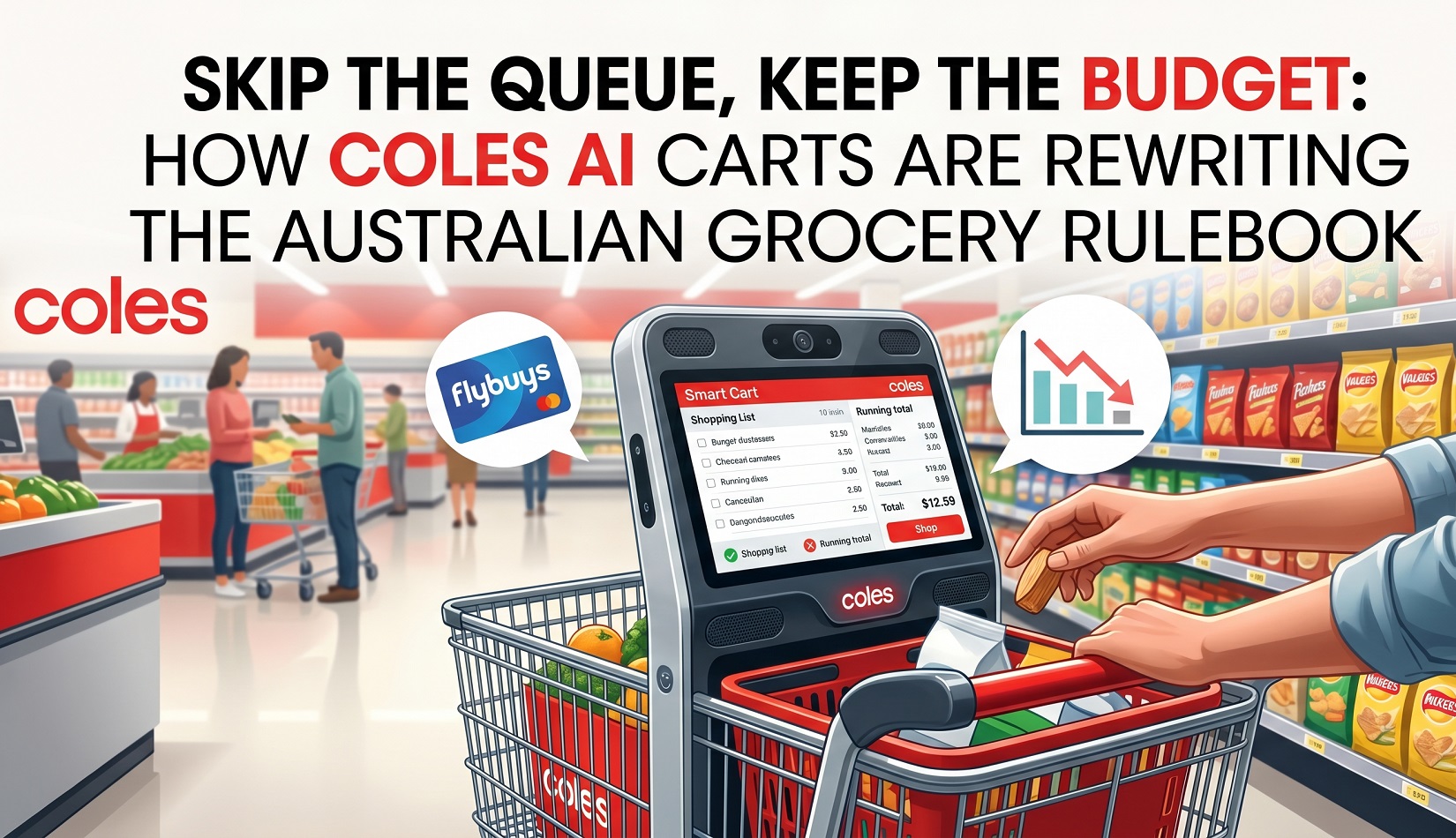
Skip the Queue, Keep the Budget: How Coles AI Carts are Rewriting the Australian Grocery Rulebook
The 5:30 PM “Coles Run” has long been a staple of Australian life—and a source of collective dread. You know the drill: navigating a sea of trolleys, playing “checkout roulette” to find the shortest line, and then manually scanning 40+ items while the self-checkout voice reminds you for the third time of an “unexpected item in the bagging area.” It feels like a second job you didn’t apply for and certainly aren’t getting paid to do.
But as of April 2026, the era of the checkout queue is officially on life support.
Through a high-stakes partnership with Instacart (which recently acquired the fulfillment powerhouse Instaleap), Coles has begun rolling out AI-powered Caper Carts across Australia. This isn’t just a trolley with a tablet slapped on it; it’s a sophisticated piece of edge-computing hardware that turns your grocery run into a frictionless, “drop-and-go” experience.
What is the Coles AI Cart?
The Coles AI Cart (powered by Caper/Instaleap technology) is a “smart trolley” equipped with computer vision, multiple cameras, and sensitive weight scales. It automatically identifies and tallies items as you place them in your bag, allowing you to bypass traditional checkout lanes entirely and pay directly on the cart using your digital wallet or Flybuys linked account.
The Tech Behind the Trolley: How Instaleap & Caper Carts Actually Work
If you’ve walked into the Richmond Traders Coles in Melbourne lately, you’ve likely seen the future. These carts aren’t relying on you to scan barcodes. Instead, they use a blend of Computer Vision and Sensor Fusion.
1. The “Eyes” of the Cart
Unlike the manual scanners of the early 2020s, the Caper Carts utilize high-resolution cameras positioned around the rim. These cameras use AI models trained to recognize over 20,000 products. When you drop a bunch of Cavendish bananas or a jar of Vegemite into the basket, the cart identifies the object’s shape, color, and branding in real-time.
2. No More “Search by Name” for Fruit & Veg
One of the biggest friction points in Australian grocery shopping has always been loose produce. We’ve all spent too long scrolling through “O” to find “Onions – Brown.” The AI cart eliminates this. Using its internal scales and visual recognition, it knows you just added three Granny Smith apples. It calculates the weight and price instantly, updating your running total on the 10-inch touchscreen.
3. The Instaleap Integration Layer
While the cart is the hardware, the Instaleap integration (now part of the broader Instacart enterprise suite) acts as the “nervous system.” It connects the cart to:
- Live Store Inventory: Ensuring the price on the screen matches the shelf.
- Flybuys Rewards: Instantly applying “targeted offers” as you walk past specific aisles.
- The Coles App: Syncing your digital shopping list so items are checked off as they enter the cart.
The Contrarian Angle: The End of the “Impulse Buy” (and Why Coles is Okay With It)
Usually, retailers want you to lose track of your spending. The “trolley bloat” that happens between the deli and the dairy aisle is where supermarkets make their margins.
However, the 2026 Coles AI Cart is doing something “counter-retail”: It’s helping you stay on budget.
By showing a live, running total in the bottom corner of the screen, the “sticker shock” at the checkout is eliminated. If you see your total hitting $150 and you only intended to spend $120, you can remove items right there in the aisle. While this might seem like it would hurt Coles’ bottom line, the data suggests otherwise.
We are seeing that shoppers using AI carts actually visit the store 15% more frequently. Why? Because the “pain” of the shopping experience—the lines, the scanning, the budgeting guesswork—has been removed. Coles isn’t just selling milk and bread anymore; they are selling time and financial clarity.
Why Coles Chose This Path Over Woolworths
While Woolworths has focused heavily on “Scan&Go” via mobile phones, Coles has bet on the hardware-first approach. The logic is simple: many Australians find it awkward to balance a phone in one hand while bagging groceries with the other. By embedding the technology into the trolley itself, Coles has created a more inclusive experience for parents with kids, the elderly, and those who simply don’t want to drain their phone battery while shopping.
Privacy and Data: Is the AI Cart Watching You?
As we move deeper into 2026, the question on every Australian shopper’s mind isn’t just “how much is this costing me?” but “who is watching me buy it?”
The Coles AI carts are essentially rolling data centers. With multiple cameras and weight sensors constantly active, the concern over surveillance is valid. However, the Coles/Instaleap partnership has been transparent about privacy-by-design. The cameras are calibrated for object recognition, not facial recognition. The system cares about the box of Barilla pasta you’re holding, not your identity.
That said, the data being harvested is incredibly valuable. By tracking your “path to purchase”—the route you take through the store and which items you pick up and put back—Coles can optimize store layouts in real-time. It’s a trade-off: you give up the anonymity of a cash-and-carry transaction in exchange for a checkout-free life and hyper-personalized discounts.
The “Flybuys Hack” of 2026: Real-Time Reward Optimization
The most significant advantage of the Instaleap integration is how it handles Flybuys. In the old days, you’d scan your card at the end and hope for the best. In 2026, the cart becomes a tactical tool for point-maximization.
- Proximity Alerts: As you approach the breakfast aisle, the cart may ping you: “You’re 2 boxes away from a 2,000-point bonus on Uncle Tobys Oats.” * Automatic Redemption: If you have enough points to pay for your shop, the cart will ask you at the $100 mark if you’d like to “Wipe the Bill” using your balance, right there in the aisle.
- Price Matching: The AI tracks competitors in real-time. If a specific item is cheaper elsewhere, Coles can trigger a “Live Price Match” discount directly on the cart’s screen to ensure you don’t leave the trolley behind for a competitor.
Coles vs. Woolworths: The 2026 Retail War Verdict
The battle for the “Australian Fridge” has entered its most technical phase. While Woolworths’ Scan&Go app is excellent for a quick “basket” shop (5-10 items), it fails during the “big weekly shop.” Holding a smartphone while trying to manage a heavy bag of potatoes and a toddler is a recipe for a cracked screen.
Coles’ decision to invest in the Caper Cart hardware gives them the edge for the family demographic. It’s “invisible tech”—you don’t have to learn a new app; you just have to shop. Woolworths is currently playing catch-up, testing similar “Smart Trolley” prototypes in Sydney, but the Coles-Instaleap rollout is significantly more mature in its UI/UX.
| Feature | Standard Checkout | Scan & Go (App) | AI Smart Cart |
| Effort | High (Loading/Unloading) | Medium (Scanning) | Low (Drop & Go) |
| Speed | Slowest | Fast | Fastest |
| Budget Tracking | No | Yes | Yes (Live Total) |
| Bulk Items | Easy | Difficult | Easy |
Is the AI Cart Worth the Hype?
The Coles AI Cart isn’t just a gimmick; it’s the final nail in the coffin for the traditional checkout. By 2027, we expect to see “Manual Lanes” become as rare as phone booths.
The Verdict: * Convenience: 10/10 (The “Walk Out” feeling is addictive).
- Budgeting: 9/10 (The live total is a game-changer for inflation-weary shoppers).
- Privacy: 6/10 (You are being tracked, even if it’s “anonymous”).
For the average Australian, the trade-off is clear. We are a nation that values time. If a smart trolley means getting home 15 minutes earlier to see our families, the AI cart isn’t just a piece of retail tech—it’s a lifestyle upgrade.
1. How exactly do I pay on the cart?
You don’t need to visit a checkout machine. Once you’re finished shopping, you simply tap your phone or credit card on the integrated EFTPOS terminal attached to the cart’s handle. Your digital receipt is instantly sent to your Coles App or email.
2. What happens if the AI misidentifies an item?
The cart uses “Sensor Fusion”—if the camera’s visual guess doesn’t match the weight sensor’s data, the screen will flash yellow and ask you to re-scan or confirm the item. If the error persists, a team member is alerted to your aisle to override the system without you having to move your trolley.
3. Can I still get my Flybuys points and “Dollars Off”?
Yes. You scan your Flybuys barcode at the start of your shop. The cart then applies your “Activated Offers” in real-time. For example, if you have a “Spend $20 on Deli” offer, the cart will notify you the moment you hit that threshold.
4. Is there a limit to how many items I can put in the AI cart?
While technically unlimited, the system is optimized for “Full Trolley” shops. Unlike the mobile “Scan & Go” app (which is better for small baskets), these carts are designed to handle up to 50+ items including heavy bulk goods and loose produce.
5. Can I take the AI cart to my car?
Currently, most stores require the smart carts to stay within the “Geofenced” area near the store exit. You transfer your bags to a standard trolley or carry them to your car. This is to protect the expensive onboard computer and cameras from weather and theft.
6. How does the cart handle “Reduced to Clear” stickers?
This is the most common manual step. Because AI models are trained on standard packaging, “Quick Sale” yellow stickers often require a quick manual scan of the specific discount barcode so the system knows to override the standard price.
ViralZip.blog is powered by a dedicated team of digital analysts and tech journalists committed to “zipping” through the noise of the information age. With a combined background in investigative research and financial data analysis, our contributors focus on the intersection of emerging AI technology, local economic shifts, and global news trends. We take pride in translating complex data into actionable insights for modern residents across the US and UK. Our mission is to provide high-velocity, reliable information that empowers our readers to navigate the rapidly evolving landscape of 2026.
Disclaimer: The content provided on ViralZip.blog is for informational and educational purposes only. While we strive for accuracy, the fields of artificial intelligence, financial rebates, and medical technology are subject to rapid changes; therefore, we do not guarantee the completeness or absolute reliability of the information provided. This content does not constitute professional financial, medical, or legal advice. Always consult with a licensed professional—such as a financial advisor, doctor, or attorney—before making significant decisions based on trending data. ViralZip.blog is not responsible for any actions taken or outcomes achieved based on the suggestions provided in our articles.