TikTok’s Mass UK Layoffs: Why 85% AI Moderation is a Dangerous Gamble for Your Safety
The UK has just finished implementing some of the strictest online safety regulations in the world, yet the platform that has captured the attention of millions is quietly firing the very people hired to enforce them. We are witnessing a fundamental shift in how digital spaces are policed, and for many, the change is nothing short of chilling.
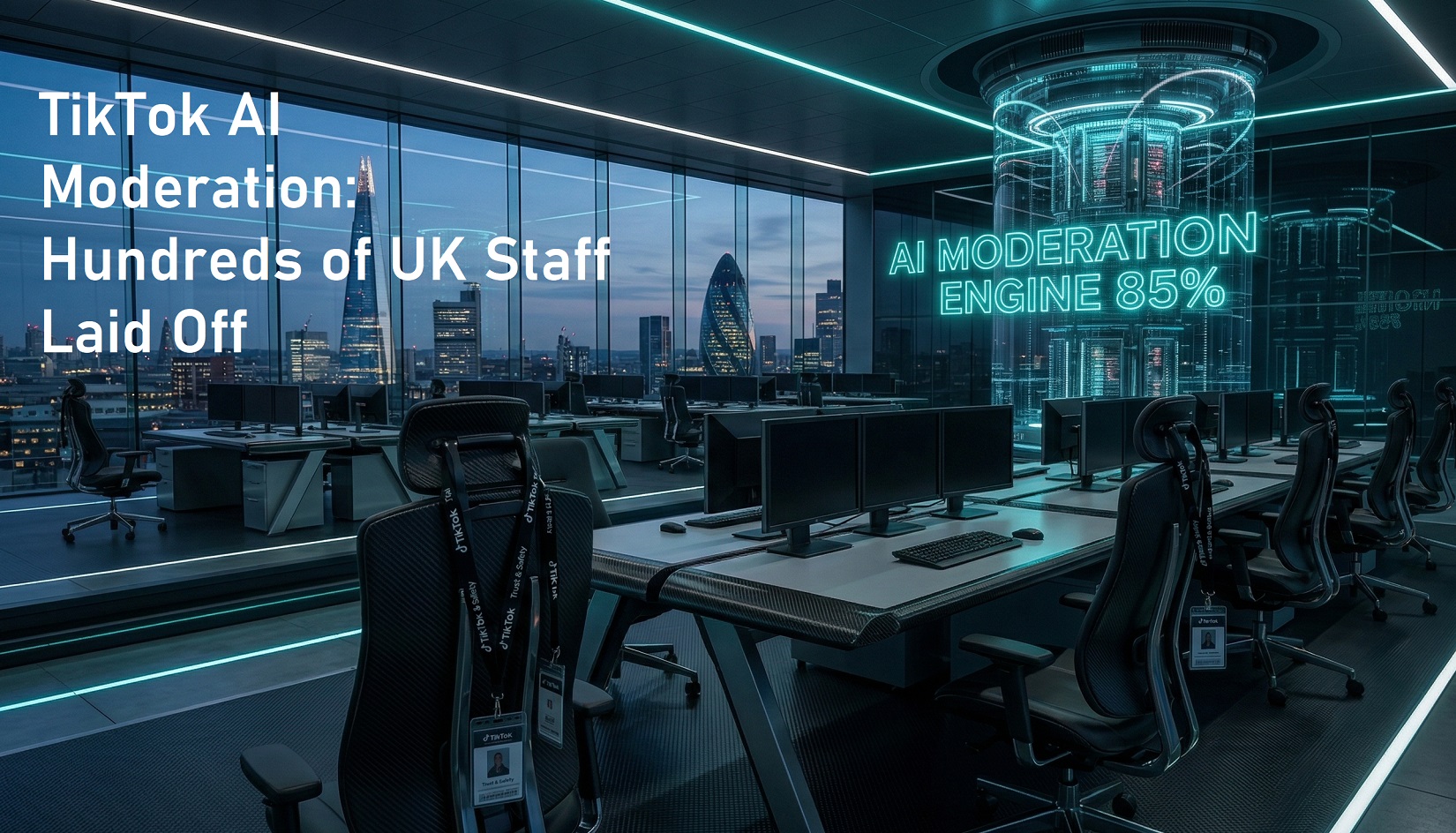
TikTok has recently moved to cut hundreds of roles within its UK-based Trust and Safety teams. This isn’t just a standard “cost-cutting” measure or a routine corporate restructure. It is a deliberate pivot toward a system where machines—not humans—decide what you are allowed to see, say, and share. As the platform admits that TikTok AI moderation now handles a staggering 85% of content takedowns, a high-stakes tension is brewing between corporate efficiency and public safety.
Can a Large Language Model (LLM) understand the specific nuance of a British “dog whistle”? Can it recognize a coded self-harm trend before it goes viral in a London school? We are pulling back the curtain on a global restructuring that prioritizes profit margins over human judgment, and what this means for your digital life under the shadow of the Online Safety Act.
Why is TikTok laying off its UK Trust and Safety staff? TikTok is restructuring its global safety operations to prioritize “automated efficiency.” By laying off UK-based staff and moving oversight to regional hubs in Dublin and Lisbon, the platform is shifting 85% of its content moderation to AI systems. This move aims to reduce overhead costs while attempting to meet the massive scale of content production.
The Great UK Restructure: Understanding the TikTok Mass Layoffs
The layoffs in London have sent shockwaves through the tech industry. For years, TikTok positioned its UK “Trust and Safety” hub as the gold standard for localized moderation. These were the teams responsible for understanding the cultural context of the UK market—everything from regional slang and political sensitivities to specific local safety concerns.
Now, those offices are being gutted. The Communication Workers Union (CWU) has been vocal in its opposition, labeling the move as a dangerous reliance on “immature” technology. We see this as a pivot from Contextual Moderation to Algorithmic Enforcement.
When a platform offshores its human oversight to broad regional hubs like Dublin or Lisbon, it loses the granular, local expertise that kept the feed safe. The decision suggests that TikTok believes its AI is now sophisticated enough to handle the “heavy lifting,” leaving only the most extreme edge cases for the remaining humans who may not even live in the country they are moderating.
The 85% Metric: How TikTok AI Moderation Actually Works
The statistic is jarring: 85% of content removed from TikTok is now caught and deleted by automated systems before a human eye ever sees it. To achieve this, TikTok utilizes advanced Large Language Models (LLMs) and computer vision algorithms designed to scan every frame of video and every line of text.
Can Large Language Models (LLMs) replace human nuance?
On paper, AI is the perfect moderator. It doesn’t get tired, it doesn’t suffer from the psychological trauma of viewing disturbing content, and it can process millions of videos per second. However, AI lacks what we call “Semantic Intuition.”
Consider the complexities of British humor—sarcasm, irony, and self-deprecation. These are linguistic minefields for an AI. An algorithm trained on a global dataset might flag a sarcastic comment as “harassment” while missing a genuine, coded threat that uses localized slang. This is the limitation of Large Language Models in ethics that we should all be concerned about. By automating 85% of the process, TikTok is trading accuracy for speed.
A Legal Minefield: The Online Safety Act vs. Automated Moderation
The timing of these layoffs couldn’t be more controversial. The UK’s Online Safety Act (OSA) is now in full swing, placing a “Duty of Care” on social media companies to protect users—particularly children—from harmful content. Failure to comply can result in fines of up to 10% of global turnover.
TikTok is betting that its AI can navigate this legal minefield. But there is a massive “Compliance Paradox” at play here. The OSA requires platforms to be proactive about “locally relevant” harms. If an AI fails to catch a viral trend that leads to real-world harm in a UK city, Ofcom (the regulator) may not find “efficiency” to be a valid legal defense.
We believe TikTok is engaging in a high-stakes gamble. They are betting that the cost-savings of AI moderation will outweigh the potential fines from the UK government. It is a “Savings First, Safety Second” strategy that treats the Online Safety Act as a checklist to be automated rather than a responsibility to be upheld.
The Human Cost: CWU Warnings and the “Offshoring” of Safety
The human moderators who remain are under immense pressure. By removing the UK-based experts and centralizing oversight in Dublin and Lisbon, TikTok has created a “Context Gap.”
The CWU has warned that the remaining human oversight is spread too thin. When an AI hits a “low confidence” score on a video—meaning it isn’t sure if the content violates rules—it gets kicked to a human. But if that human is in a different time zone, lacks local cultural knowledge, and is managed by a quota system, the quality of that “human oversight” becomes a hollow promise.
This offshoring of safety is a trend we see across the tech sector, but TikTok’s version is particularly aggressive. Moving the “Safety Brain” of the company away from the users it protects is a move that prioritizes the balance sheet over the “Duty of Care” enshrined in UK law.
The Future of Your Feed: Will Over-Moderation Break TikTok?
One of the most immediate effects of 85% automation is over-moderation. To avoid being fined by regulators, AI systems are often tuned to be “extra sensitive.” This leads to:
- Shadowbanning: Creators find their reach mysteriously plummeted because an algorithm misidentified a word or image.
- False Positives: Legitimate educational or political content is removed because it contains “trigger words” the AI cannot put in context.
- Creative Stifling: Users begin to “self-censor,” using “algospeak” (like saying “unalive” instead of “dead”) just to avoid the automated guillotine.
Is this the TikTok we want? A sterile, algorithmically-curated echo chamber where nuance goes to die?
As the tech industry layoff tracker for 2026 shows, TikTok is not alone in this AI-driven shift. However, because of its influence on younger generations, its choice to gut human safety teams is the most consequential. We must ask ourselves: if the algorithm is the one firing the people who protect us, who is left to hold the algorithm accountable?
The “chilling truth” isn’t just that people are losing their jobs. It’s that we are letting a machine decide the boundaries of our public square, and we might not realize what we’ve lost until the context is gone for good.
ViralZip.blog is powered by a dedicated team of digital analysts and tech journalists committed to “zipping” through the noise of the information age. With a combined background in investigative research and financial data analysis, our contributors focus on the intersection of emerging AI technology, local economic shifts, and global news trends. We take pride in translating complex data into actionable insights for modern residents across the US and UK. Our mission is to provide high-velocity, reliable information that empowers our readers to navigate the rapidly evolving landscape of 2026.
Disclaimer: The content provided on ViralZip.blog is for informational and educational purposes only. While we strive for accuracy, the fields of artificial intelligence, financial rebates, and medical technology are subject to rapid changes; therefore, we do not guarantee the completeness or absolute reliability of the information provided. This content does not constitute professional financial, medical, or legal advice. Always consult with a licensed professional—such as a financial advisor, doctor, or attorney—before making significant decisions based on trending data. ViralZip.blog is not responsible for any actions taken or outcomes achieved based on the suggestions provided in our articles.