
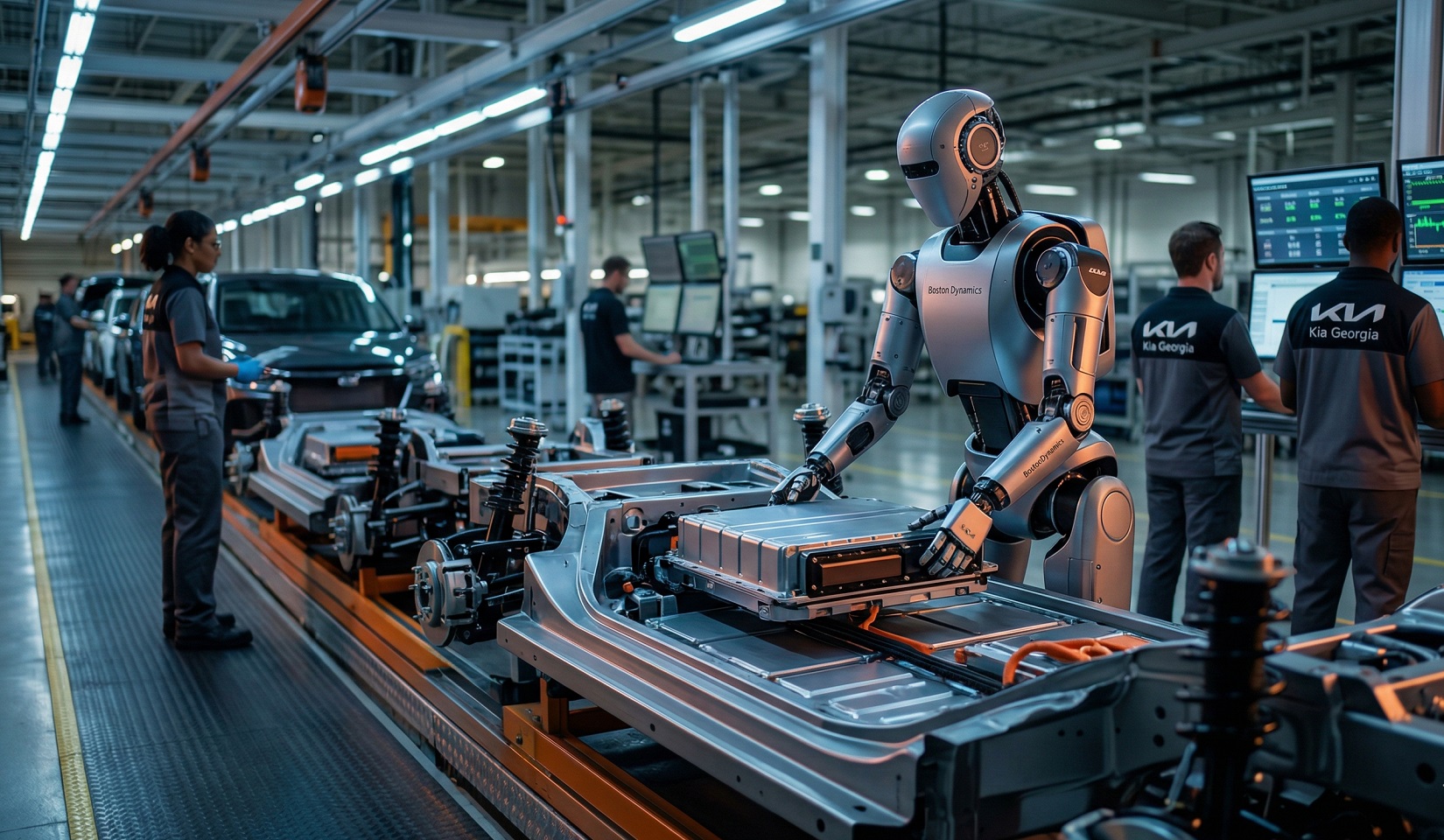
Why Kia Is Quietly Replacing EVs With Humanoid Robots At Its US Factory
The electric vehicle revolution was supposed to be unstoppable. A few short years ago, legacy automakers were locked in an arms race, fiercely competing to unveil the most ambitious battery-powered fleet transitions imaginable. But the landscape has violently shifted. A harsh new reality defined by slashed consumer incentives, cooling buyer demand, and brutal import tariffs has forced major automotive players to aggressively hit the brakes on their electrified dreams.
For years, consumers and investors expected a seamless, rapid transition to fully electric highways. Now, the underlying financial math is failing. Profit margins on battery-electric cars are shrinking. Legacy automakers are quietly hunting for alternative ways to secure their financial futures without burning through billions in unsold inventory.
Enter the era of automotive robotics. At their highly anticipated 2026 CEO Investor Day, Kia made a stunning strategic declaration. We are going to analyze exactly why Kia humanoid robots are taking center stage as the company officially slashes its 2030 vehicle sales goal for electric cars by over 20%. Rather than pushing unprofitable metal into a saturated market, Kia is pivoting toward deploying Boston Dynamics’ Atlas robots at their US factory to revolutionize hybrid and auto manufacturing efficiency from the ground up.
What exactly did Kia announce regarding EVs and humanoid robots? During its 2026 CEO Investor Day, Kia officially slashed its 2030 electric vehicle sales target from 1.26 million to 1 million units. Simultaneously, the automaker announced a massive capital pivot, detailing plans to deploy Boston Dynamics’ Atlas humanoid robots at its AutoLand Georgia factory to automate manufacturing and offset severe tariff costs.
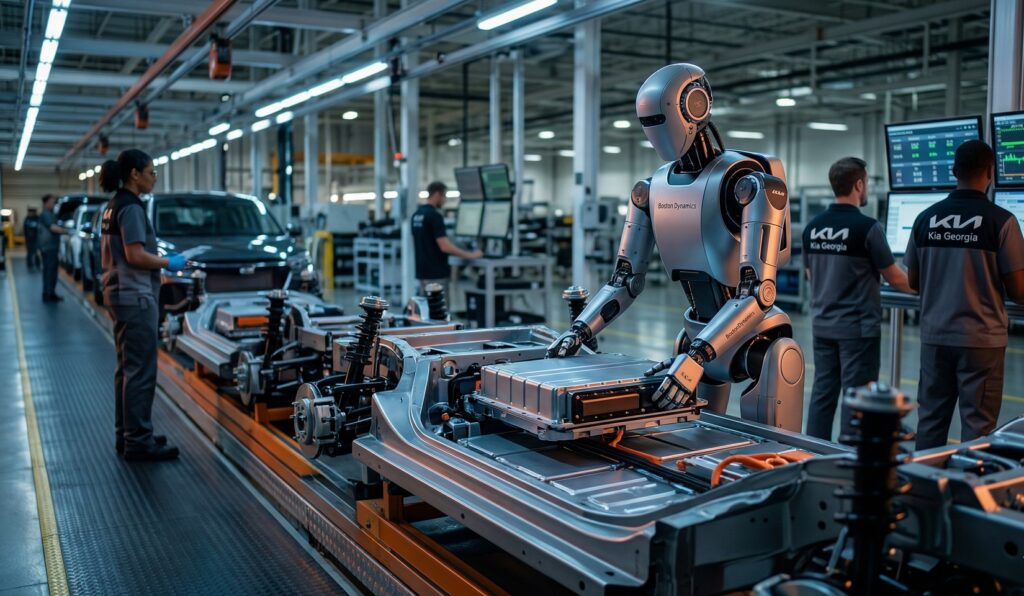
The 2026 Pivot: From Aggressive EV Targets to Humanoid Robotics
When Kia President and CEO Ho Sung Song took the stage in Seoul this April, the automotive world anticipated standard corporate optimism. Instead, they received a masterclass in strategic recalibration. Kia essentially rewrote its entire mid-to-long-term playbook. The company explicitly reduced its total global sales target to 4.13 million units by 2030, down from the 4.19 million projected just a year prior.
This is not a sign of defeat. It is a highly calculated reallocation of capital. The headline grabber was the brutal 20.6% haircut applied to their EV ambitions. But the true story lies in where that deferred electric vehicle capital is moving. Hyundai Motor Group (Kia’s parent company) is funneling unprecedented resources into software-defined vehicles (SDVs), Level 2++ autonomous driving, and cutting-edge industrial robotics.
What exactly did Kia announce regarding EVs and humanoid robots?
Kia confirmed a five-year investment blueprint totaling KRW 49 trillion (approximately $37.7 billion). Crucially, a staggering KRW 21 trillion of that sum is ring-fenced strictly for future technologies. They are actively deprioritizing the sheer volume of electric vehicles rolling off the assembly line to prioritize the efficiency of how vehicles are assembled.
By integrating Boston Dynamics into their core production strategy, Kia is shifting the battleground. They realize they cannot force the American consumer to buy an EV if the economic conditions are hostile. They can, however, control their own overhead. Replacing human bottlenecks and outdated machinery with humanoid robotics is their chosen mechanism to protect operating margins.
Why Did Kia Cut Its 2030 Electric Vehicle Sales Goal?
To understand the pivot to automation, we must first dissect the collapse of the electric vehicle euphoria. Kia originally targeted 1.26 million EV sales by 2030. Dropping that figure to an even 1 million units represents a massive concession for a brand that spent the early 2020s aggressively marketing the EV6 and EV9.
The rationale boils down to a toxic cocktail of trade policy and consumer fatigue.
The harsh reality of missing US EV subsidies and mounting tariffs
The United States market is the linchpin of Kia’s global strategy. When US lawmakers eliminated massive federal EV purchase subsidies, they removed the primary financial incentive driving middle-class adoption. Without that government cash masking the premium price tag of an electric car, dealership lots began to overflow. You can track the impact of changing EV tax credits and subsidies directly to Kia’s revised spreadsheets; the demand simply vanished overnight.
Furthermore, trade policy has become a weapon. The implementation of 25% reciprocal tariffs on South Korean imports has severely wounded Asian automakers. In 2025 alone, tariffs cost the Hyundai Motor Group an estimated KRW 3.3 trillion.
Kia cannot simply eat those costs, nor can they pass a 25% price hike onto the American consumer. The math demands localized production. But building a traditional EV battery plant in the US is wildly expensive due to high domestic labor costs. The solution? Build the cars in America to dodge the tariffs, but build them using a robotic workforce to dodge the labor overhead.
Meet Atlas: The Humanoid Robot Taking Over Kia AutoLand Georgia
If you want a glimpse into the future of the auto industry, look at the factory floor, not the showroom. The star of Kia’s revised strategy is Atlas, the bipedal, incredibly agile humanoid robot developed by Boston Dynamics.
Hyundai Motor Group acquired Boston Dynamics years ago, and we are finally seeing the industrial payoff. Kia announced that Atlas will begin deployment at the Hyundai Motor Group Metaplant America (HMGMA) in 2028, followed by a massive rollout at Kia AutoLand Georgia in the second half of 2029.
How Boston Dynamics is changing the modern auto industry assembly line
Atlas is not a static robotic arm welded to the floor. It is a fully mobile, humanoid entity capable of navigating complex, unpredictable environments.
Initially, Kia will deploy these robots to handle highly repetitive, ergonomically dangerous tasks—specifically parts sequencing and heavy component assembly. This directly addresses the chronic labor shortages and high injury rates plaguing domestic automotive manufacturing. But the vision extends far beyond heavy lifting.
Kia is investing over $500 million to strengthen its physical AI capabilities and vision-language-action models through partnerships with tech giants like Nvidia and Google DeepMind. We are witnessing the evolution of AI in manufacturing happen in real-time. Atlas robots will utilize machine learning to observe human workers, learn complex assembly nuances, and eventually handle higher-value manufacturing processes. The humanoid form factor is critical; automakers do not need to spend billions redesigning their factories to accommodate wheeled or tracked robots. Atlas is designed to step seamlessly into workspaces built for humans.
The Financial Trade-Off: Trading Battery Plants for Factory Automation
When you pull capital away from pure EV manufacturing, it has to go somewhere to maintain market share. Kia is funneling the remainder of its budget into a proven, highly profitable stopgap: hybrids.
Kia has completely doubled down on its Hybrid Electric Vehicle (HEV) lineup. They plan to expand their HEV offerings to 13 models, targeting 1.1 million hybrid sales annually by 2030. They even confirmed the development of a mid-size, body-on-frame hybrid pickup truck specifically tailored for the North American market to capture the lucrative light-truck segment.
Why investing KRW 21 trillion in future tech means doubling down on hybrid vehicles
There is a direct correlation between funding humanoid robotics and expanding hybrid production. Hybrids are currently the financial lifeblood of legacy automakers.
Building battery-electric cars is still a low-margin endeavor. The battery packs are astronomically expensive, and the technology becomes obsolete rapidly. Conversely, automakers have spent a century perfecting the internal combustion engine. Marrying that legacy technology with small battery packs yields massive profit margins. If you are wondering why hybrid cars are making a massive comeback, look at the balance sheets. Hybrids generate the cash flow necessary to fund the KRW 21 trillion required to develop Boston Dynamics robots, Level 2++ autonomous driving software, and Purpose-Built Vehicles (PBVs).
Kia is using the immediate profitability of hybrids to bankroll the automated factories of tomorrow, completely insulating themselves from the volatility of the EV price wars.
Are EVs Losing Momentum to Manufacturing Automation?
This brings us to the ultimate contrarian reality of the 2026 auto industry. Electric vehicles are not dead, but the obsession with them is. The initial rush to transition every consumer to a battery-powered car ignored the foundational economics of manufacturing.
We are seeing a massive paradigm shift. Automakers are realizing that whoever builds a vehicle the cheapest will win the decade. It does not matter if that vehicle is electric, hybrid, or gas-powered.
What Kia’s US factory strategy signals for the global auto industry
Kia’s decision to heavily integrate Atlas humanoid robots at AutoLand Georgia is a bellwether for the entire sector. They are trading the consumer-facing hype of EVs for the operational dominance of automation.
By 2030, Kia expects to achieve an operating margin of 10%, translating to roughly $13.1 billion in pure profit. They will not achieve that by forcing overpriced electric vehicles onto a hesitant American public facing high interest rates. They will achieve it by utilizing Boston Dynamics’ humanoid robots to aggressively drive down the cost of assembling high-demand hybrids on US soil, legally bypassing tariffs while simultaneously slashing labor overhead.
The auto industry is no longer just competing over battery range or dashboard touchscreens. The true arms race is happening behind closed factory doors. Kia’s quiet retreat from its 2030 EV targets proves that the next era of automotive dominance belongs to the manufacturer who masters the humanoid robot, not just the electric motor.
1. Is Kia stopping EV production for robots?
No. Kia is not stopping EV production, but it is reallocating resources. At its 2026 CEO Investor Day, Kia slashed its 2030 EV sales goal by over 20% (from 1.26 million to 1 million units) while simultaneously announcing a massive KRW 21 trillion investment in future tech, including humanoid robotics and autonomous driving.
2. Why did Kia lower its 2030 EV sales targets?
Kia cited two primary reasons: cooling global demand for fully electric vehicles and the termination of US federal EV subsidies. To fill the gap, the company is doubling its focus on hybrids (HEVs), aiming for 1.1 million hybrid sales annually by 2030.
3. What kind of robots will be used at the Kia factory?
Kia will deploy the Atlas humanoid robot, developed by Boston Dynamics (a subsidiary of Hyundai Motor Group). Unlike stationary robotic arms, Atlas is a bipedal, mobile robot designed to handle complex, repetitive, and ergonomically challenging tasks on the assembly line.
4. When will robots start working at the Kia US factory?
The rollout is staggered across Hyundai Motor Group’s Georgia footprint. Atlas is scheduled to debut at the Hyundai Metaplant (HMGMA) in 2028, with a full-scale expansion into the Kia AutoLand Georgia facility starting in the second half of 2029.
5. Will these robots replace human workers?
Kia frames the move as an innovation in manufacturing rather than a total replacement. The robots are specifically targeted for 16 core manufacturing processes that are currently hazardous or highly repetitive for humans. The goal is to reduce production costs and improve quality, particularly to offset high labor costs and tariffs in the US market.
ViralZip.blog is powered by a dedicated team of digital analysts and tech journalists committed to “zipping” through the noise of the information age. With a combined background in investigative research and financial data analysis, our contributors focus on the intersection of emerging AI technology, local economic shifts, and global news trends. We take pride in translating complex data into actionable insights for modern residents across the US and UK. Our mission is to provide high-velocity, reliable information that empowers our readers to navigate the rapidly evolving landscape of 2026.
Disclaimer: The content provided on ViralZip.blog is for informational and educational purposes only. While we strive for accuracy, the fields of artificial intelligence, financial rebates, and medical technology are subject to rapid changes; therefore, we do not guarantee the completeness or absolute reliability of the information provided. This content does not constitute professional financial, medical, or legal advice. Always consult with a licensed professional—such as a financial advisor, doctor, or attorney—before making significant decisions based on trending data. ViralZip.blog is not responsible for any actions taken or outcomes achieved based on the suggestions provided in our articles.