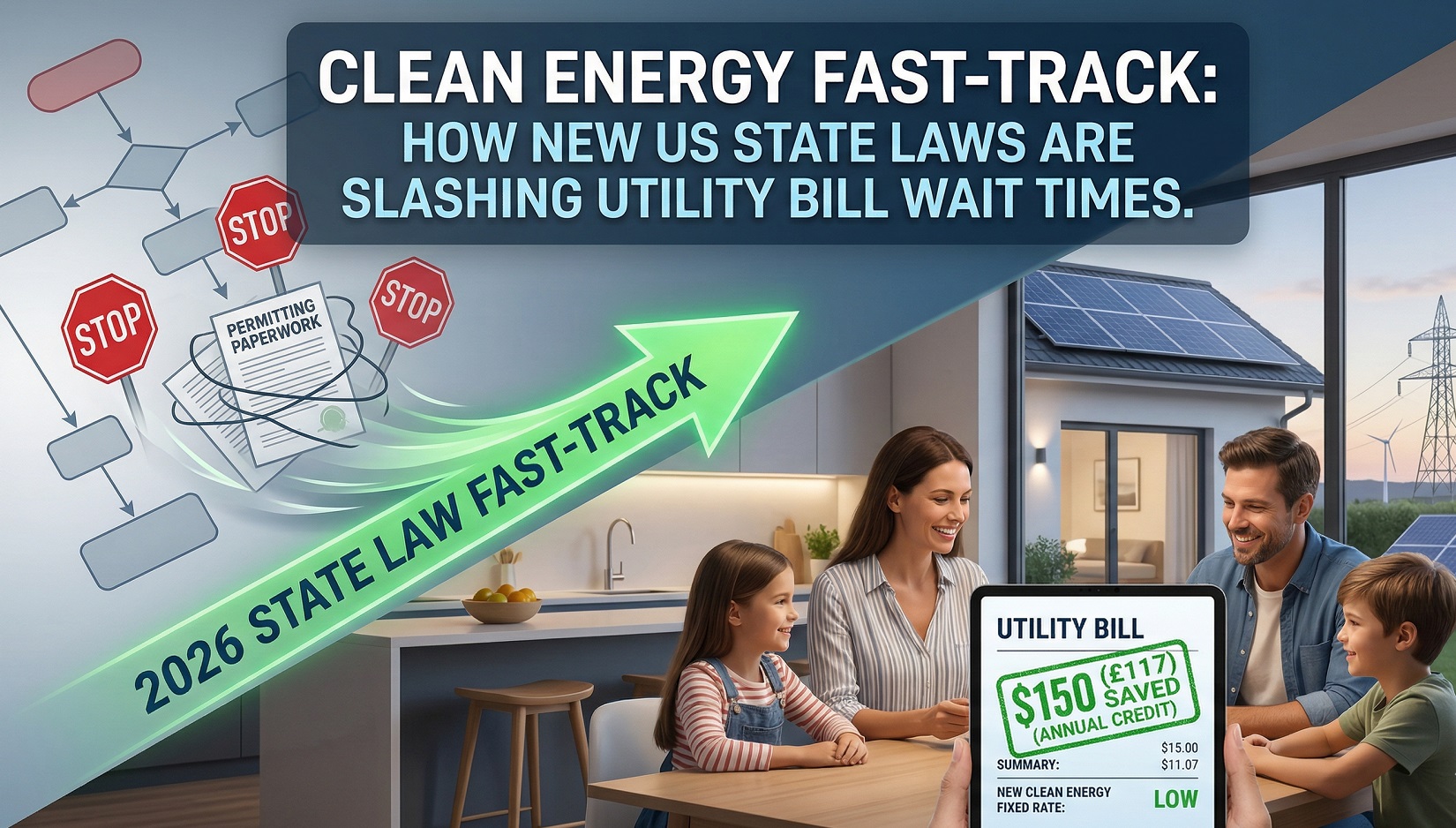
For years, the dream of cheaper, cleaner energy has been stuck behind a wall of red tape. You might have the solar panels ready or a wind farm planned in your county, but the “paperwork bottleneck” meant waiting months—or even years—for those savings to actually hit your mailbox. In 2026, that bottleneck is finally breaking.
A wave of landmark legislation, most notably the Clean and Reliable Grid Affordability Act, is sweeping across states like Illinois and Massachusetts. These aren’t just minor tweaks; they are a total “Faster Approvals” roadmap designed to bypass bureaucratic delays. By streamlining how we build and connect power lines, experts predict these reforms will save American families an average of $150 (£117) this year alone.
In this guide, we’ll break down the secret mechanics of these new laws. Whether you’re a homeowner looking to cut costs or a tech enthusiast watching the grid evolve, here is how the US is fast-tracking its way to a cheaper energy future.
1. The “Permit Pandemic” is Over: Slashing the Red Tape
Before 2026, building a new transmission line—the “highway” for electricity—was a legal nightmare. Projects often sat in “interconnection queues” for up to five years. This delay didn’t just hurt the environment; it forced utilities to keep running older, more expensive fossil fuel plants, with the cost passed directly to you.
How the “Fast-Track” Laws Work
The new 2026 state laws focus on three “Nuclear Options” for bureaucracy:
- Shotgun Permitting: States are now imposing strict 12-month deadlines on environmental and siting reviews. If the state doesn’t decide in a year, the project gets a “presumptive approval.”
- Consolidated Siting: Instead of needing permits from ten different local and state agencies, developers now go to a “One-Stop Shop.” This reduces legal fees and administrative bloat that previously inflated your bill.
- The “Grain Belt” Precedent: Recent Supreme Court rulings in states like Illinois have confirmed that utilities have the “capacity and fitness” to move forward faster, preventing small legal challenges from stalling 800-mile projects that benefit millions.
Real-Life Impact: The $150 Saving
When a clean energy project (like a massive battery storage site) comes online 24 months early, the utility can “retire” expensive peak-load gas plants sooner. For the average household in a participating state, this shift in the “Energy Mix” is resulting in an immediate credit or reduction in the monthly service fee, totaling roughly $150 annually.
2. Storage and Virtual Power Plants: Your Secret Bill Killers
It’s not just about making power; it’s about storing it. One of the most exciting parts of the 2026 legislation is the mandatory rollout of Virtual Power Plants (VPPs).
What is a Virtual Power Plant?
A VPP isn’t a building with a smokestack. It’s a digital network that connects your home’s smart devices—like your EV charger, smart thermostat, and home battery—to the grid.
- The “Smart Use” Reward: New laws in states like Illinois now require utilities to pay you for using these resources.
- Shaving the Peak: During a hot summer afternoon when everyone turns on the AC, the utility “borrows” a tiny bit of power from thousands of home batteries instead of turning on a billion-dollar gas plant.
Why This Slashing Wait Times
Previously, building a new power plant took 10 years. Setting up a VPP takes weeks. By legalizing and incentivizing these “digital” plants, states are providing instant grid relief. This means less “grid stress,” fewer blackouts, and significantly lower “delivery charges” on your utility statement.
3. The “Solar Bill of Rights”: Protection for Prosumers
One of the most significant parts of the 2026 legal wave is the Solar Bill of Rights, which has now been adopted by over 20 states. This law protects “prosumers”—people who both produce and consume energy.
Your New Legal Protections
Under these new 2026 rules, utilities can no longer “gatekeep” your savings. Key protections include:
- The 3-Day Connection Rule: In major municipal areas, utilities are now legally mandated to connect your residential solar system to the grid within three business days of final inspection. No more waiting months for a “Permission to Operate” (PTO) letter.
- Anti-Discrimination Fees: New laws prevent utilities from charging “punitive” standby fees or higher fixed costs just because you have solar panels. If they do, they face automatic state-level audits.
- Billing Transparency: A new “Automatic Review” clause triggers if your bill fluctuates by more than 5x (up or down). This prevents “sticker shock” from billing errors during the transition to smart meters.
4. Common Mistakes Homeowners Make When Switching
While the laws are making it easier to save, many families still fall into “traps” that eat away at their $150 annual savings.
- Ignoring the “Solar-Hour” Tariff: In 2026, many states are moving to Time-of-Day (ToD) tariffs.
- The Mistake: Running heavy appliances (like dryers or EV chargers) during “Peak Hours” (usually 6 PM – 9 PM) when electricity is 20% more expensive.
- The Fix: Schedule high-energy tasks for “Solar Hours” (10 AM – 3 PM) when rates are at least 20% lower thanks to the surplus of clean energy on the grid.
- Improper Battery Sizing: Many people buy a home battery that is either too small to cover their night-time use or too large to ever pay for itself.
- The Fix: Use a “Digital Twin” health check for your home energy (similar to the medical twins we discussed earlier!) to calculate your exact storage needs based on last year’s usage.
- Failing to Perform an Energy Audit: You can have the best solar panels in the world, but if your attic is poorly insulated, you are literally “throwing money out the window.”
- The Fix: Most 2026 state laws now offer no-cost home energy assessments (like New York’s EmPower+ program). Take advantage of these before you buy new hardware.
5. The “Utility Audit” Hack for 2026
Pro Tip: Most homeowners don’t realize that under the new Utility RELIEF Act, your energy provider is often required to offer you a free “Smart Meter Audit.” In 2026, you can request a remote diagnostic of your home’s energy “leakage.” By identifying which appliances are drawing “vampire power” during peak hours, you can often save an additional $50 a year on top of the state-mandated $150 reduction—without spending a dime on new equipment.
6. Common Mistakes to Avoid in the New Grid Era
- Ignoring Time-of-Use (ToU) Windows: With the rise of the Clean and Reliable Grid Affordability Act, many states are defaulting users into “Time-of-Use” pricing. Mistake: Running your dishwasher or EV charger at 6 PM. In 2026, electricity can be 3x more during these peak “Grid Stress” hours.
- Missing Out on “Rebate Stacking”: Many homeowners apply for a federal tax credit but forget that their state (like Maryland or Illinois) now offers immediate point-of-sale rebates for heat pumps and batteries. Mistake: Not “stacking” these local incentives to cover up to 80% of your upgrade costs.
- Trusting “Door-to-Door” Solar Scams: The “Faster Approvals” roadmap has unfortunately attracted “shady” installers promising “Free Solar” via government programs. Mistake: Signing a 20-year lease without verifying the installer is a Certified Equitable Contractor under the new 2026 state guidelines.
7. Frequently Asked Questions (FAQs)
How do I know if my state has passed a “Faster Approvals” law?
As of April 2026, Illinois, Maryland, Massachusetts, and California have led the way. You can check your local utility website for a “2026 Ratepayer Relief” or “RELIEF Act” banner to see if your area is eligible for the automatic $150 credit.
Does the $150 saving apply to renters, or just homeowners?
It applies to anyone with a utility account. Because the savings come from “Grid Modernization” and “Interconnection” reforms, they lower the base cost of electricity for every ratepayer on the network, regardless of whether you own the roof.
Do I need a “Smart Meter” to get these savings?
For the general $150 reduction, no. However, to maximize your savings through “Virtual Power Plants” or “Time-of-Use” rewards, a smart meter is usually required. Most 2026 laws include funding for free smart meter upgrades if you don’t already have one.
A New Era of Energy Affordability
The “Clean Energy Fast-Track” is more than just a win for the environment; it’s a necessary correction for the American wallet. By 2026, the US has proven that by slashing red tape and empowering “prosumers,” we can make energy both cleaner and significantly cheaper. Whether it’s through the Utility RELIEF Act in Maryland or the CRGA Act in Illinois, the “Faster Approvals” roadmap is finally delivering on its promise.
Don’t let the bureaucracy of the past dictate your bills today. Stay informed, audit your usage, and claim your share of the 2026 energy windfall.
ViralZip.blog is powered by a dedicated team of digital analysts and tech journalists committed to “zipping” through the noise of the information age. With a combined background in investigative research and financial data analysis, our contributors focus on the intersection of emerging AI technology, local economic shifts, and global news trends. We take pride in translating complex data into actionable insights for modern residents across the US and UK. Our mission is to provide high-velocity, reliable information that empowers our readers to navigate the rapidly evolving landscape of 2026.
Disclaimer: The content provided on ViralZip.blog is for informational and educational purposes only. While we strive for accuracy, the fields of artificial intelligence, financial rebates, and medical technology are subject to rapid changes; therefore, we do not guarantee the completeness or absolute reliability of the information provided. This content does not constitute professional financial, medical, or legal advice. Always consult with a licensed professional—such as a financial advisor, doctor, or attorney—before making significant decisions based on trending data. ViralZip.blog is not responsible for any actions taken or outcomes achieved based on the suggestions provided in our articles.