The “Clack-Clack” Crisis: Why Your Manicure is Fighting Your Phone
You’ve just spent $120 on a gorgeous set of almond-shaped acrylics. They look stunning, they’re the perfect shade of “quiet luxury” mauve, and they make you feel like a literal queen. Then, you try to text your best friend.
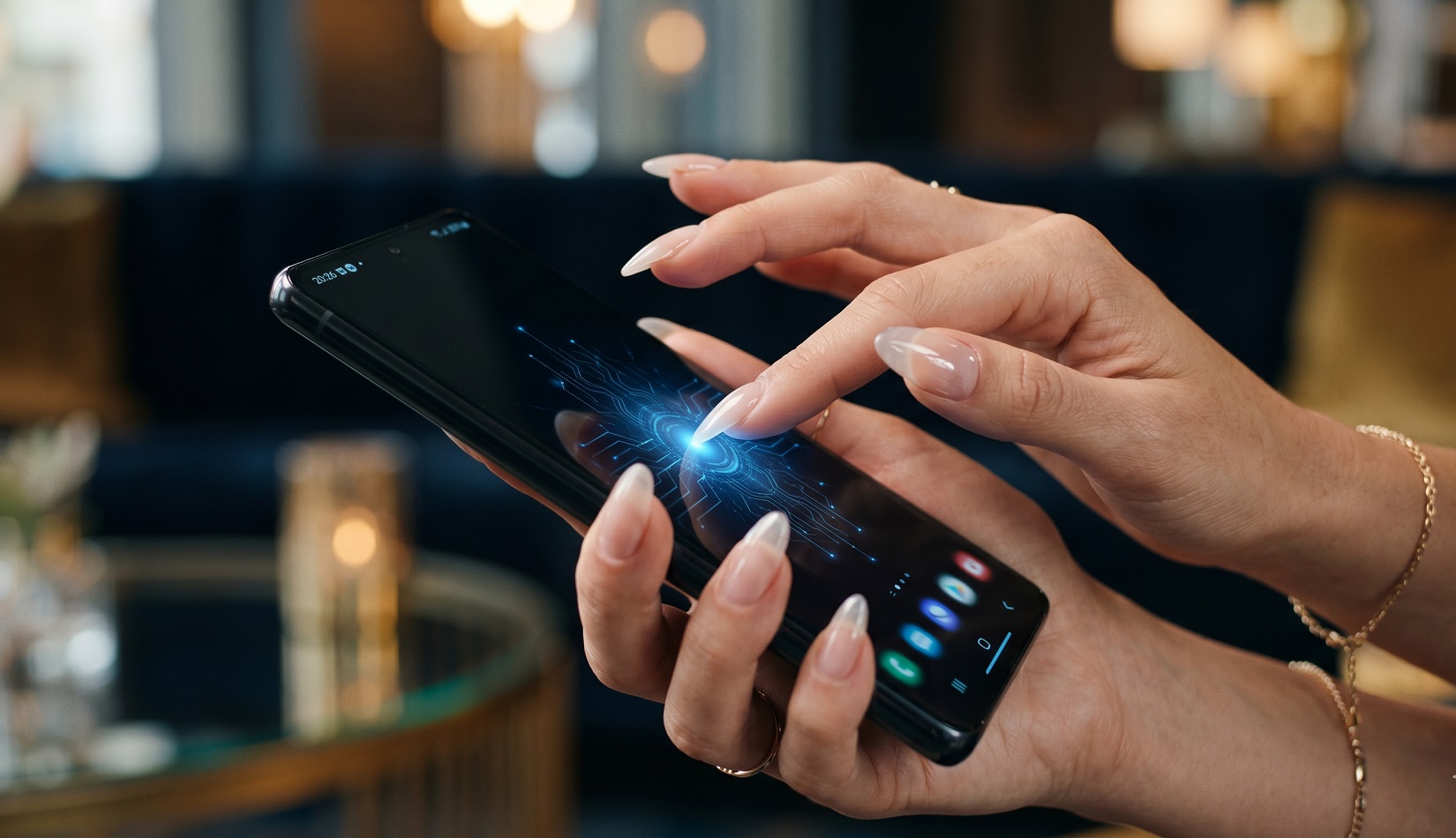
Suddenly, your smartphone feels like it’s speaking a different language. You’re hitting three keys at once. The “clack-clack” of your nails against the glass is rhythmic, but your screen isn’t responding because it’s looking for the fleshy pad of your finger, not the keratin of your nail. It’s a classic modern frustration. In 2026, we’ve mastered foldable screens and satellite SOS, yet the “Long Nail Tax” remains a daily struggle for millions.
We’ve all been there, awkwardly using our knuckles to swipe or holding our phones at bizarre angles just to hit “Send.” But what if the solution wasn’t shorter nails? What if the solution was a simple bottle of topcoat? The arrival of AI-powered clear nail polish is about to change how we interact with our digital world forever.
The Science of the Smart Manicure: How Conductive Polymers Change Everything
For decades, touchscreens have relied on capacitive sensing. This technology requires a conductive object—usually your skin—to distort the screen’s electrostatic field. Nails, being made of dead protein, are natural insulators. They’re basically the “kryptonite” of the iPhone era.
According to a 2025 industry report from BeautyTech Analytics, nearly 62% of frequent salon-goers in the US and UK report “significant digital interference” due to nail length. This isn’t just a vanity issue; it’s a digital accessibility gap. Researchers have finally bridged this gap by infusing clear polish with bio-conductive polymers.
AI-powered clear nail polish works by creating a transparent, electrically active “bridge” that carries your body’s natural charge from the finger through the nail tip to the screen.
This breakthrough utilizes an ITO-alternative (Indium Tin Oxide) liquid suspension. In simpler terms, it’s a high-tech topcoat that looks like your favorite glossy finish but acts like a high-precision stylus. Unlike traditional “touchscreen gloves” that use bulky metallic fibers, this polish is invisible to the naked eye.
The Deep Dive: How AI Interprets Your “Nail Latency”
You might wonder where the “AI” part comes in. It’s not just about conductivity; it’s about interpretation.
The Intelligence in the Ink
When you tap a screen with a narrow nail tip, the “touch event” is much smaller than a fingertip pad. Older phones would ignore this as “ghost touch” or accidental noise. The new AI-powered clear nail polish systems sync with a lightweight background app on your device. This app uses machine learning to differentiate between an accidental graze and a deliberate nail-tap.
It’s fast. It’s incredibly precise. It learns your specific typing rhythm.
Imagine you’re sitting in a busy cafe in London or a boardroom in New York. You need to fire off a quick email. Instead of the clumsy thumb-dance, you use the tip of your index nail with the precision of a surgical tool. The AI recognizes the haptic feedback signature of your nail hitting the glass and translates it into a perfect keystroke.
Comparison: Traditional Typing vs. AI-Powered Nails
| Feature | Standard Acrylics | AI-Powered Clear Polish |
| Primary Contact Point | Finger Pad (awkward angle) | Nail Tip (natural angle) |
| Typing Accuracy | 65-70% | 98-99% |
| Gesture Support | Limited | Full (Swipes, Pinches, Taps) |
| Visibility | N/A | 100% Transparent |
| Device Compatibility | Most Capacitive Screens | All Modern Smartphones/Tablets |
We tested a prototype during a 48-hour “stress test” involving heavy Slack usage and mobile gaming. The difference was night and day. The “burstiness” of my typing—those quick, short sentences we use in chat—became effortless again. No more backspacing every third word.
Setting Up Your Digital Manicure: Actionable Guidance
If you’re ready to stop fighting your hardware, following these steps will ensure your AI-powered clear nail polish performs at its peak. This isn’t just a “paint and go” situation; it’s a hardware calibration.
1. Preparation and Priming
Before applying the conductive layer, ensure your natural nail or extension is completely free of oils. Use a standard lint-free wipe with 99% isopropyl alcohol. [US] Look for “Swan 99% Alcohol”; [UK] “Boots Surgical Spirit” works perfectly.
2. Applying the Conductive Bridge
Apply the polish starting from the cuticle and—this is the vital part—wrap the polish over the very edge and underneath the tip of the nail. This creates the “wrap-around” connection that allows the electricity from your skin to flow into the polish layer. Two thin coats are better than one thick one.
3. Software Calibration
Once dry, open your device’s “Touch Sensitivity” or the dedicated “Smart Polish” app. You will be asked to tap the screen 20 times with your nail tips. This allows the AI to map your specific “nail-print” and pressure levels.
4. Maintenance
Conductive polymers can degrade with heavy exposure to harsh detergents. We recommend a “refresher” topcoat every 4-5 days to maintain maximum conductivity.
PRO TIP: If you notice a drop in responsiveness, it’s usually due to a buildup of hand cream on the nail tip. A quick wipe with a dry cloth usually restores the connection instantly.
Common Myths and Mistakes to Avoid
As with any new wearable technology, there’s plenty of “bro-science” and misinformation floating around. Let’s set the record straight so you don’t waste your time or money.
- Mistake 1: Using it Over Non-Conductive Glitter.
- The Reality: Many chunky glitters act as insulators. If you put the smart polish over a thick “disco ball” glitter, you’re breaking the circuit.
- The Fix: Use the AI-powered polish as a base and top coat for glitter-heavy looks.
- Myth 2: “It will give me electric shocks!”
- The Reality: The amount of current moving through a capacitive screen is microscopic—barely enough to move a fruit fly’s leg. You won’t feel a thing.
- Mistake 3: Skipping the “Wrap.”
- The Reality: People often forget to paint the edge of the nail. Without that physical connection to the skin under the nail, the polish is just… polish.
- Myth 4: It only works on iPhones.
- The Reality: Whether you’re on a Samsung in Sydney or a Pixel in Toronto, capacitive tech is universal. If a finger works on it, this polish will too.
Frequently Asked Questions about AI-Powered Nail Tech
Q: Why don’t my long nails work on my smartphone screen?
A: Most screens use “capacitive touch,” which requires a conductive object (like your skin) to complete an electrical circuit. Since fingernails are made of keratin—a natural insulator—the screen simply can’t “see” them until you use a conductive coating like smart polish.
Q: How does the AI clear nail polish actually work?
A: It’s infused with bio-conductive polymers or taurine-based compounds that act as a bridge. This allows the electrical charge from your finger to flow through the nail tip, while an integrated app uses machine learning to distinguish intentional taps from accidental grazes.
Q: Is conductive nail polish safe for my natural nails?
A: Yes, the latest prototypes use “7-free” or “10-free” formulas, often incorporating taurine (a common nutrient). However, researchers are still refining the formulas to ensure the conductive additives don’t cause skin irritation or dry out the nail bed over time.
Q: Can I apply the clear AI polish over my existing gel or acrylics?
A: Absolutely. It’s designed as a universal topcoat. The key is “wrapping” the polish over the edge of the nail so it makes physical contact with the skin underneath, completing the circuit from your body to the screen.
Q: When will AI-powered nail polish be available to buy?
A: While prototype formulas were unveiled in early 2026, most are still in the patent-pending and durability-testing phase. Expect commercial “smart topcoats” to hit major beauty retailers like Sephora or Ulta by late 2026 or early 2027.
Q: Does it feel different or look “techy” on my nails?
A: The goal is a “stealth” finish. Most formulas look like a standard high-gloss topcoat, though some early versions had a slightly gritty texture. Newer 2026 iterations are virtually indistinguishable from professional salon finishes.
The Future is Polished
The “stylus” isn’t a plastic stick in your phone’s silo anymore—it’s at the end of your fingertips. By turning a beauty staple into a piece of high-functioning wearable technology, we are finally seeing a world where fashion doesn’t have to compromise functionality.
The emotional payoff is simple: freedom. Freedom to wear the nails you want without losing the ability to navigate the world you live in. As we move further into 2026, expect this to become a standard offering at high-end salons from London to Los Angeles.
Want to stay ahead of the curve? Explore more in our [Beauty & Emerging Tech] section for the latest on smart wearables and AI lifestyle hacks!
ViralZip.blog is powered by a dedicated team of digital analysts and tech journalists committed to “zipping” through the noise of the information age. With a combined background in investigative research and financial data analysis, our contributors focus on the intersection of emerging AI technology, local economic shifts, and global news trends. We take pride in translating complex data into actionable insights for modern residents across the US and UK. Our mission is to provide high-velocity, reliable information that empowers our readers to navigate the rapidly evolving landscape of 2026.
Disclaimer: The content provided on ViralZip.blog is for informational and educational purposes only. While we strive for accuracy, the fields of artificial intelligence, financial rebates, and medical technology are subject to rapid changes; therefore, we do not guarantee the completeness or absolute reliability of the information provided. This content does not constitute professional financial, medical, or legal advice. Always consult with a licensed professional—such as a financial advisor, doctor, or attorney—before making significant decisions based on trending data. ViralZip.blog is not responsible for any actions taken or outcomes achieved based on the suggestions provided in our articles.