
The clock is ticking. It’s mid-April, the piles of paper on your desk are reaching critical mass, and the “April 15th” deadline on your calendar looks less like a date and more like a threat. Whether you’re waiting on a missing 1099, dealing with a complex K-1 from a side business, or life simply got in the way, the panic is real.
But here is the good news: Take a deep breath.
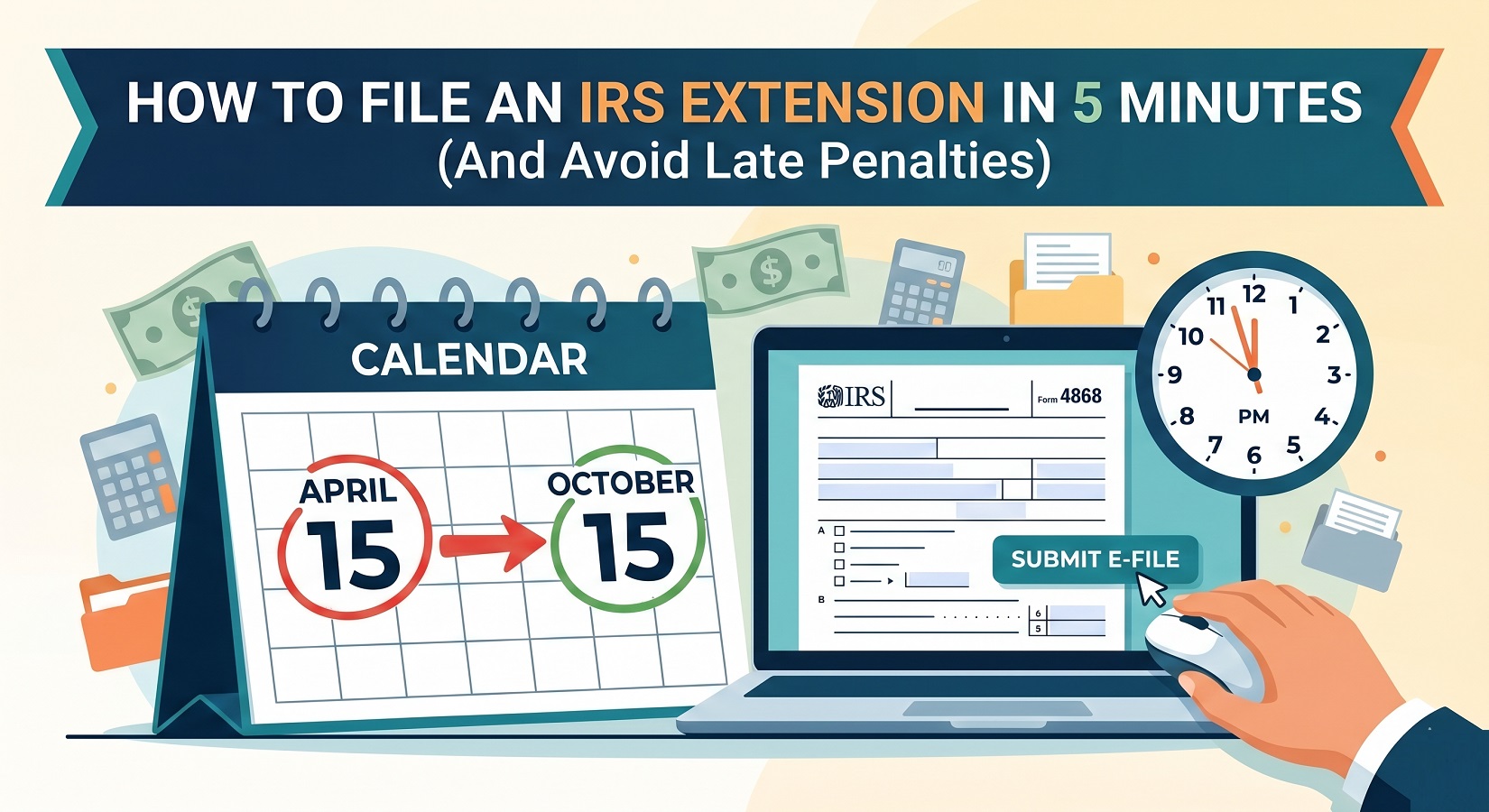
The IRS actually provides a “get out of jail free” card (well, a “get out of late penalties free” card) that takes less than five minutes to play. It’s called Form 4868, and filing it gives you an automatic six-month extension.
Before we dive in, we have to bust the biggest myth in tax season: An extension to file is NOT an extension to pay. If you owe the government money, they still want their check by April 15. The extension simply buys you time to get your paperwork perfect so you don’t get hit with massive “failure to file” fees.
The “Wait, Should I Do This?” Quick Checklist
Filing an extension is an “automatic” right, meaning the IRS doesn’t need a sob story—they just need the form. You should file an extension if:
- You’re missing documents: Still waiting on that late brokerage statement? Don’t guess; extend.
- Life happened: Illness, travel, or family emergencies are all valid reasons to hit the pause button.
- You want to avoid the “Big Penalty”: The penalty for failing to file is 5% per month of the unpaid tax. The penalty for failing to pay is only 0.5%. Filing the extension eliminates that scary 5% charge immediately.
The Deadline: You must submit your extension request by midnight on the regular tax deadline (usually April 15th).
Step-by-Step: Filing Form 4868 in 5 Minutes
You don’t need a CPA to do this. Here are the three fastest ways to get it done right now:
Option A: The Fastest Way (IRS Direct Pay)
This is the “pro-tip” for those in a rush. If you use IRS Direct Pay to make a payment and select “Extension” as the reason for payment, the IRS automatically grants you the extension.
- No form to mail.
- No separate e-filing.
- You get an immediate confirmation number.
Option B: IRS Free File
If you don’t want to make a payment yet but want the extension on record, every taxpayer—regardless of income—can use IRS Free File to electronically submit Form 4868. It’s a simple “fill-in-the-blanks” digital form that takes about three minutes to complete.
Option C: The “Old School” Paper Route
You can download Form 4868 from IRS.gov, print it, and mail it. However, if it’s currently the day of the deadline, this is risky. If you go this route, send it via Certified Mail so you have proof of the postmark.
The Critical Warning: Paying vs. Filing
Here is where many taxpayers get tripped up. Filing Form 4868 buys you time, but it doesn’t buy you interest-free credit.
The IRS treats “failure to file” and “failure to pay” as two different sins. Because you filed your extension, you’ve successfully dodged the “Failure to File” penalty (which is a staggering 5% per month). However, the “Failure to Pay” penalty still applies to any balance due.
The Math of Late Fees
- Failure to Pay: Usually 0.5% of the unpaid taxes for each month or part of a month the tax remains unpaid.
- Interest: On top of the penalty, the IRS charges interest that compounds daily.
The Strategy: Even if you can’t pay your full tax bill today, pay whatever you can. Paying 50% of what you owe now is significantly better than paying 0%. Use your best estimate based on last year’s return or your W-2s to send in a “good faith” payment with your extension.
What Happens Next? (The New Timeline)
Once your extension is accepted, the “ticking clock” slows down, but it doesn’t stop.
- The New Deadline: October 15th. This is your hard finish line. There are no “extensions for the extension.” If you haven’t filed by midnight on October 15, the heavy penalties mentioned above will kick in retroactively.
- State Taxes: This is a big one—Federal extensions do not always cover State taxes. While some states (like California) give you an automatic extension if you have a federal one, others require a separate form. Check your specific State Department of Revenue website immediately.
- Don’t Procrastinate: Use this extra six months to find every deduction, organize your receipts, and perhaps consult with a professional. The goal is to file a perfect return, not just a late one.
Conclusion & Summary Table
Filing an extension is a smart move that protects your wallet from unnecessary penalties. It’s not an admission of guilt or a red flag for an audit; it’s a tool designed to help you file accurately.
Quick Reference for Today:
| Action | Deadline | Penalty if Missed |
| File Form 4868 | April 15 | 5% per month (Failure to File) |
| Pay Estimated Tax | April 15 | 0.5% per month + Interest |
| File Final Return | October 15 | Loss of extension benefits |
Does filing an extension increase my chance of an audit?
No. There is no evidence that filing an extension triggers an audit. In fact, many tax professionals argue that a rushed, error-prone return filed on April 15 is more likely to trigger IRS red flags than a carefully prepared one filed in August.
Can I file an extension if I owe $0 or expect a refund?
Yes. While the penalty for late filing is based on taxes owed (and 5% of $0 is $0), it is still safer to file an extension. It keeps your account in good standing and protects you if you later realize you actually did owe money.
How do I know the IRS received my extension?
If you e-file through IRS Free File or a tax software, you will receive an email confirmation within 24 hours. If you use IRS Direct Pay, your confirmation number is your “receipt.” Keep these for your records!
ViralZip.blog is powered by a dedicated team of digital analysts and tech journalists committed to “zipping” through the noise of the information age. With a combined background in investigative research and financial data analysis, our contributors focus on the intersection of emerging AI technology, local economic shifts, and global news trends. We take pride in translating complex data into actionable insights for modern residents across the US and UK. Our mission is to provide high-velocity, reliable information that empowers our readers to navigate the rapidly evolving landscape of 2026.
Disclaimer: The content provided on ViralZip.blog is for informational and educational purposes only. While we strive for accuracy, the fields of artificial intelligence, financial rebates, and medical technology are subject to rapid changes; therefore, we do not guarantee the completeness or absolute reliability of the information provided. This content does not constitute professional financial, medical, or legal advice. Always consult with a licensed professional—such as a financial advisor, doctor, or attorney—before making significant decisions based on trending data. ViralZip.blog is not responsible for any actions taken or outcomes achieved based on the suggestions provided in our articles.