What does it mean when the Dow Jones crashes while the Nasdaq rises?
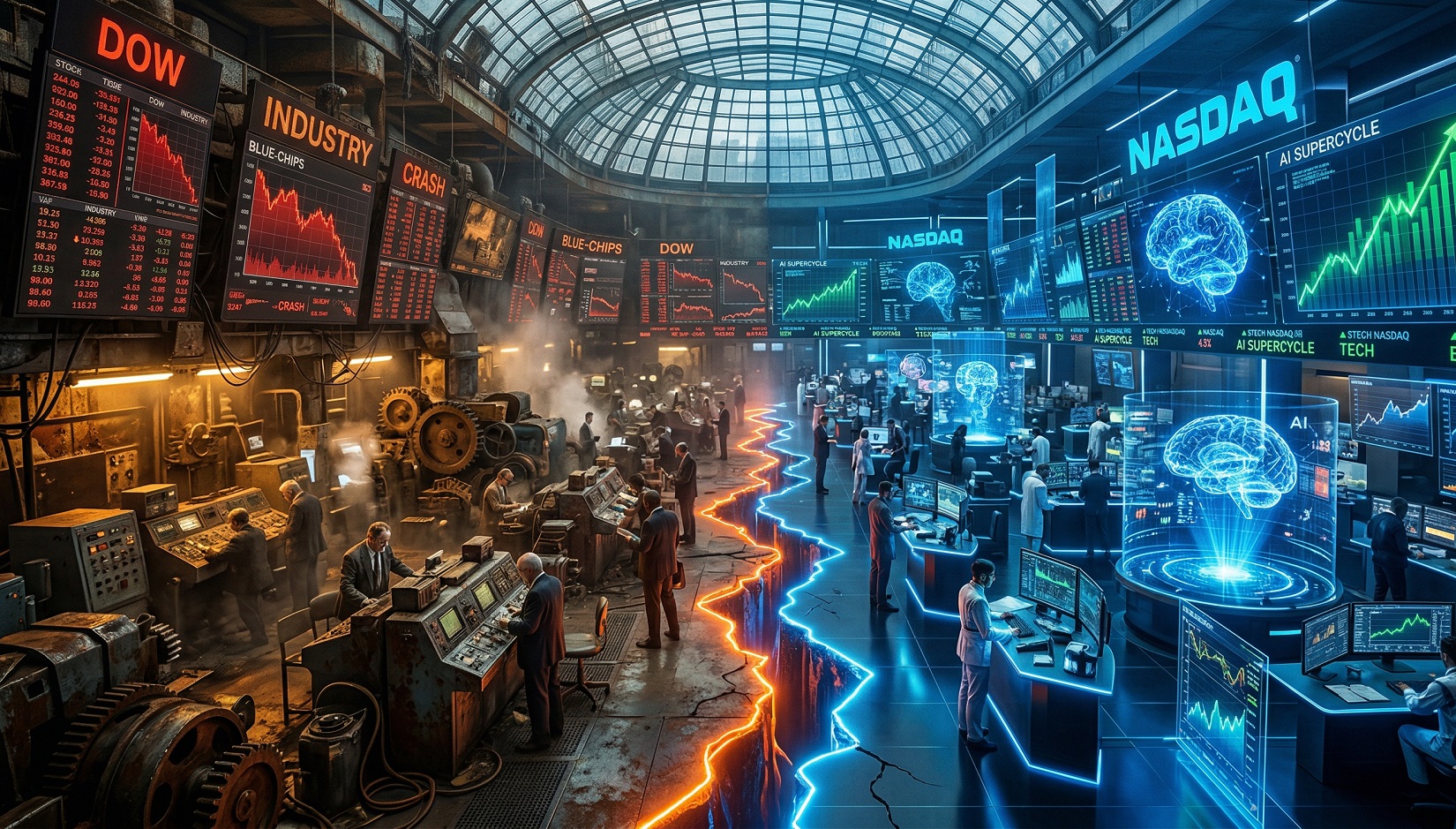
It signals a sector divergence — industrial and financial blue-chips are being punished while tech stocks find temporary shelter. This split usually reflects different tariff exposures, inflation sensitivities, or policy-specific exemptions hitting each index’s component stocks differently on the same trading day.
You checked your portfolio. The Dow Jones was crashing — down over 1,000 points on April 10, 2025. You expected chaos everywhere. Then you saw the Nasdaq. It had rallied.
That makes no sense. Or does it?
Here’s the problem: most financial media covers these moves like sports scores. “Dow down. Nasdaq up. Markets mixed.” They hand you the what without the why. And the why — the actual mechanism driving this divergence — is what determines whether you should be worried, repositioning, or doing nothing at all.
The US stock market is showing one of the sharpest index splits we’ve seen in years. And if you don’t understand what’s really driving it, you’ll make the wrong call.
Why Is the Dow Jones Crashing While the Nasdaq Rises?
The simplest answer is this: the two indexes are made of completely different companies, and those companies are being hit by completely different problems.
The Dow Jones Industrial Average tracks 30 large “blue-chip” companies. Think industrial manufacturers, healthcare giants, financial institutions, and consumer brands — the kind of companies that depend heavily on physical supply chains, global trade routes, and consumer spending. When tariffs rise, when import costs surge, when recession fear sets in, these companies bleed first.
The Nasdaq is a different animal. It’s weighted heavily toward technology — Apple, Nvidia, Microsoft, Meta, Alphabet. These companies earn most of their money from software, digital advertising, cloud services, and semiconductors. They are not immune to tariffs. But on April 10, 2025, something specific happened: the White House signaled that high-demand tech hardware — smartphones, computers, chips — would receive at least a temporary exemption from the highest reciprocal tariff rates.
That single policy signal sent money rushing toward tech. The Nasdaq caught a bid. The Dow did not.
What Actually Happened on April 10, 2025: A Timeline

The context matters enormously here. April 10 didn’t happen in a vacuum.
Just one day earlier, on April 9, the US stock market had surged dramatically after President Trump confirmed a 90-day decrease to 10% on most tariffs — excluding China. The S&P 500 posted its third-best single-day gain since World War II, rising 9.52%. The Dow jumped 7.87% and the Nasdaq leaped 12.16%.
Then April 10 arrived. The euphoria collapsed.
The S&P 500 fell 189 points, or 3.5%. The Dow Jones dropped 1,015 points, or 2.5%. The Nasdaq sank 4.31%. CBS News The catalyst? The White House confirmed that cumulative tariffs on Chinese imports had reached 145% — not the 125% initially reported. Investors had assumed a de-escalation. They got an escalation instead.
But here’s where the divergence gets interesting. By the end of that same volatile week, the two indexes told very different stories for April as a whole. The Nasdaq Composite ended April up 0.88%, while the Dow Jones Industrial Average posted a 3.08% decline. The S&P 500 slipped 0.68% in between.
That’s not a blip. That’s a structural split.
The Real Driver Nobody Is Talking About: It’s Not Tech Strength — It’s Tariff Shelter
I want to push back on the dominant narrative here, because I think most commentators are getting it wrong.
The framing you’ll hear everywhere is: tech is resilient, industrials are vulnerable. That’s partially true. But it misses the primary mechanism.
Late on April 10, the Trump administration announced it would at least temporarily exempt a variety of high-demand tech devices from the reciprocal tariff rates, including smartphones, computers, solar cells, and flat panel TV displays. That exemption — announced after hours — is the real story. It wasn’t that tech companies are fundamentally stronger. It’s that they received a policy-specific lifeline that industrial companies did not.
This matters for your investment thinking. A rally built on a tariff exemption is not the same as a rally built on earnings growth or improving fundamentals. Exemptions can be reversed. They can expire. They’re political instruments, not structural improvements.
Research published in ScienceDirect found that one standard deviation shocks to tariffs cause significant long-run reductions in stock prices ranging from 7.33% to 10.13% across indices after two years — and that trade policy uncertainty collectively explains up to 9.9% of forecast error variance in the Dow Jones.
Short-term, money chases safety. Long-term, tariff uncertainty extracts a real cost from all indexes.
What Does the Dow’s Composition Tell Us About Why It Falls Harder?
“The Dow is a price-weighted index of 30 ‘blue-chip’ names — and right now, those names are exactly the type of companies most exposed to tariff-driven cost increases, supply chain disruptions, and slowing consumer spending.” — Composite view from institutional analysis across April 2025
The Dow’s construction is unusual. It’s price-weighted, not market-cap weighted, meaning a $500 stock has more influence than a $100 stock regardless of company size. That quirk amplifies moves in certain sectors.
In April 2025, 21 of the 30 Dow constituents finished the month negative. The two worst performers — Chevron, which fell 18.67%, and UnitedHealth Group, which dropped 21.44% — together make up roughly 8% of the index.
These aren’t random declines. Chevron is an energy company battered by oil price drops and demand uncertainty. UnitedHealth is a healthcare insurer dealing with rising medical loss ratios and regulatory pressure. Neither company has much to gain from a tariff pause on tech hardware.
This is the Dow’s core vulnerability right now: its heaviest weights are in sectors facing their own independent headwinds, layered on top of the macro tariff chaos. When you see the Dow “crashing,” you’re often watching three or four specific stocks — not 30 — dragging the entire index down.
Why Industrial Stocks Are Especially Tariff-Sensitive
Manufacturing companies — the backbone of the Dow — depend on imported components, cross-border supply chains, and predictable trade relationships. When tariffs spike, their input costs rise immediately. They can’t pass all of it to consumers without risking demand collapse.
A software company, by contrast, ships nothing. Its “product” crosses borders as data. That fundamental difference in business model is why the Nasdaq holds up better in a tariff storm. Not because tech is invincible — but because tariffs hit physical goods, not code.
Should You Be Worried? What the Dow-Nasdaq Split Means for Your Portfolio
Let me be direct: a Dow-Nasdaq divergence on a single day is not a crisis signal. It’s a sector rotation signal. Money is moving, not disappearing.
The question is whether the rotation is sustainable.
Here’s what I watch in moments like this. If the Nasdaq rallies while the Dow falls, and the divergence is driven by a specific policy exemption (as it was in this case), I treat it as temporary. Exemptions have an end date. When that date arrives, or when the policy changes again, tech stocks lose their shelter.
If the divergence is driven by fundamental earnings strength — tech companies genuinely outperforming on revenue and profit while industrial companies report declining earnings — that’s a different story. That’s a real shift in economic leadership worth positioning around.
Right now, in April 2025, it’s the former. The tariff exemption window is the driver. Act accordingly.
Three scenarios to consider:
- You hold industrial/Dow-heavy ETFs: The near-term pressure is real. If tariff policy continues to escalate against China, sectors like manufacturing, energy, and healthcare (for unrelated reasons) face extended headwinds.
- You hold tech-heavy positions (Nasdaq, QQQ): You’re currently in the shelter zone. But the exemptions are temporary. Watch for any policy reversal on tech hardware tariffs closely — the Nasdaq rallied because of the exemption, and it will give back those gains if that exemption is removed.
- You’re sitting in cash: The volatility is likely not over. Analysts noted in April 2025 that the trade war with China remains escalating and that earnings season adds another layer of uncertainty to an already volatile landscape. Entering in pieces — dollar-cost averaging into both indexes — reduces timing risk substantially.
What Does a Split Market Mean for the S&P 500 and Broader Economic Health?
The S&P 500 sits between these two stories. It holds both industrial giants and tech mega-caps, so when the Dow falls hard and the Nasdaq rises modestly, the S&P 500 often lands somewhere in the middle — which is exactly what we saw.
Inflation data released on April 10 showed that CPI rose 2.4% on an annual basis in March, a signal that the Federal Reserve’s effort to bring inflation down was showing progress. Analysts noted this gave the Fed more breathing room to respond to economic damage if tariffs continued to bite.
That cooling inflation reading is actually the quiet positive in all this noise. Lower inflation pressure means the Fed retains the option to cut rates if the tariff damage to growth worsens. Rate cuts would benefit growth stocks (Nasdaq-heavy) and provide relief to interest-rate-sensitive Dow components like financials.
This is the underreported part of the April 10 story: the inflation data was constructive. The tariff data was destructive. Markets tried to price both simultaneously — and the result was the split you saw.
How to Read a Market Divergence Without Panicking: A 3-Step Framework
Step 1 — Identify the specific driver of the divergence. Was it a policy event (tariff, Fed statement, executive order)? A single earnings report pulling an index down? Or broad economic data? The driver tells you whether the move is likely temporary or structural.
Step 2 — Check the index composition. Look at which stocks are actually causing the move. On April 10, a handful of Dow components drove most of the damage. A 1,000-point Dow drop sounds catastrophic. But when three or four stocks explain 70% of the move, it’s a sector story, not a systemic one.
Step 3 — Ask whether the catalyst is reversible. Tariff exemptions are reversible. Earnings misses are reversible. Structural economic shifts (demographic changes, long-term productivity trends) are not. A reversible catalyst creates a temporary opportunity. An irreversible one requires a real portfolio rethink.
What Comes Next: The 90-Day Clock Is Ticking
The April 9 tariff pause — the one that triggered the historic rally — has a 90-day expiration window. That clock is running.
Despite the pause, analysts noted that the remaining tariffs still placed the United States’ average effective tariff rate at its highest in a century. The truce on most countries doesn’t touch China, where the situation has continued to escalate.
What this means practically: the next 60–90 days will be defined by two questions. First, does the US and China reach any meaningful trade de-escalation? Second, do the tech hardware exemptions hold — or does the administration extend them to broader product categories, or reverse them entirely?
The answer to both questions will determine whether the Nasdaq-Dow split we saw in April was a temporary anomaly or the opening chapter of a longer period of index divergence.
I’m watching semiconductor earnings, any White House statements on tariff scope expansion, and the 10-year Treasury yield as the three most important signals between now and July.
Why is the Dow Jones falling while the Nasdaq is rising?
The two indexes hold different types of companies. The Dow tracks industrial and financial blue-chips that are directly exposed to tariff cost increases and supply chain disruption. The Nasdaq is weighted toward tech companies that received a temporary tariff exemption on hardware products, making them relatively sheltered in the short term.
Is it bad if the Dow is crashing but the Nasdaq is up?
Not necessarily. It often signals sector rotation — money moving between parts of the market — rather than a systemic collapse. If the divergence is driven by a temporary policy event, it usually reverses. If it reflects a genuine shift in economic leadership, it can persist.
What should I do when the stock market shows a Dow-Nasdaq split?
First, identify whether the driver is temporary (a tariff exemption, a single earnings miss) or structural. Then check your index exposure and whether your holdings sit in the benefiting or the pressured sector. Avoid panic-selling based on Dow points alone — context matters more than the number.
ViralZip.blog is powered by a dedicated team of digital analysts and tech journalists committed to “zipping” through the noise of the information age. With a combined background in investigative research and financial data analysis, our contributors focus on the intersection of emerging AI technology, local economic shifts, and global news trends. We take pride in translating complex data into actionable insights for modern residents across the US and UK. Our mission is to provide high-velocity, reliable information that empowers our readers to navigate the rapidly evolving landscape of 2026.
Disclaimer: The content provided on ViralZip.blog is for informational and educational purposes only. While we strive for accuracy, the fields of artificial intelligence, financial rebates, and medical technology are subject to rapid changes; therefore, we do not guarantee the completeness or absolute reliability of the information provided. This content does not constitute professional financial, medical, or legal advice. Always consult with a licensed professional—such as a financial advisor, doctor, or attorney—before making significant decisions based on trending data. ViralZip.blog is not responsible for any actions taken or outcomes achieved based on the suggestions provided in our articles.