For decades, the term “Digital Twin” was something you’d only hear in high-end manufacturing plants or aerospace hangars. Engineers at Boeing or Tesla would create a perfect virtual replica of a jet engine or a car chassis to simulate wear and tear before it ever happened in the real world. But as we move through 2026, that same technology has officially moved from the factory floor to the doctor’s office—and it’s about to save your life.
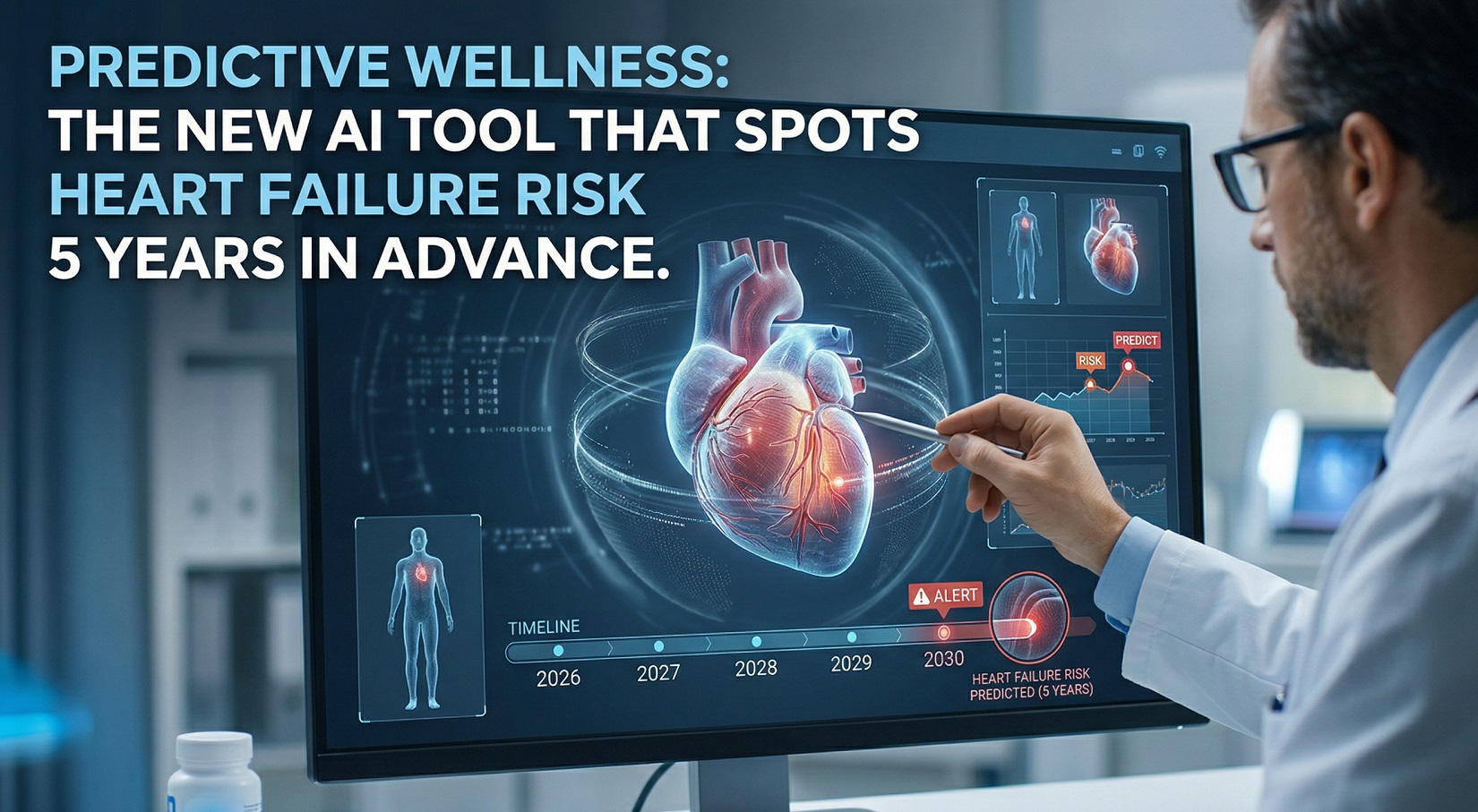
Imagine having a “Virtual You” living inside a computer. This digital double doesn’t just look like you; it breathes like you, pumps blood like you, and ages like you. By feeding this twin your real-time health data, doctors can now spot a heart failure risk up to five years before you ever feel a single chest pain or shortness of breath.
In this post, we’re diving into the world of Predictive Wellness, where AI isn’t just a chatbot—it’s a time machine for your heart. Whether you’re a tech enthusiast or just someone looking to live a longer, healthier life, here is how the “Digital Twin” revolution is changing everything.
1. From Factory to Pharmacy: The Rise of the Medical Digital Twin
The transition of Digital Twin technology into healthcare represents the most significant shift in medicine since the invention of the X-ray. In the past, doctors were “reactive”—they waited for you to get sick before they started treatment. In 2026, we are becoming “proactive.”
How a Digital Twin is Built
A medical digital twin isn’t just a 3D model; it’s a living data structure. It is built using three main “ingredients”:
- Electronic Health Records (EHR): Your entire medical history, including past surgeries, blood work, and family history.
- Real-Time Wearables: Continuous data from your smartwatch or Oura ring, tracking your heart rate variability (HRV), sleep patterns, and oxygen levels.
- High-Res Imaging: Advanced 3D MRIs and CT scans that map the unique geometry of your heart’s chambers and valves.
The “Five-Year Window”
The most staggering breakthrough this year comes from researchers at institutions like Johns Hopkins and MIT. Their AI models, such as the PULSE-HF and the TWIN-VT protocols, can analyze the “electrical wave” of your heart. They’ve found that subtle patterns in how your heart processes electricity can predict a future “hurricane” of arrhythmia or heart failure years in advance. By simulating different lifestyles on your digital twin, doctors can tell you exactly which habits will trigger a crisis and which will prevent it.
2. Why “Predictive” is the New “Preventative”
We’ve all heard the advice: “Eat well and exercise to prevent heart disease.” But generic advice often fails because every body is different. Predictive wellness takes the guesswork out of the equation.
Precision vs. Generalization
Traditional heart risk scores (like the Framingham score) rely on averages. They look at a thousand people like you and guess your risk. A Digital Twin looks only at you.
- Scenario A (Traditional): “You have a 10% risk of heart issues in the next decade based on your age and cholesterol.”
- Scenario B (Digital Twin): “Your specific left ventricle is showing signs of thinning. If you maintain your current stress levels, your risk of a failure event spikes in October 2029. However, switching to this specific medication today reduces that risk to near zero.”
Practical Tip: The “Health Snapshot”
If you want to prepare for this tech, start by centralizing your data. Use apps like Apple Health or Google Fit to sync your data. When these AI tools become standard in your local clinic later this year, having a clean “data trail” will allow the AI to build your digital twin much faster and with higher accuracy.
3. The Role of AI Transformers: Analyzing Your Medical “Story”
You’ve probably heard of “Transformers” in the context of ChatGPT (the ‘T’ stands for Transformer). In 2026, this same technology is being used to read your medical history like a book. Instead of looking at a single blood pressure reading in isolation, new models like TRisk (developed by Oxford researchers) analyze your entire life journey.
Why Transformers are Game-Changers
Traditional models are like a snapshot; they see you only at the moment you’re in the office. Transformers, however, are designed to recognize long-term patterns.
- Sequential Memory: They can link a minor flu you had three years ago with a slight change in your heart rhythm yesterday.
- Multimodal Data: They don’t just “read” numbers; they “watch” your ECG waves and “listen” to your heart sounds, combining all that info into one predictive score.
- AUROC Accuracy: In 2026, models like PULSE-HF are achieving accuracy scores (AUROC) of 0.91. To put that in simple terms: they are becoming nearly as accurate as a team of senior cardiologists working around the clock.
4. Common Mistakes to Avoid in the AI Wellness Era
As exciting as this tech is, “blind trust” can be dangerous. Here are the biggest blunders people make when navigating the new world of predictive health:
- Chasing “Ghost” Notifications: Some lower-end wearables produce “hallucinations” or false positives. Don’t panic over one bad heart rate reading on your watch. Predictive wellness relies on trends, not single data points.
- Ignoring Data Privacy: In 2026, your health data is more valuable than your credit card number. Mistake: Using free, unvetted health apps that sell your digital twin profile to insurance companies. Always check for HIPAA or GDPR-2026 compliance.
- The “Snapshot” Fallacy: Thinking that one AI scan means you’re “good for life.” A Digital Twin is a living model. If you change your diet or stop exercising, your virtual double needs to be updated to remain accurate.
- Skipping Human Oversight: AI is a tool, not a doctor. The biggest mistake is self-diagnosing or changing medication based on an app’s output without a professional’s sign-off.
5. The “Baseline” Rule for 2026
Pro Tip: Your AI is only as good as the data you give it. To get the most out of predictive wellness, establish a “Digital Baseline” today. Even if you feel perfectly healthy, record your resting heart rate, average sleep cycles, and basic blood markers now. When the AI analyzes your Digital Twin three years from now, having that “healthy baseline” from 2026 will make it 10x more accurate at spotting the tiny deviations that signal future trouble.
6. Frequently Asked Questions (FAQs)
Will insurance companies use my Digital Twin to raise my rates?
This is a major concern in 2026. While the Genetic and Digital Information Nondiscrimination Act (GDINA) protects users in many Tier 1 countries, you should always ensure your data is stored in “Zero-Knowledge” encrypted vaults where only you and your doctor hold the keys.
Can a Digital Twin predict things other than heart failure?
Yes. While heart health is the leading application due to the electrical nature of the organ, researchers are currently rolling out twins for early-stage Type 2 Diabetes and neurodegenerative patterns like early-onset Alzheimer’s.
Do I need expensive hospital equipment to start my Digital Twin?
Not anymore. While a clinical MRI helps, 2026-grade consumer wearables (like the latest Apple Watch or Samsung Ring) now provide 80% of the data needed for basic predictive modeling.
Taking Control of Your Heart’s Future
The shift from “factory floor to doctor’s office” isn’t just a cool tech story—it’s a fundamental change in how we perceive human mortality. For the first time in history, we have the tools to see a heart attack coming five years before it happens. By embracing Predictive Wellness and building your own Digital Twin, you aren’t just watching your health; you are actively engineering a longer life.
The future of medicine is already here, and it’s living inside your data. Don’t wait for a symptom to tell you something is wrong when your virtual self can tell you today.
ViralZip.blog is powered by a dedicated team of digital analysts and tech journalists committed to “zipping” through the noise of the information age. With a combined background in investigative research and financial data analysis, our contributors focus on the intersection of emerging AI technology, local economic shifts, and global news trends. We take pride in translating complex data into actionable insights for modern residents across the US and UK. Our mission is to provide high-velocity, reliable information that empowers our readers to navigate the rapidly evolving landscape of 2026.
Disclaimer: The content provided on ViralZip.blog is for informational and educational purposes only. While we strive for accuracy, the fields of artificial intelligence, financial rebates, and medical technology are subject to rapid changes; therefore, we do not guarantee the completeness or absolute reliability of the information provided. This content does not constitute professional financial, medical, or legal advice. Always consult with a licensed professional—such as a financial advisor, doctor, or attorney—before making significant decisions based on trending data. ViralZip.blog is not responsible for any actions taken or outcomes achieved based on the suggestions provided in our articles.