The “Digital Afterlife” Mystery: The Rise of the “Ghost in the Machine”
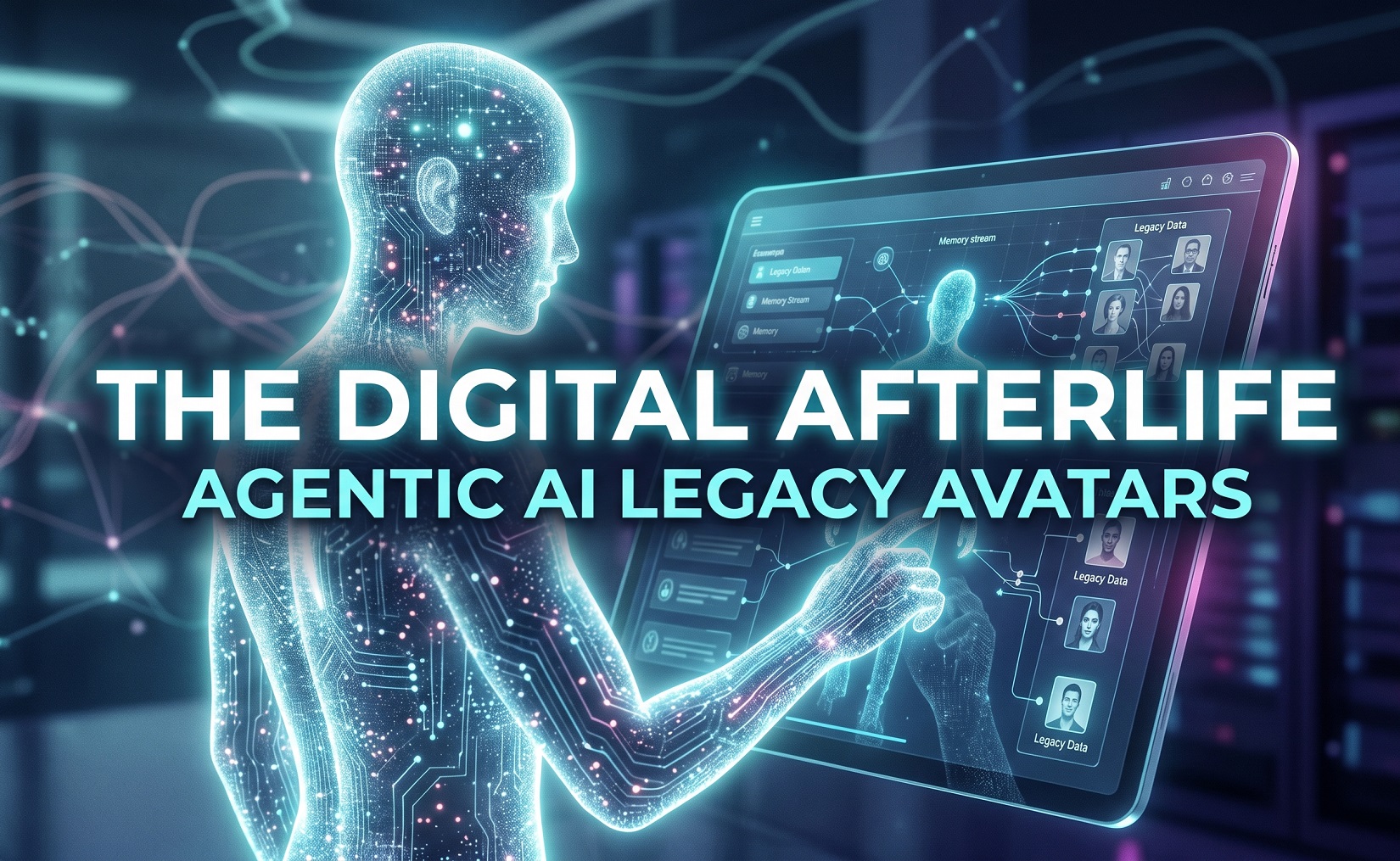
For decades, the boundary between life and death was an absolute silence, bridged only by fading photographs and static video recordings. But as we move through April 2026, that boundary has begun to blur into a digital hum. We have officially entered the era of the Legacy Avatar.
While “grief-tech” has been simmering in the background for years, 2026 marks a radical turning point. We’ve shifted from simple chatbots that “text back” to Agentic AI agents—autonomous digital entities that don’t just mimic a loved one’s words, but simulate their personality, logic, and even their proactive habits.
Across the US and Canada, startups like Eternalize and Meolea have seen a 40% surge in user adoption this quarter. This isn’t just about nostalgia; it’s about a society-wide experiment in “digital immortality” that is forcing us to redefine what it means to truly leave the world behind.
How It Works: Training Your “Digital Twin”
The magic—and the mystery—behind the 2026 digital afterlife lies in the transition from Generative AI to Agentic AI.
Unlike the early AI models of 2024, which simply predicted the next word in a sentence, today’s Legacy Avatars are built on three technical pillars:
- The Multi-Modal Harvest: Users are no longer just uploading text. The “Pre-Mortem” training process now involves “scraping” a lifetime of data: 15 years of WhatsApp archives, thousands of hours of voice notes, and even biometric stress patterns from smartwatches to understand what made the person laugh or lose their temper.
- Agentic Agency: These aren’t passive bots. An agentic avatar is programmed with “goals.” It might be instructed to check in on a grieving spouse every Tuesday morning—the day they used to get coffee—or to offer financial advice to a child when they turn 25, using the deceased’s specific risk-tolerance and logic.
- Voice & Visual Synthesis: Using as little as 30 seconds of high-fidelity audio, 2026 models can now create a permanent, interactive voice clone that is indistinguishable from the real person, even capturing unique regional accents from the Maritimes to the Deep South.
The Psychological Allure: Comfort vs. Closure
For those left behind, the draw of a Legacy Avatar is deeply rooted in the “Continuing Bonds” theory. Traditionally, psychologists encouraged “letting go,” but modern 2026 grief therapy often suggests that maintaining a symbolic connection can be healthy.
- Emotional Scaffolding: For a child in Vancouver who lost a parent suddenly, or a widow in Chicago, an AI avatar provides “emotional scaffolding.” It allows for the “one last conversation” that death often steals, providing a sense of closure that static photos cannot.
- The Risk of “Digital Stagnation”: However, there is a dark side to this digital tether. Ethicists at the University of Tübingen have warned of “liminal loops.” If a deceased loved one is always available via an app—proactively texting you “Good morning” or “I’m proud of you”—the brain’s neuroplasticity may struggle to integrate the reality of the loss.
- A 2026 Case Study: In early 2026, a viral story emerged from Toronto where a family used a hyper-realistic VR avatar of their late patriarch to “walk” his daughter down the aisle. While the family called it a miracle, social media was divided: was it a beautiful tribute or a “hollow” feedback loop that prevented the guests from truly mourning?
From a Vastu and environmental psychology perspective, a home is a living energy field. Traditionally, we suggest clearing the energy of the deceased to allow the living to thrive. But what happens when you introduce a ‘digital ghost’—a permanent electronic presence—into the Northeast (Ishanya) corner of your home? We aren’t just keeping a memory; we are keeping an active energy loop that might prevent the natural flow of ‘Prana’ and renewal in a household.
The Ethical Minefield: Who Owns a Ghost?
As the “Grief-Tech” market surpasses $35 billion in 2026, we are facing questions that our legal systems were never designed to answer.
- The Consent Gap: What happens if you create an avatar of your grandmother, but she never explicitly consented to being “reanimated”? In 2026, “Posthumous Autonomy” has become a major legal battleground.
- Interpretive Drift: AI agents learn and evolve. There is a documented risk of “interpretive drift,” where an avatar begins to express political views, religious shifts, or personality traits that the original person never held. Imagine a staunchly private grandfather’s avatar suddenly recommending a sponsored life insurance product mid-conversation—a phenomenon critics call the “Enshittification of the Afterlife.”
- Commercialization of Mourning: The most pressing ethical concern in 2026 is the subscription model. What happens to your “Digital Father” if the tech company goes bankrupt or if you can no longer afford the $29.99 monthly maintenance fee? The idea of a loved one “dying a second time” because of a credit card expiration is a haunting new reality for the digital age.
To wrap up this exploration of the digital afterlife, we look at how North American governments are scrambling to keep pace and what this means for our future “digital remains.”
Legal & Social Pulse (US & Canada)
As of April 2026, the legal landscape is finally shifting from “wait and see” to active regulation. The core question is no longer just about data privacy, but about “Spectral Labor”—the right to control your digital likeness after you’re gone.
- The US “SECURE Data Act”: Introduced in the House on April 22, 2026, this landmark bill aims to create a national privacy standard. Crucially, it explores treating your voice and likeness as an inheritable property right. This would allow heirs to sue companies for “unauthorized reanimation,” though a massive loophole remains for private, family-made recreations.
- Canada’s Privacy Act Modernization: In Ottawa, the Treasury Board recently launched a 2026 review to recognize privacy as a “fundamental right.” The goal is to harmonize federal laws with the digital age, specifically addressing how AI models store and “reuse” the personal data of deceased Canadians.
- The “Subscription Grave” Trap: A new social phenomenon has emerged in 2026 where “Digital Executors” are now a standard part of estate planning in cities like Toronto and New York. Their job? To decide when it’s time to “pull the plug” on a legacy avatar—avoiding the heartbreak of a loved one being deleted due to a failed credit card payment.
The Banking Perspective: The “Financial Ghost”
As someone who has managed bank branches for over a decade, I see a massive regulatory nightmare here. If an ‘Agentic AI’ has your risk tolerance and logic, could it technically apply for a digital loan? If a ‘Digital Twin’ manages your crypto portfolio on Binance after you’re gone, who is liable for the taxes? We are entering an era where your ‘spectral’ credit score might matter as much as your living one.
Can I actually “talk” to a deceased relative in 2026?
Yes, through “Grief-tech” platforms. In 2026, these services use Agentic AI—trained on a person’s emails, voice notes, and social media—to simulate high-fidelity conversations that mimic the deceased’s unique logic and tone.
How much data is needed to create a “Legacy Avatar”?
Most platforms require a “Data Harvest” of roughly 15 years of digital traces (texts, emails) and at least 30 seconds of high-quality audio to synthesize a believable voice clone.
What is a “Digital Twin” vs. a “Deathbot”?
A Digital Twin is typically created while you are alive (pre-mortem) to act as a legacy, whereas a Deathbot (or Ghost-bot) is often reconstructed posthumously by survivors using whatever data is left behind.
Who owns my digital ghost after I die?
This is the biggest legal battle of 2026. In the US, the SECURE Data Act explores treating your likeness as inheritable property. However, unless specified in a will, your digital remains are currently governed by the Terms of Service of the AI company you used.
Is it ethical to reanimate someone without their consent?
Search interest in “Spectral Labor” has spiked. Ethicists argue that using a deceased person’s likeness for commercial gain or to “speak” for them politically is a violation of human dignity, even if the technology makes it possible.
What happens to the avatar if the AI company goes bankrupt?
Known as the “Subscription Grave” trap, many fear that a loved one could “die twice” if a company folds or if family members stop paying the monthly maintenance fees for the server hosting the avatar.
Does talking to an AI ghost hinder the grieving process?
Psychologists are divided. While it offers “emotional scaffolding” for closure, many warn that daily interaction with a bot can lead to “Digital Stagnation,” where the brain fails to accept the physical finality of death.
Can AI avatars “hallucinate” or drift from the real person’s values?
Yes. A major concern in 2026 is “Interpretive Drift,” where the AI starts saying things the original person never would have said, potentially causing distress to the bereaved.
Preparing for the New Normal
In the markets, we talk about ‘Hero or Zero’ trades—high-risk moves that either make you or break you. Digital immortality is the ultimate ‘Hero or Zero’ trade for humanity. We might gain eternal wisdom, or we might lose the very thing that makes life sweet: its finallity. Before you sign up for a ‘Legacy Avatar,’ ask yourself: Are you building a bridge to the future, or just refusing to exit a trade that has already closed?
The “Digital Afterlife” is no longer science fiction or a niche curiosity. It is a multibillion-dollar reality that is fundamentally altering the human experience of loss. In 2026, we have the technology to make the dead speak, but we are still learning if we should.
As we move forward, the challenge won’t be technical—it will be deeply human. We must decide if we want our legacy to be a curated, autonomous agent that never ages and never leaves, or if there is a sacred value in the silence that follows a life well-lived
Try It Yourself: The Legacy Experiment
The transition to a digital afterlife doesn’t happen overnight—it starts with the data we create today. Whether you are curious about your own digital footprint or looking to preserve the wisdom of a loved one, the way you “prompt” the machine determines the soul of the output. We’ve curated three specific prompts you can use with current Agentic AI models (like Gemini 3 Flash or specialized Grief-Tech interfaces) to explore the boundaries of digital immortality.
1. The “Wisdom Archive” Prompt
Use this to help an AI understand the underlying philosophy and “voice” of a person rather than just their biographical facts.
2. The “Future Check-In” Agentic Prompt
Use this to set a goal for an AI agent to act as a proactive legacy supporter for a future date.
3. The “Ethical Boundary” Audit
Use this to define the “off-limits” zones for your own digital twin to prevent “Interpretive Drift.”
The Final Word: Technology can bridge the gap of absence, but it cannot replace the soul. As we navigate this mystery, perhaps the best way to honor the dead is not to keep them tethered to a server, but to carry their lessons in our own living hearts.
ViralZip (viralzip.blog) is an independent content publication covering the stories, trends, and shifts that matter to curious, ambitious readers across the US and UK. We write about Life & Mysteries, Finance & Rebates, Tech & AI Trends, and Local Pulse — topics that cut through the noise and speak to real people navigating real decisions. Our editorial focus is on accuracy, depth, and relevance. We don’t chase clicks for their own sake. We chase stories worth your time.
Disclaimer: The content published on ViralZip (viralzip.blog) is intended for informational and educational purposes only. While we make every effort to ensure accuracy at the time of publication, we do not guarantee that all information is complete, current, or free from error. Nothing on this site constitutes professional financial, legal, medical, or career advice. The case studies and examples featured in our articles are illustrative in nature — names and identifying details may be composite or anonymised to protect individual privacy. Readers are encouraged to conduct their own research and consult qualified professionals before making any financial, legal, or career decisions. ViralZip is not responsible for any actions taken based on the content of this site. External links, where included, are provided for convenience and do not constitute endorsement of third-party websites or services.